U.S. flag

An official website of the United States government

Images

Click through our gallery of photographs showcasing New England Water Science Center research projects and monitoring work throughout the region.

Filter Total Items: 627
A woman in snowshoes weighing a long yellow pole in a snowy field.
Measuring Snowpack in Sleepers River Research Watershed

A USGS physical scientist weighs a fiberglass tube containing a snow core on a hanging spring scale. Snow water equivalent (SWE) is calculated from the weight and volume of the snow in the tube. This measurement is being taken in Sleepers River Research Watershed in Danville, Vermont.
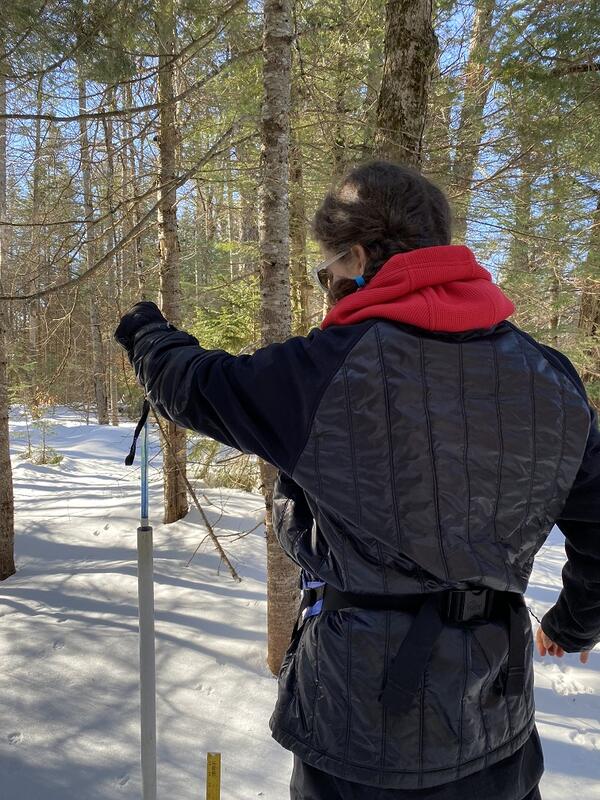
A USGS physical scientist weighs a fiberglass tube containing a snow core on a hanging spring scale. Snow water equivalent (SWE) is calculated from the weight and volume of the snow in the tube. This measurement is being taken in Sleepers River Research Watershed in Danville, Vermont.
Pulling up a blue tube out of a white PVC pipe in the ground in the winter.
Measuring Soil Frost at Sleepers River Research Watershed

USGS hydrologist Serena Matt measures soil frost at Sleepers River Research Watershed in Danville, Vermont. Soil frost measurements are made with tubes filled with methylene blue solution. Upon freezing, the methylene blue remains in the liquid phase, yielding clear ice that marks the depth of soil frost.

USGS hydrologist Serena Matt measures soil frost at Sleepers River Research Watershed in Danville, Vermont. Soil frost measurements are made with tubes filled with methylene blue solution. Upon freezing, the methylene blue remains in the liquid phase, yielding clear ice that marks the depth of soil frost.
The sign of Sleepers River Research Watershed in the snow.
Sleepers River Research Watershed Sign

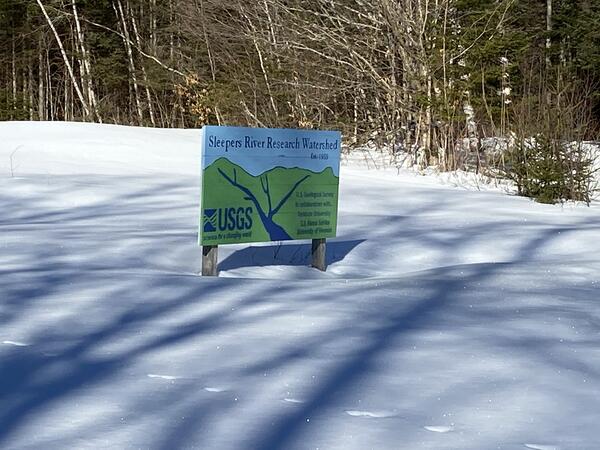
A sign welcomes visitors into the Sleepers River Research Watershed in Danville, Vermont. 
A streamgage house in a snowy, forested landscape.
Streamgage on Pope Brook Tributary in Sleepers River Watershed

This streamgage is located in North Danville, Vermont, a part of the Sleepers River watershed. It is located on Pope Brook, a tributary of Sleepers River. Check out the water data for this streamgage station here.


A man in the woods in the snow looks at a data logger.
Collecting Soil Data at Sleepers River Research Watershed

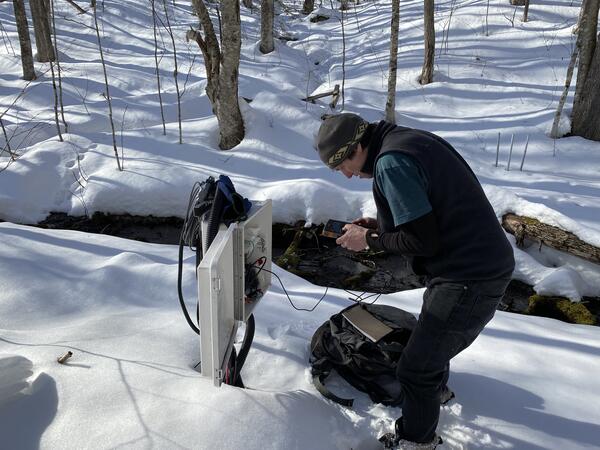
USGS Hydrologist Jamie Shanley collecting data from soil sensors in the woods of the Sleepers River Research Watershed. These data loggers collect water content and concentrations of oxygen and carbon dioxide. 

USGS Hydrologist Jamie Shanley collecting data from soil sensors in the woods of the Sleepers River Research Watershed. These data loggers collect water content and concentrations of oxygen and carbon dioxide. 

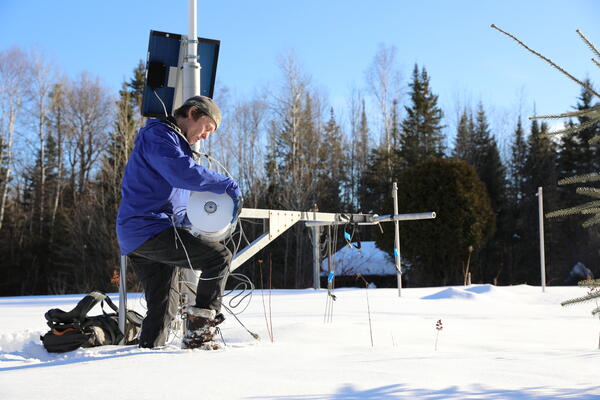
A man kneels down in the snow fixing metal equipment.
Snow Monitoring Station at Sleepers River Research Watershed

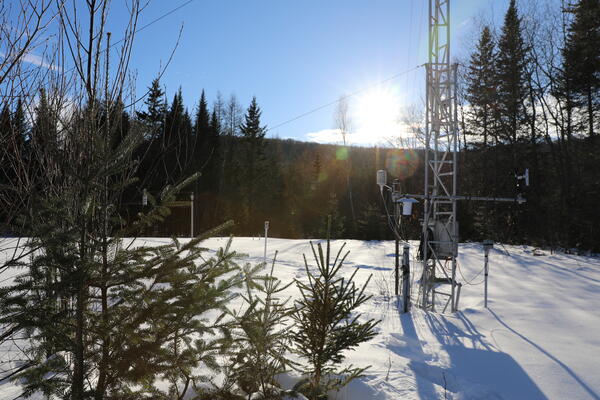
A snow monitoring station at Sleepers River Research Watershed measures snow depth and total water content of the snowpack.

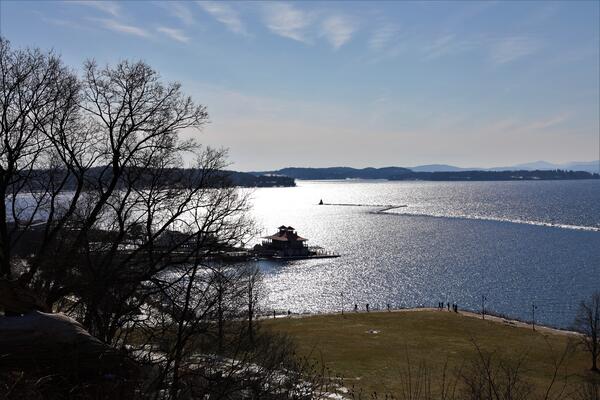
An overhead wide view of a lake with sun reflection.
Lake Champlain from Burlington, Vermont

A view of Lake Champlain from Battery Park in Burlington, Vermont. The Burlington Community Boathouse can be seen in the distance. 

A view of Lake Champlain from Battery Park in Burlington, Vermont. The Burlington Community Boathouse can be seen in the distance. 

Hydrologic Technicians recover a continuous monitor buoy in the Southport, CT estuary near the Long Island Sound

Physical scientists and hydrologic technicians from New England Water Science Center and Woods Hole Dive Team recover and repair a continuous monitor buoy in the Southport, Connecticut estuary near the Long Island Sound. The buoy had been damaged in a recent storm.

Winter 2023 Photo Contest Winner: Donald Jeandervin, USGS at Work category

Hydrologic Technicians point to where they have moored an acoustic doppler velocity meter (ADVM)
Hydrologic Technicians moored an acoustic doppler velocity meter (ADVM) in the channel of the Southport, CT river estuary

Hydrologic Technicians Paul Solis, Brittney Izbicki and Nigel Pepin of the New England WSC CT office point to where they have just moored an acoustic doppler velocity meter (ADVM) in the channel of the Southport, CT river estuary.

Winter 2023 Photo Contest: Donald Jeandervin, Honorable Mention category

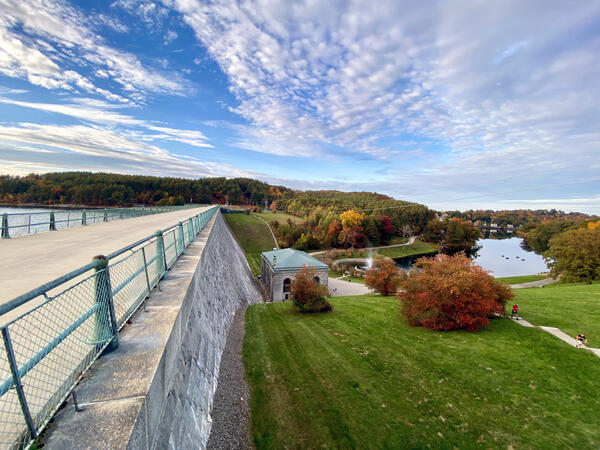
Wachusett Dam, Clinton, Massachusetts — Hydrologic Infrastructure of the Nashua River System
Wachusett Dam, Clinton, Massachusetts

The Wachusett Dam in Clinton, Massachusetts, completed in 1905, impounds the Nashua River to form the 65‑billion‑gallon Wachusett Reservoir, a major water‑supply source for metropolitan Boston. This granite gravity dam regulates downstream flow and maintains stable reservoir levels that support long‑term regional water‑resource management.

The Wachusett Dam in Clinton, Massachusetts, completed in 1905, impounds the Nashua River to form the 65‑billion‑gallon Wachusett Reservoir, a major water‑supply source for metropolitan Boston. This granite gravity dam regulates downstream flow and maintains stable reservoir levels that support long‑term regional water‑resource management.

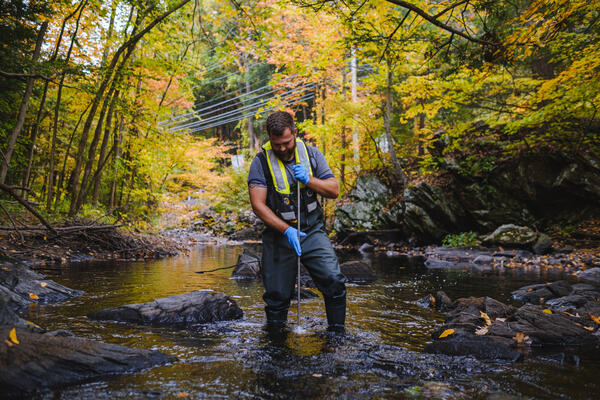
A man taking a water sample in a small river in the fall.
Water Sample taken from the Saugatuck River near Redding, Connecticut
Mill River at Northampton, Massachusetts

U.S. Geological Survey Mill River at Northampton, Massachusetts streamgage (01171500) on October 11, 2022 looking downstream. The low-flow was about 12 cubic feet per second (cfs) for a 56.2-square-mile drainage area.

U.S. Geological Survey Mill River at Northampton, Massachusetts streamgage (01171500) on October 11, 2022 looking downstream. The low-flow was about 12 cubic feet per second (cfs) for a 56.2-square-mile drainage area.

Green River near Colrain, Massachusetts

A downstream view of the Green River near Colrain, Massachusetts close to the USGS streamgage (01170100). The low-flow was about 7.7 cubic feet per second (cfs) for a 41.4-square-mile drainage area.

A downstream view of the Green River near Colrain, Massachusetts close to the USGS streamgage (01170100). The low-flow was about 7.7 cubic feet per second (cfs) for a 41.4-square-mile drainage area.

Pearl Hill Brook at Mill Creek Drive in Ashby, Massachusetts
Pearl Hill Brook in Ashby, Massachusetts

Pearl Hill Brook at Mill Creek Drive in Ashby, Massachusetts on October 1, 2021. The drop at the outflow of the culvert would impede aquatic organism passage.

Pearl Hill Brook at Mill Creek Drive in Ashby, Massachusetts on October 1, 2021. The drop at the outflow of the culvert would impede aquatic organism passage.

Unnamed tributary to Trapfall Brook at Harris Road in Ashby, Massachusetts
Unnamed tributary to Trapfall Brook in Ashby, Massachusetts

Unnamed tributary to Trapfall Brook at Harris Road in Ashby, Massachusetts, on October 1, 2021. The shallowness of water in the culvert could impede aquatic organism passage.

Unnamed tributary to Trapfall Brook at Harris Road in Ashby, Massachusetts, on October 1, 2021. The shallowness of water in the culvert could impede aquatic organism passage.

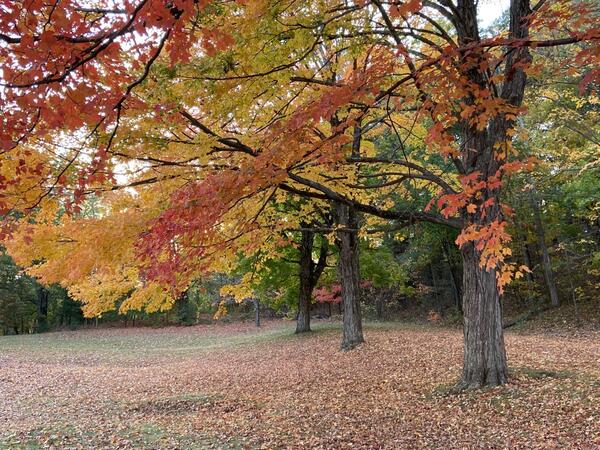
Vibrant autumn foliage of maple trees
Autumn splendor at Wachusett Reservoir confluence

Vibrant autumn foliage of maple trees near the confluence of the Stillwater and Quinapoxet Rivers at the Wachusett Reservoir in West Boylston, Massachusetts.

Vibrant autumn foliage of maple trees near the confluence of the Stillwater and Quinapoxet Rivers at the Wachusett Reservoir in West Boylston, Massachusetts.

Was this page helpful?