U.S. flag

An official website of the United States government

Images

Pacific Coastal and Marine Science Center images.

Filter Total Items: 1334
A collection of equipment is mounted on  yellow catamaran in the bay. In the background: a pier & skyline with tall buildings
SQUID-5 test near the St. Pete Pier
Graphic showing structure of the ocean floor from beach to deep sea
USGS Ocean Research
USGS Ocean Research
USGS Ocean Research

Our coasts, the most familiar part of the ocean are the gateway to the larger deeper ocean world. USGS studies processes and hazards in the coastal zone and how they affect people, wildlife, and ecosystems.

Our coasts, the most familiar part of the ocean are the gateway to the larger deeper ocean world. USGS studies processes and hazards in the coastal zone and how they affect people, wildlife, and ecosystems.

Two men deploy scientific equipment mounted on yellow tanks into the bay
SQUID-5 deployment in Tampa Bay

The SQUID-5, or Structure-from-motion (SfM) Quantitative Underwater Imaging Device with 5 cameras, being deployed by Mitch Lemon (SPCMSC, on the left) and Gerry Hatcher (PCMSC, on the right)  in Tampa Bay for testing.

The SQUID-5, or Structure-from-motion (SfM) Quantitative Underwater Imaging Device with 5 cameras, being deployed by Mitch Lemon (SPCMSC, on the left) and Gerry Hatcher (PCMSC, on the right)  in Tampa Bay for testing.

Scientific equipment mounted on two yellow tanks is sitting on a grassy lawn waiting for deployment in the bay
SQUID-5 being prepped for a test run

The SQUID-5, or Structure-from-motion (SfM) Quantitative Underwater Imaging Device with 5 cameras, shown being staged for a test run at the St. Petersburg Coastal and Marine Science Center. In the background, Andy Farmer (SPCMSC) and Gerry Hatcher (PCMSC) prep the R/V Sallenger, the vessel being used to tow the device. 

The SQUID-5, or Structure-from-motion (SfM) Quantitative Underwater Imaging Device with 5 cameras, shown being staged for a test run at the St. Petersburg Coastal and Marine Science Center. In the background, Andy Farmer (SPCMSC) and Gerry Hatcher (PCMSC) prep the R/V Sallenger, the vessel being used to tow the device. 

An aerial view of ocean waves
Animated gif of ocean waves

Gif of ocean waves. The ocean holds great cultural and economic value and hosts numerous ecosystems that support life on Earth and produce valuable resources. USGS science focuses on improved understanding of many aspects of our world’s interconnected oceanic system, from the continental shelf to the deep sea. 

Gif of ocean waves. The ocean holds great cultural and economic value and hosts numerous ecosystems that support life on Earth and produce valuable resources. USGS science focuses on improved understanding of many aspects of our world’s interconnected oceanic system, from the continental shelf to the deep sea. 

Animated illustration shows the propagation of a tsunami wave around and near islands in the ocean.
Idealized animation of tsunamis in the Kingdom of Tonga

Idealized animation of tsunamis produced by the 15 January 2022 eruption of Hunga Tonga-Hunga Ha‛apai volcano in the Kingdom of Tonga. View to the southeast. 

Screenshot of an animation that shows how tsunami waves propagate in the ocean.
Screenshot of a simulated tsunami animation

Screenshot of an idealized animation of tsunamis produced by the 15 January 2022 eruption of Hunga Tonga-Hunga Haʻapai volcano in the Kingdom of Tonga. View to the north-northeast. The fastest water wave to radiate away from the eruption is being pushed by an atmospheric wave triggered by the explosion.

Screenshot of an idealized animation of tsunamis produced by the 15 January 2022 eruption of Hunga Tonga-Hunga Haʻapai volcano in the Kingdom of Tonga. View to the north-northeast. The fastest water wave to radiate away from the eruption is being pushed by an atmospheric wave triggered by the explosion.

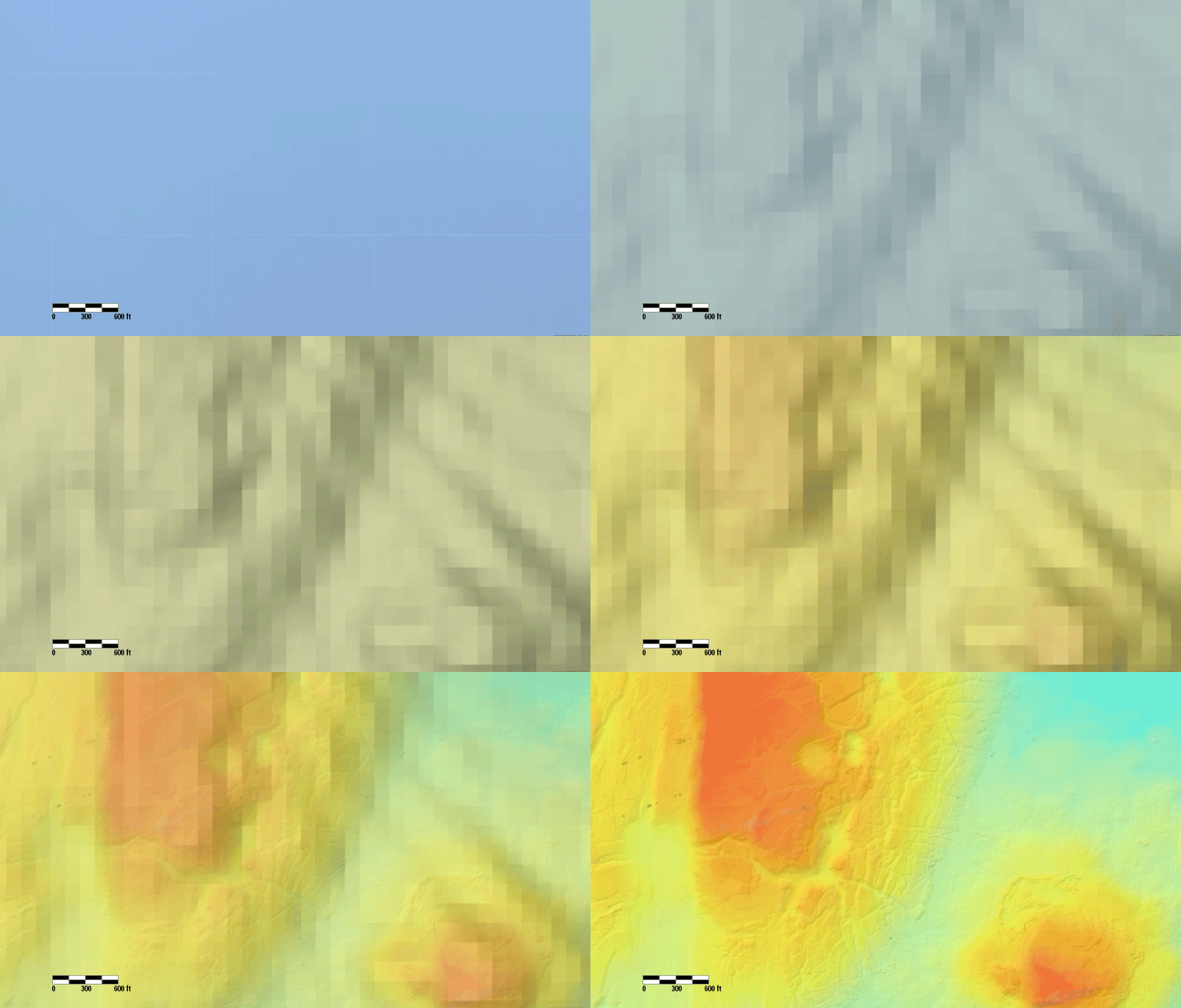
Abstract looking shapes show the water depth near a coral reef: shallower shapes at top and deeper shapes at bottom
Bathymetric digital elevation model (DEM) of Eastern Dry Rocks coral reef, Florida, 2021

A digital elevation model (DEM) was created from underwater images collected at Eastern Dry Rocks coral reef near Key West, Florida, in May 2021 using the SQUID-5 camera system. The underwater images were processed using Structure-from-Motion (SfM) photogrammetry techniques into a classified two-class ('unclassified' and 'low noise') 3D point cloud.

A digital elevation model (DEM) was created from underwater images collected at Eastern Dry Rocks coral reef near Key West, Florida, in May 2021 using the SQUID-5 camera system. The underwater images were processed using Structure-from-Motion (SfM) photogrammetry techniques into a classified two-class ('unclassified' and 'low noise') 3D point cloud.

Cover image for Climate Science Champions series

Screenshot of introduction episode of the Climate Science Champions video series.

Large metal sediment coring device on the deck of a ship with a man sitting nearby, preparing a long plastic tube.
Jumbo Piston Corer
Jumbo Piston Corer
Jumbo Piston Corer

Deep water camera and light installed in the head weight of the upgraded USGS jumbo piston corer. In the background, USGS Marine Engineering Technician Daniel Powers is preparing the core liner for sediment collection. 

man in hard hat standing behind a blue jumbo piston corer
Jumbo Piston Corer
Jumbo Piston Corer
Jumbo Piston Corer

Pete Dal Ferro, USGS Marine Engineering Technician and lead fabricator on the JPC upgrade, monitors the testing of the coring system on R/V Hugh R. Sharp in March 2022.

Pete Dal Ferro, USGS Marine Engineering Technician and lead fabricator on the JPC upgrade, monitors the testing of the coring system on R/V Hugh R. Sharp in March 2022.

The Global Marine Mineral Resources Group poses for a photo
Global Marine Mineral Resources Group

Global Marine Mineral Resources Group. From left to right, USGS Research Oceanographer Amy Gartman, visiting scientist Mariana Benites from University São Paolo, USGS Physical Scientist Denise Payan, graduate student Noemi Ortega Dominguez, student contractor Manda Au, and USGS Research Oceanographer Kira Mizell.

Global Marine Mineral Resources Group. From left to right, USGS Research Oceanographer Amy Gartman, visiting scientist Mariana Benites from University São Paolo, USGS Physical Scientist Denise Payan, graduate student Noemi Ortega Dominguez, student contractor Manda Au, and USGS Research Oceanographer Kira Mizell.

Triptych showing wildfire, roadside flooding and Big Sur coastline
Fire plus Flood equals Beach

Triptych of images showing wildfire, roadside flooding, and the Big Sur coastline in California.

Photo looks out at an ocean bay from a stony beach with grasses growing.
The wee strand, Loch Indaal, Scotland

The wee strand is a beach along the head of of Loch Indaal, Scotland. Loch Indaal is an ocean bay on Islay, the southernmost island of the Hebrides, off the west coast of Scotland.

The wee strand is a beach along the head of of Loch Indaal, Scotland. Loch Indaal is an ocean bay on Islay, the southernmost island of the Hebrides, off the west coast of Scotland.

Close-up of the printing on a plastic yellow disk that survived over 30 years in the ocean and surrounding environment.
USGS ocean current drifter disk

None the worse for wear, a plastic, ocean current drifter disk, originally released off Barter Island in Alaska, was discovered on the coast of Scotland 37 years after its initial release into the ocean.

None the worse for wear, a plastic, ocean current drifter disk, originally released off Barter Island in Alaska, was discovered on the coast of Scotland 37 years after its initial release into the ocean.

Photo of a yellow plastic disk sitting on a counter.
USGS ocean drifter
USGS ocean drifter
USGS ocean drifter

A 37-year-old plastic ocean drifter, originally released off Barter Island in Alaska, was discovered on the coast of Scotland.

A 37-year-old plastic ocean drifter, originally released off Barter Island in Alaska, was discovered on the coast of Scotland.

PCMSC scientist measuring land-surface elevation near the bay-marsh edge of Whale's Tail South marsh

PCMSC scientist measuring land-surface elevation near the bay-marsh edge of Whale's Tail South marsh in Eden Landing Ecological Reserve, Hayward, CA, with birds foraging on the South San Francisco Bay mudflats at low tide in the background.

Scientists from PCMSC deploying instruments to measure water level and suspended-sediment concentration in Whale's Tail South
Scientists from PCMSC deploying instruments to measure water level and suspended-sediment concentration in Whale's Tail South marsh

Scientists from PCMSC deploying instruments to measure water level and suspended-sediment concentration in Whale's Tail South marsh in Eden Landing Ecological Reserve, Hayward, CA.

Photo looks down to a coastal area with ice and snow and the open ocean in the background.
Video monitoring at Nuvuk

This image from a video camera pointed at the coast tracks the brightest pixels in the camera view over 10 minutes of video. The resulting image is useful for identifying features such as the position of maximum wave run-up on the beach, the position of all breaking waves, and sea-state.

This image from a video camera pointed at the coast tracks the brightest pixels in the camera view over 10 minutes of video. The resulting image is useful for identifying features such as the position of maximum wave run-up on the beach, the position of all breaking waves, and sea-state.

Was this page helpful?