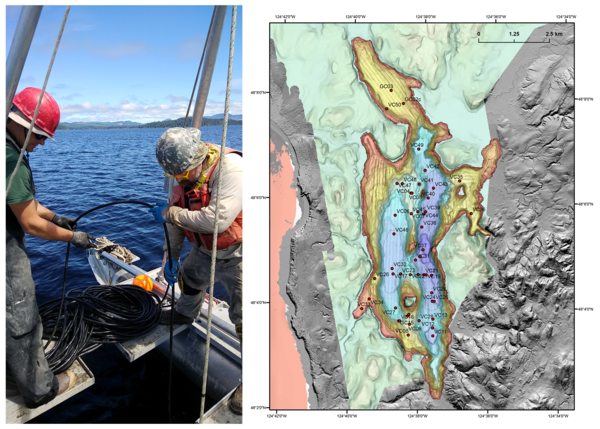
UCSC student Travis Alonghi and USGS scientist Danny Brothers deploying the Chirp sub-bottom profiler at sunset from M/V Bold Horizon.
Images
Pacific Coastal and Marine Science Center images.
UCSC student Travis Alonghi and USGS scientist Danny Brothers deploying the Chirp sub-bottom profiler at sunset from M/V Bold Horizon.
The USGS Coastal and Estuarine Dynamics Group will be deploying a cross shore array at Pea Island, various intruments will be connected to the poles to measure oceanographic conditions
USGS scientists Nora Nieminski, Jenna Hill, and Brandon Nasr working to cap and secure a trigger core on deck. Trigger cores can provide important information about seafloor sediments just below the seafloor
The crew of research vessel Bold Horizon with USGS science crew prepare to launch the Chirp sub-bottom profiler off the west coast near northern California and southern Oregon.
After recovery, the jumbo piston corer sits on the deck of research vessel Bold Horizon in its launch and recovery system. This muddy collar is removed to reveal the removable length of the core, which sits within a stiff plastic tube inside the metal tube.
USGS marine technician Jenny McKee prepares the jumbo piston corer for launching off research vessel Bold Horizon off the coast of California and Oregon. The corer will collect sediment samples from the seafloor. Scientists will examine the sediment to determine its age, character, and distribution. This area off the west coast of the U.S.
USGS scientist Janet Watt making a shear vane measurement on a gravity core to understand how the seafloor responds to earthquake shaking.
Dr. Nora Nieminski is a research geologist and Mendenhall Fellow at the USGS Pacific Coastal and Marine Science Center in Santa Cruz, California. She is pictured here, on board Marine Vessel Bold Horizon, with a piston core sample collected from the southern Cascadia subduction zone offshore of northern California/southern Oregon.
USGS scientists Pete Dal Ferro and Jenny McKee securing a recently collected jumbo piston core (JPC) on the back deck of M/V Bold Horizon for preliminary core processing.
Goleta Beach in Santa Barbara experienced an unusual storm and large wave event in the Spring of 2014. Gaviota Pier, seen far off in the background, sustained heavy damage as did the restaurants on the pier and nearby. The USGS conducts seasonal surveys throught the year to see how the beaches are changing through time.
The USGS California Deepwater Investigations and Groundtruthing, or Cal DIG, science crew aboard research vessel Bold Horizon on San Francisco Bay.
Pom-pom anemone on the Pacific Ocean floor off California
Pom-pom anemone on the Pacific Ocean floor off CaliforniaThese “pom-pom” anemones (Liponema sp.) have attached to the rock in a place where there are probably very good currents, which bring small floating particles of food to them. Water depth is 1041 m (3415 ft).
Pom-pom anemone on the Pacific Ocean floor off California
Pom-pom anemone on the Pacific Ocean floor off CaliforniaThese “pom-pom” anemones (Liponema sp.) have attached to the rock in a place where there are probably very good currents, which bring small floating particles of food to them. Water depth is 1041 m (3415 ft).
A small juvenile skate (left) and a large rockfish (right) hang out on the murky, silty seafloor with sea stars. Water depth: 856 m (2808 ft).
Jumbo piston corer
Retrieving the MBARI (Monterey Bay Aquarium Research Institute) MiniROV from the Pacific Ocean offshore of California, on research vessel (R/V) Bold Horizon.
Overview of Hawaii high-resolution SWAN model grids
Overview of Hawaii high-resolution SWAN model gridsOverview of the high-resolution model grids from: “Dynamically downscaled future wave projections from SWAN model results for the main Hawaiian Islands”
Overview of Hawaii high-resolution SWAN model grids
Overview of Hawaii high-resolution SWAN model gridsOverview of the high-resolution model grids from: “Dynamically downscaled future wave projections from SWAN model results for the main Hawaiian Islands”
Example of a high-oblique photograph taken with an unmanned aerial system (UAS), or drone, of the coastal bluffs of Barter Island on North Slope of Alaska. The photographs from different time periods can be compared, using a technique called structure-from-motion photogrammetry, to measure changes in the coastal bluffs.
Large blocks of failed coastal bluff on Barter Island
Large blocks of failed coastal bluff on Barter IslandLarge blocks of coastal bluff tumble down onto the beach of Barter Island, on the North Slope of Alaska.
Large blocks of failed coastal bluff on Barter Island
Large blocks of failed coastal bluff on Barter IslandLarge blocks of coastal bluff tumble down onto the beach of Barter Island, on the North Slope of Alaska.
Along the stretch of coastal bluffs of Barter Island, North Slope of Alaska, a new drainage gully developed between September 2018 and September 2019. USGS scientists have been measuring permafrost degradation, coastal erosion, and flooding hazards on and around Barter Island for the last decade.
An remotely piloted aircraft (RPA) or drone, equipped with a camera, sits on the Arctic tundra awaiting a radio signal that tells it to fly.
Example of a low-oblique photograph taken with an unmanned aerial system (UAS), or drone, of the coastal bluffs of Barter Island on North Slope of Alaska. The photographs from different time periods can be compared, using a technique called structure-from-motion photogrammetry, to measure changes in the coastal bluffs.