



This is our office.
These are our co-workers.
This is our rush hour.
Pacific Island Ecosystems Research Center
Research at the Pacific Island Ecosystems Research Center focuses on providing the scientific understanding and technologies needed to support and implement sound management and conservation of our Nation's biological resources occurring in Hawai'i and other Pacific island locations.
Featured Research
Featured Research

Learn about research to understand power outages caused by brown treensnakes and explore approaches to protect sensitive infrastructure.
News
WEBINAR: USGS Invasive Species Science - Innovation for a Healthy Nation
WEBINAR: USGS Invasive Species Science - Innovation for a Healthy Nation
USGS ecologists lead Powell Center working group investigating the broader impacts of invasive plants
USGS ecologists lead Powell Center working group investigating the broader impacts of invasive plants
Inaugural USGS Wildlife Health Awareness Day - April 25, 2025
Inaugural USGS Wildlife Health Awareness Day - April 25, 2025
Publications
Experimental translocation of a rare Hawaiian tree reveals disparity between remnant and potential habitat Experimental translocation of a rare Hawaiian tree reveals disparity between remnant and potential habitat
Translocation is implemented worldwide as a conservation strategy for rare and endangered plant species, yet the factors that influence long-term success remain poorly understood. Remnant wild populations are often used as indicators to model habitat preference and select translocation sites, but such populations may be refugia from past biological or anthropogenic stressors and...
Day-roost use by ‘ōpe‘ape‘a, the Hawaiian hoary bat (Lasiurus semotus) Day-roost use by ‘ōpe‘ape‘a, the Hawaiian hoary bat (Lasiurus semotus)
The ‘ōpe‘ape‘a, also known as the Hawaiian hoary bat (Lasiurus semotus; family Vespertilionidae), is a solitary, insectivorous, foliage-roosting endemic species. Over a three-year period, we investigated day-roost lability and fidelity of 35 bats at 52 roosts (for a total of 544 days of observation), and roost emergence and return patterns of 46 bats at 50 roosts (for a total of 277 days...
Variation in pathogen load and the pathogen load–infectiousness relationship broaden avian malaria’s distribution Variation in pathogen load and the pathogen load–infectiousness relationship broaden avian malaria’s distribution
Two aspects of host infectiousness shape pathogen transmission and distribution but are underappreciated: the relationship between pathogen load and infectiousness, and variability in pathogen load within species. We quantified the relationship between host pathogen load (parasitemia) for avian malaria (Plasmodium relictum) and infectiousness for biting Culex quinquefasciatus mosquitoes...
Science
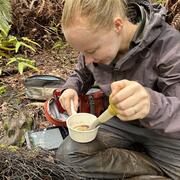
How to catch a vector: Mosquito monitoring for avian malaria control
USGS researchers are combatting avian malaria by improving the trapping and tracking of mosquitoes in endangered Hawaiian bird habitats.
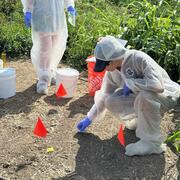
eDNA and the Efficacy of Management Actions
Environmental DNA (eDNA) is a powerful feedback tool, giving managers fast, clear, and cost-effective evidence to guide decisions and improve conservation outcomes.
By
Ecosystems Mission Area, Biological Threats and Invasive Species Research Program, Environmental Health Program, Species Management Research Program, Alaska Science Center, Columbia Environmental Research Center, Eastern Ecological Science Center, Forest and Rangeland Ecosystem Science Center, Fort Collins Science Center, Great Lakes Science Center, National Wildlife Health Center, Northern Prairie Wildlife Research Center, Northern Rocky Mountain Science Center, Pacific Island Ecosystems Research Center, Southwest Biological Science Center, Upper Midwest Environmental Sciences Center, Western Ecological Research Center (WERC), Western Fisheries Research Center, Wetland and Aquatic Research Center , Pacific Northwest Environmental DNA Laboratory
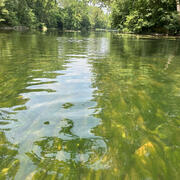
eDNA for Water-Quality Monitoring and Public Health Protection
By analyzing genetic traces left behind in water, eDNA provides early warning signs of problems—helping managers respond faster, protect public health, and keep freshwater ecosystems resilient.
By
Ecosystems Mission Area, Biological Threats and Invasive Species Research Program, Environmental Health Program, Alaska Science Center, Columbia Environmental Research Center, Eastern Ecological Science Center, Forest and Rangeland Ecosystem Science Center, Fort Collins Science Center, Great Lakes Science Center, National Wildlife Health Center, Northern Prairie Wildlife Research Center, Northern Rocky Mountain Science Center, Pacific Island Ecosystems Research Center, Upper Midwest Environmental Sciences Center, Western Ecological Research Center (WERC), Western Fisheries Research Center, Wetland and Aquatic Research Center , Pacific Northwest Environmental DNA Laboratory