



Biosurveillance
Our early detection & rapid response are improving biological threat detection
Our early detection & rapid response are improving biological threat detection
Fish and Wildlife Disease
We are the lead Federal agency for wildlife disease research and surveillance
We are the lead Federal agency for wildlife disease research and surveillance
Biological Threats and Invasive Species Research Program
The Biological Threats Research Program delivers science to protect public safety, property, and ecosystems from invasive plants and animals and infectious fish and wildlife diseases that pose significant ecologic and economic threats to the resources of the United States.
Links to Cool USGS Web Tools
Links to Cool USGS Web Tools
Explore powerful tools that provide immediate access to data and information on aquatic invasive species, wildlife diseases, and invasive plants.

News
EcoNews | Winter 2026 - Vol. 7 | Issue 1
EcoNews | Winter 2026 - Vol. 7 | Issue 1
Tackling Invasive Mussels with Science and Strategy
Tackling Invasive Mussels with Science and Strategy
WEBINAR: USGS Invasive Species Science - Innovation for a Healthy Nation
WEBINAR: USGS Invasive Species Science - Innovation for a Healthy Nation
Publications
Between a rock and a hard place: Experiences of the chronic wasting disease management community Between a rock and a hard place: Experiences of the chronic wasting disease management community
Chronic wasting disease (CWD) is a widespread and incurable cervid disease. Despite continuing investments, the logistical challenges of CWD have required wildlife managers and researchers to navigate changing priorities with conflicting public perceptions. When overcoming difficult management problems, leveraging exploratory methods may identify previously unrecognized hypotheses. In...
Observational, virological, and serological data provide insights into an outbreak of highly pathogenic avian influenza among wild birds on the Yukon-Kuskokwim Delta, Alaska in 2022 Observational, virological, and serological data provide insights into an outbreak of highly pathogenic avian influenza among wild birds on the Yukon-Kuskokwim Delta, Alaska in 2022
In 2021–22, clade 2.3.4.4b highly pathogenic avian influenza (HPAI) viruses were introduced by wild birds into North America, leading to geographically widespread disease. In response to HPAI outbreaks throughout late 2021 and early 2022, we recorded observations of sick and dead birds, estimated abundance of carcasses, collected swab and sera samples to detect viruses, and monitored...
Spatial distribution and relative biomass of bigheaded carps in Lake Balaton, Hungary estimated from an environmental DNA survey Spatial distribution and relative biomass of bigheaded carps in Lake Balaton, Hungary estimated from an environmental DNA survey
Silver carp (Hypophthalmichthys nobilis), bighead carp (H. molitrix) and their hybrids, collectively known as bigheaded carps, have been introduced to Lake Balaton, Hungary. The current stock sizes are difficult to assess. We investigated environmental DNA (eDNA) techniques targeted for bigheaded carps, assessed the spatial distribution of eDNA in Lake Balaton, compared eDNA...
Science
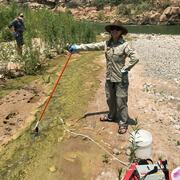
Early detection of aquatic threats: eDNA research in the Colorado River ecosystem & Lake Powell
The USGS and partners are conducting environmental DNA (eDNA) research in the Colorado River downstream from Glen Canyon Dam and in Lake Powell to detect invasive fish species and other aquatic threats before they become established. eDNA is a cutting-edge technology that makes it possible to identify invasive species before they are visible, even in vast or hard-to-survey environments like rivers...

USGS Sagebrush Science: Supporting Public Safety and Economic Decision Making Across the West
The sagebrush biome is one of the largest ecosystems in North America. Encompassing nearly one-third of the continental U.S., it provides critical resources for millions of Americans and a home for hundreds of plants and animal species in the West. Natural resource management in sagebrush ecosystems can be complex, and science can support management decisions by providing knowledge and tools to...
By
Core Science Systems Mission Area, Ecosystems Mission Area, Biological Threats and Invasive Species Research Program, Climate Adaptation Science Centers, Cooperative Research Units, Land Management Research Program, Species Management Research Program, Earth Resources Observation and Science (EROS) Center , Forest and Rangeland Ecosystem Science Center, Fort Collins Science Center, Northern Rocky Mountain Science Center, Southwest Biological Science Center, Western Ecological Research Center (WERC), Wildland Fire Science
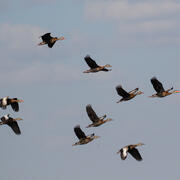
Tackling avian influenza with automated detection for an early warning system
The USGS is collaborating with agricultural and wildlife management partners to address the threat of highly-pathogenic avian influenza (HPAI) to wildlife, domestic poultry, and livestock. Partners include federal (U.S. Fish and Wildlife Service and U.S. Department of Agriculture) and non-federal agencies as well as State government, private organizations, and academic institutions. Our...