



Welcome to the MD-DE-DC Water Science Center
Consider this site your source for water-related information, collected and interpreted by the USGS in MD, DE, and Washington, DC
Consider this site your source for water-related information, collected and interpreted by the USGS in MD, DE, and Washington, DC
Explore our Scientific Expertise
We work with our partners to study important water issues facing the nation.
We work with our partners to study important water issues facing the nation.
Access data from our streamgages and wells
Explore real-time streamflow, water-quality, and groundwater conditions for Maryland, Delaware, and Washington, D.C.
Explore real-time streamflow, water-quality, and groundwater conditions for Maryland, Delaware, and Washington, D.C.
USGS WaterAlert
Get notifications for changes in water conditions based on thresholds you choose.
Get notifications for changes in water conditions based on thresholds you choose.
Soaking Up Stormwater In Clarksburg
A 20-year study by the U.S. Geological Survey and Montgomery County, Maryland assesses ecosystem response to different types of stormwater management.
A 20-year study by the U.S. Geological Survey and Montgomery County, Maryland assesses ecosystem response to different types of stormwater management.
Maryland-Delaware-D.C. Water Science Center
We are your go to source for water monitoring and research in the nation’s Capital region. Operating streamgages, observation wells, and monitoring stations, we collect scientific data that supports both real-time monitoring and long-term research, delivering reliable information essential for understanding and managing our natural water resources.
Explore our Expertise
Explore our Expertise

Our highly skilled staff work with our partners to study important water issues facing the Nation.
Local Water Conditions
Local Water Conditions
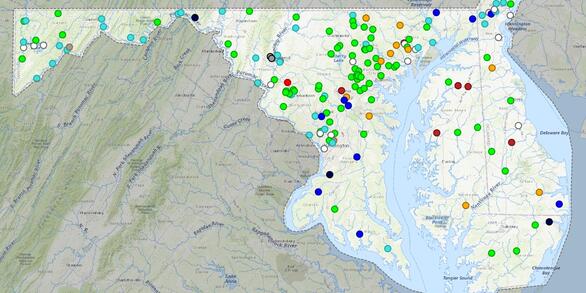
Explore real-time streamflow, groundwater, and water-quality conditions and access data for MD, DE, and DC.
News
The Hydrologic Instrumentation Facility (HIF) launches national research and development program
The Hydrologic Instrumentation Facility (HIF) launches national research and development program
Spring 2026 Newsletter - In The Flow
Spring 2026 Newsletter - In The Flow
Winter 2026 Newsletter - In The Flow
Winter 2026 Newsletter - In The Flow
Publications
A hybrid approach for revealing headwater hydrology A hybrid approach for revealing headwater hydrology
Coordinated work to compile existing data and apply models pairing physical understanding with machine learning could substantially improve streamflow predictions for little-known headwater basins.
Continental-scale prediction of hydrologic signatures and processes Continental-scale prediction of hydrologic signatures and processes
Understanding how dominant hydrologic processes and their drivers vary across diverse continental-scale landscapes is critical for hydrologic modeling and water management applications. Our research addresses this question by synthesizing large-sample watershed datasets, Caravan and GAGES-II, and developing random forest models to identify patterns in hydrologic function. We assessed...
PFAS remediation in a bioelectrochemical system inoculated with the west branch consortium (WBC-2) PFAS remediation in a bioelectrochemical system inoculated with the west branch consortium (WBC-2)
Groundwater contamination by per- and polyfluoroalkyl substances (PFAS) poses a persistent environmental and public health concern. This study evaluates a two-chambered bioelectrochemical system (BES) inoculated with the West Branch Consortium (WBC-2) for PFAS remediation. Under an applied cathodic potential of −450 mV (versus Ag/AgCl), the BES with active WBC-2 achieved >99.0%...
Science

Northeast Region Coastal Science Capabilities Team
Learn about the Northeast Region Coastal Science Capabilities Team.
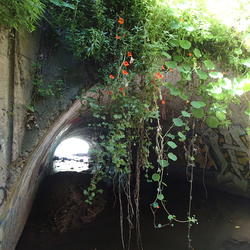
Northeast Region Urban Landscapes Capabilities Team
Learn about the Northeast Region Urban Landscapes Capabilities Team.

Northeast Region Capability Teams
Meet the USGS Northeast Region's Capability Teams.