



A geothermal power plant at The Geysers near Santa Rosa, California. The USGS researches and assesses geothermal resources.
Images
Energy and Minerals Mission Area images.
Filter Total Items: 523

Geothermal Plant
A geothermal power plant at The Geysers near Santa Rosa, California. The USGS researches and assesses geothermal resources.

Small-scale Commercial Windmill
USGS researchers used a small-scale commercial windmill as an essential part of its new device to measure snowfall in remote areas.
USGS researchers used a small-scale commercial windmill as an essential part of its new device to measure snowfall in remote areas.

Northern Alaska and potential gas hydrate occurences
Northern Alaska and potential gas hydrate occurences

Wind Turbines on a Farm
Scientists have found that wind turbines are causing fatalities of certain species of migratory insect-eating bats, although a March 2011 study in Science suggests that solutions to reduce the impacts of wind turbines on bats may be possible.
Scientists have found that wind turbines are causing fatalities of certain species of migratory insect-eating bats, although a March 2011 study in Science suggests that solutions to reduce the impacts of wind turbines on bats may be possible.

Gas Hydrate Drill Rig at the Mt. Elbert Test Site in Alaska
Gas Hydrate Drill Rig at the Mt. Elbert Test Site in AlaskaA drill rig at the Mount Elbert test site in Alaska's North Slope, just west of Prudhoe Bay. USGS joined BP Exploration (Alaska) and the U.S. Department of Energy to drill a test well to study natural gas production from gas hydrate deposits. Read more about the Mt.
Gas Hydrate Drill Rig at the Mt. Elbert Test Site in Alaska
Gas Hydrate Drill Rig at the Mt. Elbert Test Site in AlaskaA drill rig at the Mount Elbert test site in Alaska's North Slope, just west of Prudhoe Bay. USGS joined BP Exploration (Alaska) and the U.S. Department of Energy to drill a test well to study natural gas production from gas hydrate deposits. Read more about the Mt.
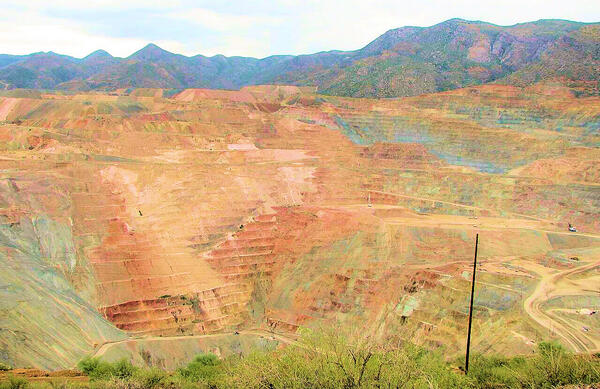
Ray_copper_mine_AZ_USGS_revised_Jan_7_2025.jpg
USGS photo of Ray Copper Mine in Pinal County, Arizona. Taken by Mark Coker on September 1, 2007. Revised for brightness and contrast for use as a webpage Carousel image.
USGS photo of Ray Copper Mine in Pinal County, Arizona. Taken by Mark Coker on September 1, 2007. Revised for brightness and contrast for use as a webpage Carousel image.

Alaskan Pipeline
Trans-Alaska Pipeline, northern Brooks Range, Alaska. Rocks in the background produce oil on the North Slope.
Trans-Alaska Pipeline, northern Brooks Range, Alaska. Rocks in the background produce oil on the North Slope.

Streambed Sediment Sampling
Bed sediment sampling, Suwanee Creek, Gwinnett Co, Georgia
Bed sediment sampling, Suwanee Creek, Gwinnett Co, Georgia

Gas Hydrate Well
Mount Elbert gas hydrate stratigraphic test well on the North Slope of Alaska.
Mount Elbert gas hydrate stratigraphic test well on the North Slope of Alaska.

Gas Hydrates in Marine Sediments from the Indian Ocean
Gas Hydrates in Marine Sediments from the Indian OceanThis image shows gas hydrates (the white material) in marine sediments from a test well drilled in the Indian Ocean in 2006 during the Indian National Gas Hydrate Program (NGHP) Expedition 01.
Gas Hydrates in Marine Sediments from the Indian Ocean
Gas Hydrates in Marine Sediments from the Indian OceanThis image shows gas hydrates (the white material) in marine sediments from a test well drilled in the Indian Ocean in 2006 during the Indian National Gas Hydrate Program (NGHP) Expedition 01.

Gas Hydrates in Marine Sediments from the Indian Ocean
Gas Hydrates in Marine Sediments from the Indian OceanThis image shows gas hydrates (the white material) in marine sediments from a test well drilled in the Indian Ocean in 2006 during the Indian National Gas Hydrate Program (NGHP) Expedition 01.
Gas Hydrates in Marine Sediments from the Indian Ocean
Gas Hydrates in Marine Sediments from the Indian OceanThis image shows gas hydrates (the white material) in marine sediments from a test well drilled in the Indian Ocean in 2006 during the Indian National Gas Hydrate Program (NGHP) Expedition 01.

Gas Hydrates in Marine Sediments
This image shows gas hydrates (the white material) in marine sediments from a test well drilled in the Indian Ocean in 2006 during the Indian National Gas Hydrate Program (NGHP) Expedition 01.
This image shows gas hydrates (the white material) in marine sediments from a test well drilled in the Indian Ocean in 2006 during the Indian National Gas Hydrate Program (NGHP) Expedition 01.

Gas Hydrates in Marine Sediments from the Indian Ocean
Gas Hydrates in Marine Sediments from the Indian OceanThis image shows gas hydrates (the white material) in marine sediments from a test well drilled in the Indian Ocean in 2006 during the Indian National Gas Hydrate Program (NGHP) Expedition 01.
Gas Hydrates in Marine Sediments from the Indian Ocean
Gas Hydrates in Marine Sediments from the Indian OceanThis image shows gas hydrates (the white material) in marine sediments from a test well drilled in the Indian Ocean in 2006 during the Indian National Gas Hydrate Program (NGHP) Expedition 01.

rare earth oxides
These rare-earth oxides are used as tracers to determine which parts of a watershed are eroding. Clockwise from top center: praseodymium, cerium, lanthanum, neodymium, samarium, and gadolinium. Image Number D1115-1. Photo by Peggy Greb, USDA-ARS.
These rare-earth oxides are used as tracers to determine which parts of a watershed are eroding. Clockwise from top center: praseodymium, cerium, lanthanum, neodymium, samarium, and gadolinium. Image Number D1115-1. Photo by Peggy Greb, USDA-ARS.

Copper Mine in the Republic of Georgia
An open-pit mine for volcanic-hosted copper deposits from the Bolnisi District of the Republic of Georgia.
An open-pit mine for volcanic-hosted copper deposits from the Bolnisi District of the Republic of Georgia.

Copper Mine in the Republic of Georgia
An open-pit mine for volcanic-hosted copper deposits from the Bolnisi District of the Republic of Georgia. A controlled blast as part of the mining process can be seen.
An open-pit mine for volcanic-hosted copper deposits from the Bolnisi District of the Republic of Georgia. A controlled blast as part of the mining process can be seen.

Bernard Hubbard Ground-Truthing Remote Sensing
USGS scientist Bernard Hubbard conducting spectral measurements of soils and cover crops to ground truth satellite imagery being used to map soil erosion and runoff potential into the Chesapeake Bay watershed.
USGS scientist Bernard Hubbard conducting spectral measurements of soils and cover crops to ground truth satellite imagery being used to map soil erosion and runoff potential into the Chesapeake Bay watershed.

Brown's Gulch Below Brooklyn Mine near Silverton, Colorado
Brown's Gulch Below Brooklyn Mine near Silverton, ColoradoUSGS scientist measuring pH, Specific Conductance and dissolved oxygen in a remediation ditch constructed with local volcanic rock possessing some acid neutralizing capacity.
Brown's Gulch is below the Brooklyn Mine, a few miles north of Siverton, Colorado, in the Mineral Creek basin.
Brown's Gulch Below Brooklyn Mine near Silverton, Colorado
Brown's Gulch Below Brooklyn Mine near Silverton, ColoradoUSGS scientist measuring pH, Specific Conductance and dissolved oxygen in a remediation ditch constructed with local volcanic rock possessing some acid neutralizing capacity.
Brown's Gulch is below the Brooklyn Mine, a few miles north of Siverton, Colorado, in the Mineral Creek basin.

Inukshuk at the Mallik Gas Hydrate Test Site in Canada
Inukshuk at the Mallik Gas Hydrate Test Site in CanadaThis image shows an inukshuk, a stone cairn used by indigenous peoples in northern latitudes, particularly in places like northern Canada.
Inukshuk at the Mallik Gas Hydrate Test Site in Canada
Inukshuk at the Mallik Gas Hydrate Test Site in CanadaThis image shows an inukshuk, a stone cairn used by indigenous peoples in northern latitudes, particularly in places like northern Canada.

Gas Hydrates in Marine Sediments off the Oregon Coast
Gas Hydrates in Marine Sediments off the Oregon CoastDuring Ocean Drilling Program Leg 204, nine sites were cored and wireline logged on the Oregon continental margin to determine the distribution and concentration of gas hydrates in an accretionary ridge setting, investigate the mechanisms that transport methane and other gases into the gas hydrate stability zone, and obtain constraints on physical properties of
Gas Hydrates in Marine Sediments off the Oregon Coast
Gas Hydrates in Marine Sediments off the Oregon CoastDuring Ocean Drilling Program Leg 204, nine sites were cored and wireline logged on the Oregon continental margin to determine the distribution and concentration of gas hydrates in an accretionary ridge setting, investigate the mechanisms that transport methane and other gases into the gas hydrate stability zone, and obtain constraints on physical properties of

Gas Hydrate Drill Rig at the Mallik Test Site in Canada
Gas Hydrate Drill Rig at the Mallik Test Site in CanadaA drill rig at the Mallik test site in Canada's Mckenzie Delta. USGS joined the Geological Survey of Canada, JAPEX, and the Japanese National Oil Company to drill test wells for natural gas production from gas hydrate deposits.
Gas Hydrate Drill Rig at the Mallik Test Site in Canada
Gas Hydrate Drill Rig at the Mallik Test Site in CanadaA drill rig at the Mallik test site in Canada's Mckenzie Delta. USGS joined the Geological Survey of Canada, JAPEX, and the Japanese National Oil Company to drill test wells for natural gas production from gas hydrate deposits.