



Mining water use is water used for the extraction of minerals that may be in the form of solids, such as coal, iron, sand, and gravel; liquids, such as crude petroleum; and gases, such as natural gas. The category includes quarrying, milling of mined materials, injection of water for secondary oil recovery or for unconventional oil and gas recovery (such as hydraulic fracturing), and other operations associated with mining activities.
Mining has played an important part in the development of this Nation. Even before the first European settlers set foot on this continent and mined coal to heat their homes, Native Americans were using coal to bake clay for vessels. The United States now produces a wide variety of mined commodities from gold to coal to "exotic" minerals used in everything from pharmaceuticals to jewelry to high-tech products. All these products would not be possible without the use of water in mining.
The USGS estimates water use for mining, including the amount lost to evaporation, to help identify where and when the Nation might have challenges meeting demand for water. Dewatering, which is the process of removing excess groundwater, rainwater, or surface runoff from mining sites, is generally excluded as a mining withdrawal unless the water was later used beneficially, such as dampening roads for dust control.
2020 Mining Water Use
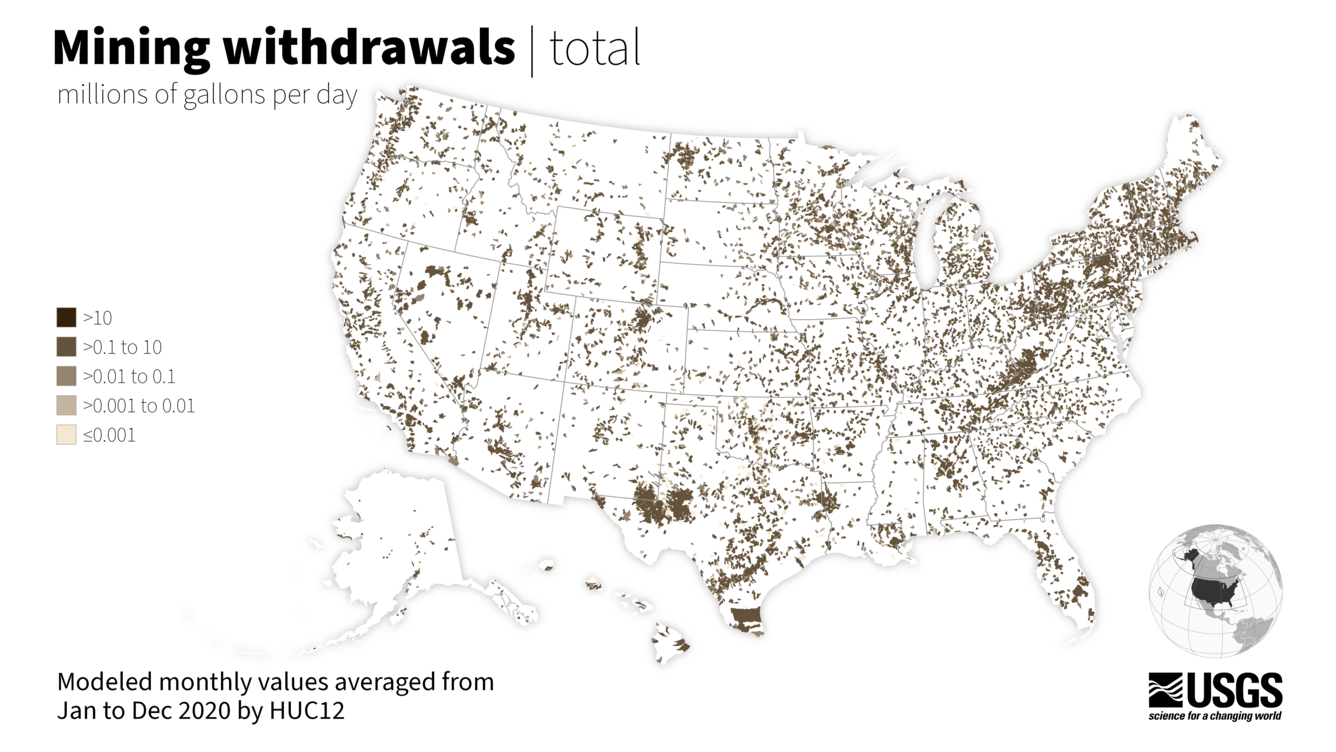
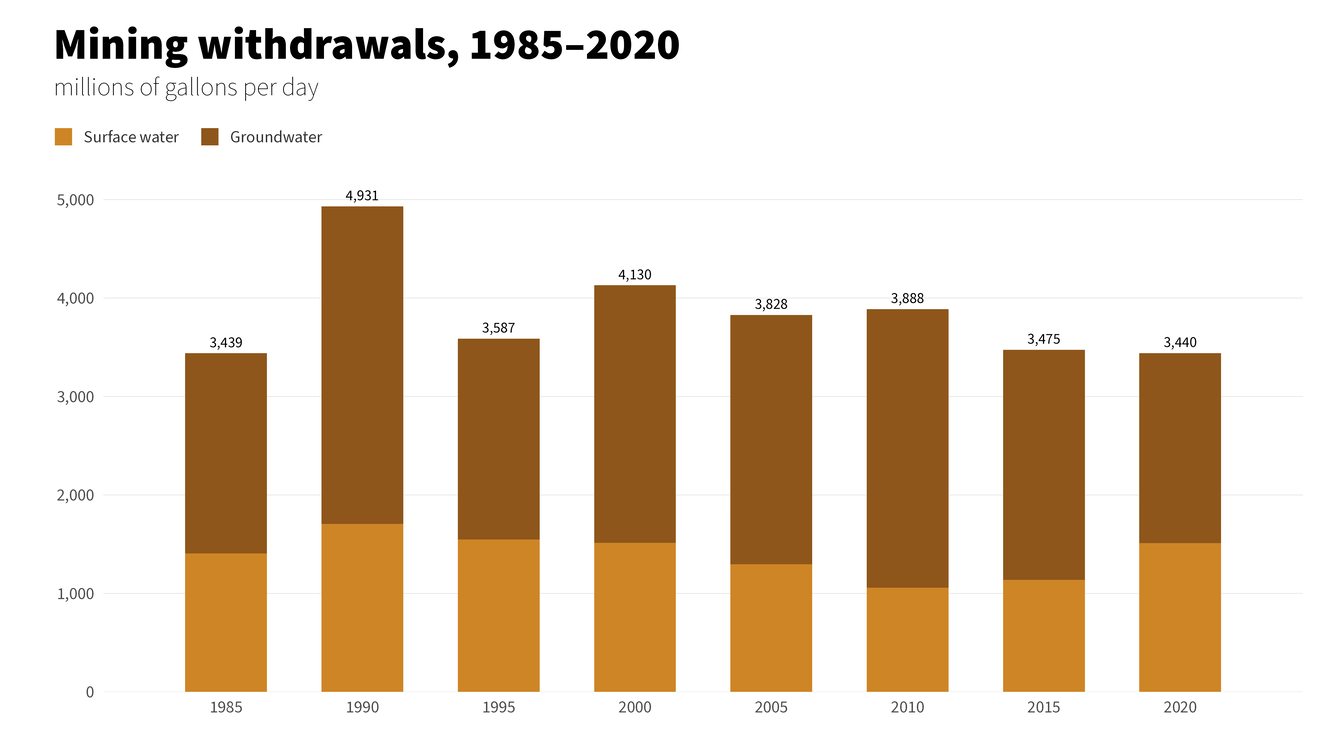
In calendar year 2020, about 3,440 million gallons per day (mgd) of water were withdrawn for mining across the 50 United States, including Alaska and Hawaii (McShane et al., 2026).
- In the lower 48 United States, the Northeast hydrologic region withdrew the most at about 529 mgd (15.4%), followed by the Tennessee-Missouri hydrologic region at about 523 mgd (15.2%). The Southeast region used the least, with about 12 mgd (0.4%).
- Mining withdrawals for areas outside of the lower 48 states where reported:
- Alaska had about 80.1 mgd withdrawn (2.3%), and the Hawaiian Islands region had about 4.7 mgd withdrawn (0.1%).
Estimating Mining Water Use
Prior to 2020, sources of data used to estimate annual water use for mining were State and Federal agencies that collect water withdrawal, discharge, or mineral production data for mining operations. Many of the 2015 withdrawals for mining were estimated according to methods described by Lovelace (2009), using mineral production data and water-use coefficients, in gallons per weight or volume of minerals produced. Production data for nonfuel minerals, including metals and nonmetallic minerals, were provided by the USGS National Minerals Information Center for 2015. Production or water-injection data for fuel minerals, including coal, petroleum, and natural gas, were obtained from the US Energy Information Administration and various State agencies.
For 2020, machine learning (ML) models were developed to estimate monthly water use for mining for all 50 States (McShane et al., 2026). ML models were trained using water use data available from 2019 to 2020 for 30 states along with multiple predictor variables on energy resources, mineral production, and mining employment (Scott et al., 2026).
Continued development is underway to estimate mining water use and consumptive use for 2025 onward.
Water Use in the United States
Accessing Water Use Data
Thermoelectric power water use
Irrigation water use
Public Supply Water Use
Domestic self-supply water use
Industrial Water Use
Livestock water use
Aquaculture water use
Below are links for other categories of water use.

Water Use in the United States

Livestock Water Use

Aquaculture Water Use

Accessing Water Use Data

Domestic Self-Supplied Water Use

Public Supply Water Use

Thermoelectric Power Water Use

Irrigation Water Use

Industrial Water Use

Estimating National Water Use Associated with Continuous Oil and Gas Development
Mining water use is water used for the extraction of minerals that may be in the form of solids, such as coal, iron, sand, and gravel; liquids, such as crude petroleum; and gases, such as natural gas. The category includes quarrying, milling of mined materials, injection of water for secondary oil recovery or for unconventional oil and gas recovery (such as hydraulic fracturing), and other operations associated with mining activities.
Mining has played an important part in the development of this Nation. Even before the first European settlers set foot on this continent and mined coal to heat their homes, Native Americans were using coal to bake clay for vessels. The United States now produces a wide variety of mined commodities from gold to coal to "exotic" minerals used in everything from pharmaceuticals to jewelry to high-tech products. All these products would not be possible without the use of water in mining.
The USGS estimates water use for mining, including the amount lost to evaporation, to help identify where and when the Nation might have challenges meeting demand for water. Dewatering, which is the process of removing excess groundwater, rainwater, or surface runoff from mining sites, is generally excluded as a mining withdrawal unless the water was later used beneficially, such as dampening roads for dust control.
2020 Mining Water Use
In calendar year 2020, about 3,440 million gallons per day (mgd) of water were withdrawn for mining across the 50 United States, including Alaska and Hawaii (McShane et al., 2026).
- In the lower 48 United States, the Northeast hydrologic region withdrew the most at about 529 mgd (15.4%), followed by the Tennessee-Missouri hydrologic region at about 523 mgd (15.2%). The Southeast region used the least, with about 12 mgd (0.4%).
- Mining withdrawals for areas outside of the lower 48 states where reported:
- Alaska had about 80.1 mgd withdrawn (2.3%), and the Hawaiian Islands region had about 4.7 mgd withdrawn (0.1%).
Estimating Mining Water Use
Prior to 2020, sources of data used to estimate annual water use for mining were State and Federal agencies that collect water withdrawal, discharge, or mineral production data for mining operations. Many of the 2015 withdrawals for mining were estimated according to methods described by Lovelace (2009), using mineral production data and water-use coefficients, in gallons per weight or volume of minerals produced. Production data for nonfuel minerals, including metals and nonmetallic minerals, were provided by the USGS National Minerals Information Center for 2015. Production or water-injection data for fuel minerals, including coal, petroleum, and natural gas, were obtained from the US Energy Information Administration and various State agencies.
For 2020, machine learning (ML) models were developed to estimate monthly water use for mining for all 50 States (McShane et al., 2026). ML models were trained using water use data available from 2019 to 2020 for 30 states along with multiple predictor variables on energy resources, mineral production, and mining employment (Scott et al., 2026).
Continued development is underway to estimate mining water use and consumptive use for 2025 onward.
Water Use in the United States
Accessing Water Use Data
Thermoelectric power water use
Irrigation water use
Public Supply Water Use
Domestic self-supply water use
Industrial Water Use
Livestock water use
Aquaculture water use
Below are links for other categories of water use.
Water Use in the United States
Livestock Water Use
Aquaculture Water Use
Accessing Water Use Data
Domestic Self-Supplied Water Use
Public Supply Water Use
Thermoelectric Power Water Use
Irrigation Water Use
Industrial Water Use