
U.S. flag

An official website of the United States government

Streamgaging Network

Filter Total Items: 45

Surge, Wave, and Tide Hydrodynamics (SWaTH) Network

During large coastal storms, the storm surge and waves are the main cause of destruction and landscape change, transporting saline water, sediment, and debris inland. The USGS, in collaboration with stakeholders, has constructed a national Surge, Wave, and Tide Hydrodynamics (SWaTH) Network for the Atlantic, Eastern Pacific, and Central Pacific. SWaTH monitors and documents the height, extent, and...
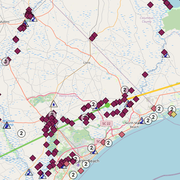
Surge, Wave, and Tide Hydrodynamics (SWaTH) Network

Surge, Wave, and Tide Hydrodynamics (SWaTH) Network

During large coastal storms, the storm surge and waves are the main cause of destruction and landscape change, transporting saline water, sediment, and debris inland. The USGS, in collaboration with stakeholders, has constructed a national Surge, Wave, and Tide Hydrodynamics (SWaTH) Network for the Atlantic, Eastern Pacific, and Central Pacific. SWaTH monitors and documents the height, extent, and...
Learn More

Providing Major Storm and Short-Term Flood Event Data

During major storms or other short-term events, the USGS collects streamflow and additional data to help document high-water events. This data is uploaded to the Short-Term Network (STN) for long-term archival and served out to the public through the Flood Event Viewer (FEV) which provides convenient, map-based access to downloadable event-based data.
Providing Major Storm and Short-Term Flood Event Data

Providing Major Storm and Short-Term Flood Event Data

During major storms or other short-term events, the USGS collects streamflow and additional data to help document high-water events. This data is uploaded to the Short-Term Network (STN) for long-term archival and served out to the public through the Flood Event Viewer (FEV) which provides convenient, map-based access to downloadable event-based data.
Learn More

Sediment Acoustics

The U.S. Geological Survey recognizes the need to provide sediment acoustic training and to develop standardized techniques and practices.
Sediment Acoustics

Sediment Acoustics

The U.S. Geological Survey recognizes the need to provide sediment acoustic training and to develop standardized techniques and practices.
Learn More

USGS Cooperative Matching Funds

USGS Cooperative Matching Funds (CMF) support joint projects with our state, regional, tribal, and local partners to provide reliable, impartial, and timely information needed to understand and manage the Nation's water resources.
USGS Cooperative Matching Funds

USGS Cooperative Matching Funds

USGS Cooperative Matching Funds (CMF) support joint projects with our state, regional, tribal, and local partners to provide reliable, impartial, and timely information needed to understand and manage the Nation's water resources.
Learn More

Flood Inundation Mapping Toolbox

The FIM Toolbox contains comprehensive information on the Flood Inundation Mapping program, including how to develop a flood inundation map library. Resources include process documents, scientific and technical requirements, forms and templates, outreach and educational materials, and contact information. The FIM Toolbox is updated as new resources become available.
Flood Inundation Mapping Toolbox

Flood Inundation Mapping Toolbox

The FIM Toolbox contains comprehensive information on the Flood Inundation Mapping program, including how to develop a flood inundation map library. Resources include process documents, scientific and technical requirements, forms and templates, outreach and educational materials, and contact information. The FIM Toolbox is updated as new resources become available.
Learn More

2011 - The Year of the Flood

2011 proved to be another record-breaking flood year in the United States. USGS Water Science Center personnel from North Dakota to Louisiana measured springtime floods on the Red River of the North, the Ohio River, the Mississippi River, and many tributaries. The Missouri River and its tributaries saw record-breaking snow-melt runoff through the summer, followed closely by Hurricane Irene and...
2011 - The Year of the Flood

2011 - The Year of the Flood

2011 proved to be another record-breaking flood year in the United States. USGS Water Science Center personnel from North Dakota to Louisiana measured springtime floods on the Red River of the North, the Ohio River, the Mississippi River, and many tributaries. The Missouri River and its tributaries saw record-breaking snow-melt runoff through the summer, followed closely by Hurricane Irene and...
Learn More

Urban Waters Federal Partnership - Suspended Sediment and Nutrient Delivery to the Gulf of America

Suspended sediment and nutrients from greater San Antonio can affect instream ecological health of the San Antonio River and ultimately impact Gulf of America bays and estuaries. Real-time monitoring in urban and rural parts of the river basin may provide a glimpse into the importance of urban sediment and nutrient sources. Real-time sensors provide a tool to better understand and manage water...
Urban Waters Federal Partnership - Suspended Sediment and Nutrient Delivery to the Gulf of America

Urban Waters Federal Partnership - Suspended Sediment and Nutrient Delivery to the Gulf of America

Suspended sediment and nutrients from greater San Antonio can affect instream ecological health of the San Antonio River and ultimately impact Gulf of America bays and estuaries. Real-time monitoring in urban and rural parts of the river basin may provide a glimpse into the importance of urban sediment and nutrient sources. Real-time sensors provide a tool to better understand and manage water...
Learn More

Flood Inundation Mapping Science

When planning for a flood, there are three key questions that must be answered: What areas will be flooded? How deep will the flood waters get? When will the flood arrive? Historical flooding can help a community anticipate how much impact similar flood events could have, but there are other methods and tools that can provide more accurate and nuanced estimations of a wide variety of flood...
Flood Inundation Mapping Science

Flood Inundation Mapping Science

When planning for a flood, there are three key questions that must be answered: What areas will be flooded? How deep will the flood waters get? When will the flood arrive? Historical flooding can help a community anticipate how much impact similar flood events could have, but there are other methods and tools that can provide more accurate and nuanced estimations of a wide variety of flood...
Learn More

Flood Inundation Mapping (FIM) Program

Floods are the leading cause of natural-disaster losses in the U.S. More than 75 percent of declared Federal disasters are related to floods, and annual flood losses average almost $8 billion with over 90 fatalities per year. Although the amount of fatalities has declined due to improved early warning systems, economic losses continue to rise with increased urbanization in flood-hazard areas.
Flood Inundation Mapping (FIM) Program

Flood Inundation Mapping (FIM) Program

Floods are the leading cause of natural-disaster losses in the U.S. More than 75 percent of declared Federal disasters are related to floods, and annual flood losses average almost $8 billion with over 90 fatalities per year. Although the amount of fatalities has declined due to improved early warning systems, economic losses continue to rise with increased urbanization in flood-hazard areas.
Learn More
Was this page helpful?