U.S. flag

An official website of the United States government

Images

Images related to Yellowstone Volcano Observatory.

Filter Total Items: 704
Marsh in the foreground, treed hill in the background. Steam vent at base of hill. Blue sky above.
New steam vent that formed in 2024 near Nymph Lake, Yellowstone National Park

New steam vent at the base of a hill north of Nymph Lake, west of the highway and between Norris Geyser Basin and Roaring Mountain. USGS photo by Mike Poland, September 1, 2024.

Dead lodgepole pine trees along the shoreline of a small lake.  Live trees are present away from the shore.
Dead trees along the edge of Nuphar Lake, Yellowstone National Park, in summer 2024

Photo of dead trees along the edge of Nuphar Lake.  The white staining at the base of the trees is a telltale sign that the trees were immersed in thermal water containing silica.  USGS photo by Mike Poland, September 1, 2024.

Marsh in foreground, tree-covered hill in background with a steam vent at it's base, all under blue sky
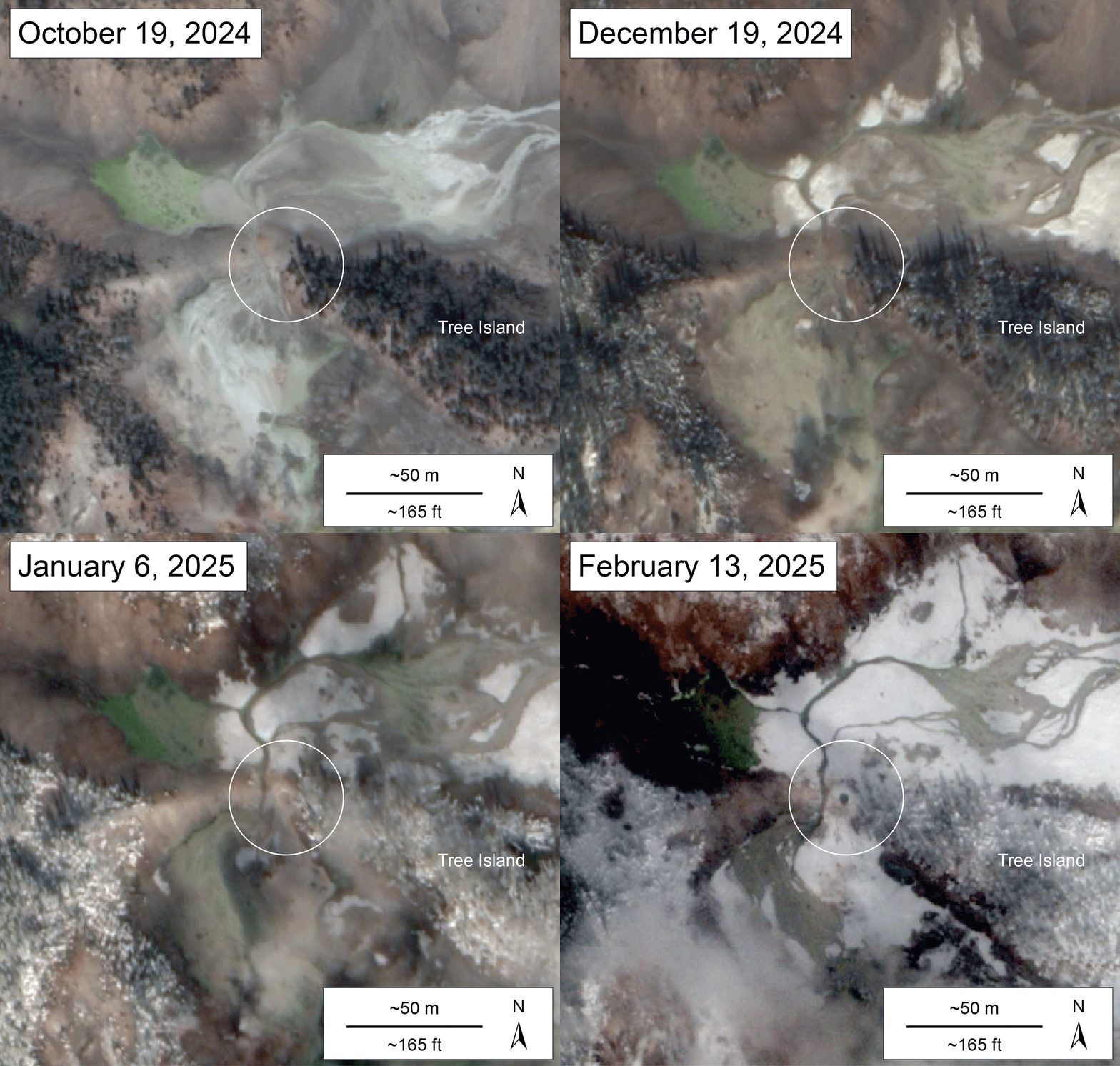
new thermal feature that formed in 2024 near Nymph Lake, Yellowstone National Park

Looking south from near a pullout along the Mammoth to Norris road just north of the Nymph Lake overlook. On the other side of the marsh is a tree-covered rhyolite lava flow, and at the base of the flow is a new thermal feature marked by a plume of steam and that formed in early August 2024.   Photo by Mike Poland, USGS, September 1, 2024.

Looking south from near a pullout along the Mammoth to Norris road just north of the Nymph Lake overlook. On the other side of the marsh is a tree-covered rhyolite lava flow, and at the base of the flow is a new thermal feature marked by a plume of steam and that formed in early August 2024.   Photo by Mike Poland, USGS, September 1, 2024.

A river winds through a meadow at sunset, with pink clouds in the sky.  Trees are in the background.
Gibbon River near Norris Geyser Basin in Yellowstone National Park

Gibbon River near Norris Geyser Basin in Yellowstone National Park at sunset.  USGS Photo by Mike Poland, August 28, 2024.

Geologist on a hillside within a barren landscape of reddish and pale rocks
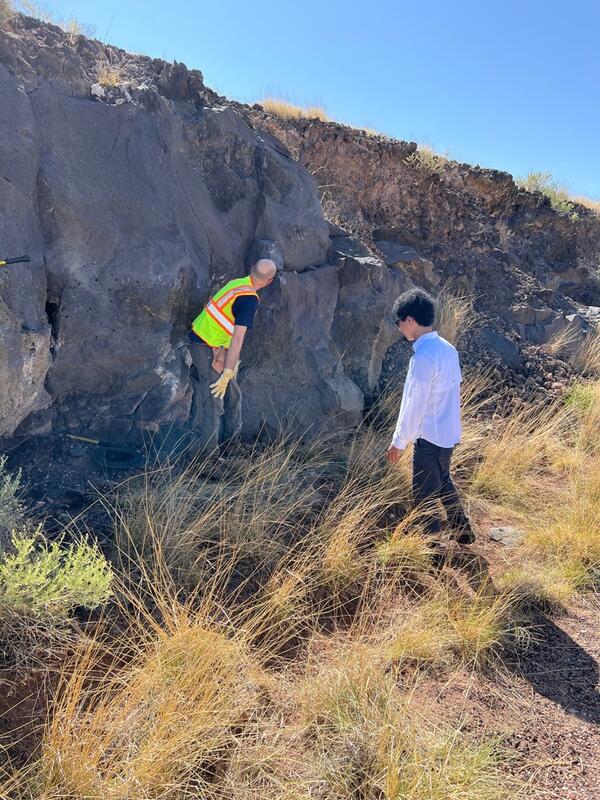
Geologist examining Lava Creek Tuff ash fall beds near Shell, Wyoming

Professor C.J.N. Wilson, FRS, pays due homage to the Lava Creek Tuff ashfall bed in a basin just east of Shell, Wyoming. Photo by Madison Myers, Montana State University, August 9, 2024.

A man in a green shirt is building a gauge for rapid deployment. The gauge is a large black box, sitting on a workbench.
USGS response to Tropical Storm Debby in Georgia

Drew Robinson, a USGS hydrological technician, is putting a Rapid Deployment Gauge together for the Georgia Department of Transportation on Wednesday, August 7. He built the RDG and deployed it in Statesboro in the early evening. That RDG was used to help the local community experiencing bad floods on Lotts Creek.

Drew Robinson, a USGS hydrological technician, is putting a Rapid Deployment Gauge together for the Georgia Department of Transportation on Wednesday, August 7. He built the RDG and deployed it in Statesboro in the early evening. That RDG was used to help the local community experiencing bad floods on Lotts Creek.

Lidar hillshade maps of fault scarps that offset Pinedale glacial till along the East Gallatin-Reese Creek fault system, Yellowstone National Park

Lidar hillshade maps of fault scarps that offset Pinedale glacial till along the East Gallatin-Reese Creek fault system (EGRCFS) near Fawn Creek (A) and Panther Creek (B). Fault scarps are visible as darker lineaments in the hillshade and are marked by the black arrows. Red rectangles on inset maps show location along the EGRCFS.

Graph showing explosions recorded at Black Diamond Pool in Biscuit Basin, Yellowstone National Park, during 2006 through 2016

Graph showing explosions recorded at Black Diamond Pool in Biscuit Basin, Yellowstone National Park, during 2006 through 2016. Confirmed events refer to eruptions that were witnessed, recorded by temperature loggers, or inferred from their aftermath. Unconfirmed events refer to eruptions that were questionable or might have been misattributed to Black Diamond.

Graph showing explosions recorded at Black Diamond Pool in Biscuit Basin, Yellowstone National Park, during 2006 through 2016. Confirmed events refer to eruptions that were witnessed, recorded by temperature loggers, or inferred from their aftermath. Unconfirmed events refer to eruptions that were questionable or might have been misattributed to Black Diamond.

Steam vent in barren ground.  Light white silica coating dusts the surroundings.  Forested area in the background
Closeup view of hydrothermal feature that formed near Nymph Lake, Yellowstone National Park, in August 2024

Looking southeast at the hydrothermal feature that formed in August 2024 just north of Nymph Lake. Steam is emanating from a vent that is partially full of water to create the frying pan feature nestled in the newly formed vent. A thin grey layer of silica mud covers the vent area.  Photo by Jefferson Hungerford, Yellowstone National Park, August 2024.

Looking southeast at the hydrothermal feature that formed in August 2024 just north of Nymph Lake. Steam is emanating from a vent that is partially full of water to create the frying pan feature nestled in the newly formed vent. A thin grey layer of silica mud covers the vent area.  Photo by Jefferson Hungerford, Yellowstone National Park, August 2024.

Plot of size versus annual probability for hydrothermal explosion craters in Yellowstone National Park

Plot of size versus annual probability for hydrothermal explosion craters in Yellowstone National Park. The line is a model based on the energy required to form a crater of a specific size, and it is fit to known hydrothermal explosion craters in Yellowstone National Park.

Photomicrograph showing water distribution in a quartz-hosted embayment, with greater concentrations at the embayment mouth. Includes a plot showing that the temperature in which the water circulated must have been about 500 degrees Celsius.
Water distribution in a quartz-hosted embayment from the Mesa Falls Tuff

(A) Water distribution in a quartz-hosted embayment measured with synchrotron Fourier Transform Infrared spectroscopy. Warmer colors indicate higher concentrations of water.  Dashed line shows a transect of water content that is modeled in panel (B) to indicate that the emplacement temperature of the ash flow deposit must have been about 500 °C (930 °F).

(A) Water distribution in a quartz-hosted embayment measured with synchrotron Fourier Transform Infrared spectroscopy. Warmer colors indicate higher concentrations of water.  Dashed line shows a transect of water content that is modeled in panel (B) to indicate that the emplacement temperature of the ash flow deposit must have been about 500 °C (930 °F).

Fist sized sample of rock, black in color with white flecks
Hand sample of the Mount Jackson vitrophyre

A clean hand sample of the Mount Jackson vitrophyre. This sample has a black, glassy groundmass with large (1–3 mm, or a small fraction of an inch), white phenocrysts suspended in the glass. Photo by Liv Wheeler, Montana State University, August 2024.

A clean hand sample of the Mount Jackson vitrophyre. This sample has a black, glassy groundmass with large (1–3 mm, or a small fraction of an inch), white phenocrysts suspended in the glass. Photo by Liv Wheeler, Montana State University, August 2024.

A blue pool with an irregular edge surrounded by barren ground and yellow grass. A boardwalk is in the foreground;.
Abyss Pool, West Thumb Geyser Basin, Yellowstone National Park

Abyss Pool is about 16 m (53 ft) deep and contains alkaline-chloride hydrothermal fluids that in the summer of 2024 had a temperature of 181 °F (83 °C).

Frothy blue-green mud pots surrounded by grassy areas. Trees and Yellowstone Lake in the background under partly cloudy sky.
Mud pots in West Thumb Geyser Basin, Yellowstone National Park

Mud pots form in a few selected areas of West Thumb Geyser Basin where low-pH acidic fluids dissolve rocks and soil to produce clay-rich muds.  USGS photo by Pat Shanks, 2024.

Shaded relief location map for the East Gallatin-Reese Creek fault system in northwest Yellowstone National Park
Comparison photos showing the same spring in a barren area. The surface of the pool is black in 2018, but blue in 2023.
Cinder Pool, located in the southwest part of 100 Spring Plain in Norris Geyser Basin, Yellowstone National Park

Cinder Pool, located in the southwest part of 100 Spring Plain in Norris Geyser Basin, Yellowstone National Park. The pool was known for “cinders” made of sulfur that condensed after rising from a molten layer at the bottom of the pool, but after 2019 those cinders disappeared.  Photos from June 2018 (left) and June 2023 (right) by Lauren Harrison.

Cinder Pool, located in the southwest part of 100 Spring Plain in Norris Geyser Basin, Yellowstone National Park. The pool was known for “cinders” made of sulfur that condensed after rising from a molten layer at the bottom of the pool, but after 2019 those cinders disappeared.  Photos from June 2018 (left) and June 2023 (right) by Lauren Harrison.

Photomicrograph showing a quartz-hosted embayment from the Mesa Falls Tuff, accompanied by a map showing the location of the tuff in eastern Idaho.
Quartz-hosted embayment from the Mesa Falls Tuff

(A) Photomicrograph of a quartz-hosted embayment from the Mesa Falls Tuff. “MI” indicates a glassy inclusion of melt within the crystal. (B) Thickness (in centimeters) and extent of the Mesa Falls ash flow deposit (pink areas) and its source, Henrys Fork Caldera (dashed line).  Figure by Kenneth Befus, University of Texas at Austin.

(A) Photomicrograph of a quartz-hosted embayment from the Mesa Falls Tuff. “MI” indicates a glassy inclusion of melt within the crystal. (B) Thickness (in centimeters) and extent of the Mesa Falls ash flow deposit (pink areas) and its source, Henrys Fork Caldera (dashed line).  Figure by Kenneth Befus, University of Texas at Austin.

Gray rock outcrop partially covered in pine needles, with some lodgepole pines growing nearby.
Exposure of the Mount Jackson Rhyolite Series vitrophyre at Gibbon River

Exposure of the Mount Jackson Rhyolite Series vitrophyre at Gibbon River. Boulders of weathered, lichen-covered rock show how easy it is to overlook these new units. Photo by Liv Wheeler, Montana State University, August 2024.

Exposure of the Mount Jackson Rhyolite Series vitrophyre at Gibbon River. Boulders of weathered, lichen-covered rock show how easy it is to overlook these new units. Photo by Liv Wheeler, Montana State University, August 2024.

Large block of debris in front of a steaming pool.  The block was transported by the July 23, 2024, hydrothermal explosion at Biscuit Basin, Yellowstone National Park
Largest identified boulder displaced by the July 23, 2024, explosion from Black Diamond Pool, Yellowstone National Park

This boulder is the largest that is confirmed to have been part of the July 23, 2024, hydrothermal explosion from Black Diamond Pool, Biscuit Basin, Yellowstone National Park.  The tape measure is 50 centimeters (20 inches) long.  Black Diamond Pool and a boardwalk are in the background.

High-resolution Planet satellite image of Biscuit Basin, Yellowstone National Park, from July 24, 2024

High-resolution Planet satellite image of Biscuit Basin, Yellowstone National Park, from July 24, 2024.  The image shows changes that occurred as a result of the July 23, 2024, hydrothermal explosion from Black Diamond Pool, including deposition of material in the vicinity of the pool and a plume of discolored water in the Forehole River.

High-resolution Planet satellite image of Biscuit Basin, Yellowstone National Park, from July 24, 2024.  The image shows changes that occurred as a result of the July 23, 2024, hydrothermal explosion from Black Diamond Pool, including deposition of material in the vicinity of the pool and a plume of discolored water in the Forehole River.

Aerial view of Biscuit Basin, Yellowstone National Park, showing debris deposited by the July 23, 2024, hydrothermal explosion from Black Diamond Pool

Aerial view of Biscuit Basin, Yellowstone National Park, showing debris deposited by the July 23, 2024, hydrothermal explosion from Black Diamond Pool.  Major features are labeled.  The main debris field (within dashed yellow line) has a gray appearance.  Photo taken by Joe Bueter, Yellowstone National Park, on July 23, 2024.

Was this page helpful?