Natural Bridges State Beach, Santa Cruz, California
Natural Bridges State Beach, Santa Cruz, CaliforniaPhotograph of the coastal region of Natural Bridges State Beach in Santa Cruz, California


Official websites use .gov
A .gov website belongs to an official government organization in the United States.

Secure .gov websites use HTTPS
A lock () or https:// means you’ve safely connected to the .gov website. Share sensitive information only on official, secure websites.

Coastal and Marine Hazards and Resources Program images.

Photograph of the coastal region of Natural Bridges State Beach in Santa Cruz, California
Photograph of the coastal region of Natural Bridges State Beach in Santa Cruz, California

The USGS, in cooperation with Santa Cruz County and the California Department of Boating and Waterways, studied the seacliffs, ocean floor, and waves of Pleasure Point, California. We created detailed maps of the seacliffs and ocean floor using LIDAR laser scanners and sonar.
The USGS, in cooperation with Santa Cruz County and the California Department of Boating and Waterways, studied the seacliffs, ocean floor, and waves of Pleasure Point, California. We created detailed maps of the seacliffs and ocean floor using LIDAR laser scanners and sonar.

Inner continental shelf sediment textures within western Massachusetts Bay classified using Barnhardt and others (1998). Bottom photographs A-D show sediment texture in select locations (photograph locations are shown as white dots on the sediment texture map).
Inner continental shelf sediment textures within western Massachusetts Bay classified using Barnhardt and others (1998). Bottom photographs A-D show sediment texture in select locations (photograph locations are shown as white dots on the sediment texture map).

Sediment texture and distribution data were mapped qualitatively in Esri ArcGIS using a hierarchical methodology. Backscatter data were the first input, followed by bathymetry, surficial geologic and shallow stratigraphic interpretations, and photograph and sample databases. DEM, digital elevation model.
Sediment texture and distribution data were mapped qualitatively in Esri ArcGIS using a hierarchical methodology. Backscatter data were the first input, followed by bathymetry, surficial geologic and shallow stratigraphic interpretations, and photograph and sample databases. DEM, digital elevation model.

Bathymetry of of the southern Gulf of Maine with the Massachusetts coastal zone boundary outlined in grey.
Bathymetry of of the southern Gulf of Maine with the Massachusetts coastal zone boundary outlined in grey.

Shaded relief backscatter image of a shipwreck near Cuttyhunk, MA
Shaded relief backscatter image of a shipwreck near Cuttyhunk, MA

Shaded relief image of Woods Hole, MA
Shaded relief image of Woods Hole, MA

Swath bathymetry and derivative products such as slope, hillshaded relief, and rugosity maps provide information not only on water depth, but also the roughness and smoothness of the sea floor, which correlates with sea floor texture and depositional environment.
Swath bathymetry and derivative products such as slope, hillshaded relief, and rugosity maps provide information not only on water depth, but also the roughness and smoothness of the sea floor, which correlates with sea floor texture and depositional environment.

Image showing the bathymetry of the southern Gulf of Maine with the Massachusetts coastal zone boundary outlined in grey. The images on the right display how the geophysical and sample data are combined to create an interpretation of seafloor geology
Image showing the bathymetry of the southern Gulf of Maine with the Massachusetts coastal zone boundary outlined in grey. The images on the right display how the geophysical and sample data are combined to create an interpretation of seafloor geology

Oblique hillshaded-relief view of the bathymetry surrounding Martha’s Vineyard and the Upper Cape looking south across Buzzards Bay and Vineyard Sound
Oblique hillshaded-relief view of the bathymetry surrounding Martha’s Vineyard and the Upper Cape looking south across Buzzards Bay and Vineyard Sound

USGS Research Oceanographer Li Erikson collects coastal data along the Pacific coast during her Mendenhall Fellowship. Her research is focused on coastal storm modeling, storm-induced coastal flooding, erosion, and cliff failures over large geographic scales.
USGS Research Oceanographer Li Erikson collects coastal data along the Pacific coast during her Mendenhall Fellowship. Her research is focused on coastal storm modeling, storm-induced coastal flooding, erosion, and cliff failures over large geographic scales.

USGS scientists Patrick Barnard (left) and Jeff Hansen navigate personal watercraft equipped with GPS and echo sounders through the waters of San Francisco Bay. They are collecting bathymetric, or depth, information in order to create maps of the bottom of the Bay.
USGS scientists Patrick Barnard (left) and Jeff Hansen navigate personal watercraft equipped with GPS and echo sounders through the waters of San Francisco Bay. They are collecting bathymetric, or depth, information in order to create maps of the bottom of the Bay.

USGS Ocean Engineer Gerry Hatcher walks along South Jetty Beach, south of Ventura Harbor in southern California, to record beach elevations using a handheld computer and mobile GPS equipment.
USGS Ocean Engineer Gerry Hatcher walks along South Jetty Beach, south of Ventura Harbor in southern California, to record beach elevations using a handheld computer and mobile GPS equipment.

This photograph of the seafloor off the California coast also shows jellyfish in the water column. This photograph was collected as part of the California Seafloor and Coastal Mapping Program.
This photograph of the seafloor off the California coast also shows jellyfish in the water column. This photograph was collected as part of the California Seafloor and Coastal Mapping Program.

A kelp greenling fish swimming above a seafloor of mixed gravel, cobble and rock outcrop with scattered shell. Fish is approx. 20 cm (8 inches) long. Image acquired 1 km (0.62 miles) offshore Half Moon Bay, California at a depth of 14 meters (46 ft). Also in the image are encrusting sponges, red algae (seaweed), and orange cup corals.
A kelp greenling fish swimming above a seafloor of mixed gravel, cobble and rock outcrop with scattered shell. Fish is approx. 20 cm (8 inches) long. Image acquired 1 km (0.62 miles) offshore Half Moon Bay, California at a depth of 14 meters (46 ft). Also in the image are encrusting sponges, red algae (seaweed), and orange cup corals.

Boulders and biota off San Gregorio, California, in water approximately 30 meters (100 feet) deep. Organisms include bat stars, small sea anemones, strawberry anemone, cup corals, and frilly sea cucumbers.
Boulders and biota off San Gregorio, California, in water approximately 30 meters (100 feet) deep. Organisms include bat stars, small sea anemones, strawberry anemone, cup corals, and frilly sea cucumbers.
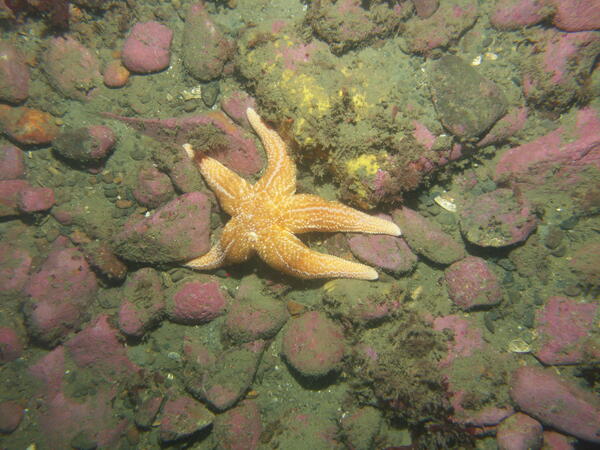
Photograph of a starfish on the sea floor, offshore of Duxbury to Hull, Massachusetts
Photograph of a starfish on the sea floor, offshore of Duxbury to Hull, Massachusetts

Eroding bluffs along Alaska’s Arctic coast. Note light permafrost in bluff face, below top few feet of soil and vegetation.
Eroding bluffs along Alaska’s Arctic coast. Note light permafrost in bluff face, below top few feet of soil and vegetation.

This nearly century-old whaling boat rests along the Beaufort Sea coast near Lonely, Alaska in July, 2007. The boat was washed away to sea just a few months later.
This nearly century-old whaling boat rests along the Beaufort Sea coast near Lonely, Alaska in July, 2007. The boat was washed away to sea just a few months later.

Beach front houses on Fire Island, NY

Contour plots of SSC for the spatial surveys during trade-wind conditions on the reef flat. (a) SSC from the low tide survey. The highest SSC (60e70 mg/l) were located in a nearshore band, and east of the fish ponds and Kaunakakai wharf. (b) SSC from the high tide surveys.
Contour plots of SSC for the spatial surveys during trade-wind conditions on the reef flat. (a) SSC from the low tide survey. The highest SSC (60e70 mg/l) were located in a nearshore band, and east of the fish ponds and Kaunakakai wharf. (b) SSC from the high tide surveys.