Northern Alaska and potential gas hydrate occurences
Northern Alaska and potential gas hydrate occurences


Official websites use .gov
A .gov website belongs to an official government organization in the United States.

Secure .gov websites use HTTPS
A lock () or https:// means you’ve safely connected to the .gov website. Share sensitive information only on official, secure websites.

Coastal and Marine Hazards and Resources Program images.


Static stress change models for known or hypothesized faults in the Hispaniola and Puerto Rico subduction segments due to (a) slip on a patch of the Puerto Rico subduction zone, and (b) slip on a patch of the Hispaniola subduction zone. An open arrow denotes slip direction and the patches are marked by dashed rectangles.
Static stress change models for known or hypothesized faults in the Hispaniola and Puerto Rico subduction segments due to (a) slip on a patch of the Puerto Rico subduction zone, and (b) slip on a patch of the Hispaniola subduction zone. An open arrow denotes slip direction and the patches are marked by dashed rectangles.

A pressurized, stable, hydrate-bearing sediment core can be fed through the IPTC body, shown here being used in Singapore to support the Indian National Gas Hydrates Program (NGHP1)
A pressurized, stable, hydrate-bearing sediment core can be fed through the IPTC body, shown here being used in Singapore to support the Indian National Gas Hydrates Program (NGHP1)

Woods Hole Coastal and Marine Science Center's Ellyn Montgomery (right) on the helipad of the Canadian Coast Guard Vessel Louis St. Laurent returning from an ice reconnaissance flight as part of a joint study mapping the foot of the continental slope in the Arctic Ocean in 2008
Woods Hole Coastal and Marine Science Center's Ellyn Montgomery (right) on the helipad of the Canadian Coast Guard Vessel Louis St. Laurent returning from an ice reconnaissance flight as part of a joint study mapping the foot of the continental slope in the Arctic Ocean in 2008

Kristen Hart releasing a satellite-tagged hawksbill sea turtle, August 2008, Dry Tortugas National Park.
Kristen Hart releasing a satellite-tagged hawksbill sea turtle, August 2008, Dry Tortugas National Park.
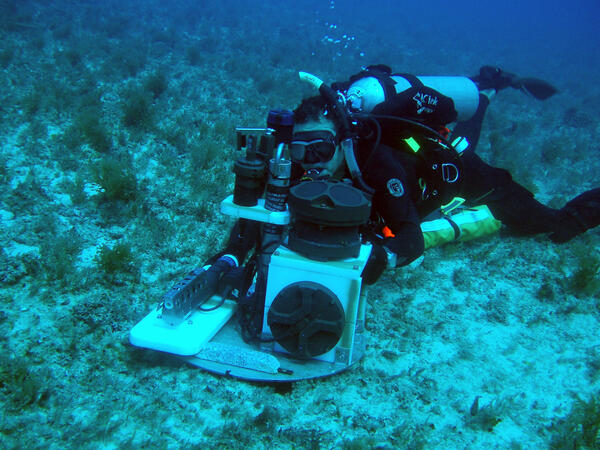
USGS research geologist Curt Storlazzi installs an instrument package on the seafloor of Maunalua Bay, Oʻahu. The platform, called a MiniPROBE, hosts six upward-looking acoustic Doppler current profilers (ADCP), seven conductivity and temperature (CT) sensors, and eight self-logging optical backscatter sensors (SLOBS).
USGS research geologist Curt Storlazzi installs an instrument package on the seafloor of Maunalua Bay, Oʻahu. The platform, called a MiniPROBE, hosts six upward-looking acoustic Doppler current profilers (ADCP), seven conductivity and temperature (CT) sensors, and eight self-logging optical backscatter sensors (SLOBS).

(Top image) Shaded relief of the new multibeam bathymetry along the Puerto Rico Trench illuminated from the northwest. Thin contours indicate bathymetry at 500-m intervals. (Bottom image) Combined bathymetry map of the multibeam bathymetry data, single-beam bathymetry compilation around Puerto Rico, Lidar data near shore, and topography of Puerto Rico.
(Top image) Shaded relief of the new multibeam bathymetry along the Puerto Rico Trench illuminated from the northwest. Thin contours indicate bathymetry at 500-m intervals. (Bottom image) Combined bathymetry map of the multibeam bathymetry data, single-beam bathymetry compilation around Puerto Rico, Lidar data near shore, and topography of Puerto Rico.

Grand Canyon sand was photographed with a hand-held point-and-shoot camera in a waterproof housing.
Grand Canyon sand was photographed with a hand-held point-and-shoot camera in a waterproof housing.

USGS scientists from the Pacific Coastal and Marine Science Center (PCMSC) in Santa Cruz, California deploy an instrument called the poking eyeball. The system, developed by PCMSC, was designed to take repetitive microscopic images of the seabed from a tripod on the seafloor.
USGS scientists from the Pacific Coastal and Marine Science Center (PCMSC) in Santa Cruz, California deploy an instrument called the poking eyeball. The system, developed by PCMSC, was designed to take repetitive microscopic images of the seabed from a tripod on the seafloor.

Helicopter on the deck of a Canadian coast guard ice breaker ship in the Arctic Ocean.
Helicopter on the deck of a Canadian coast guard ice breaker ship in the Arctic Ocean.

Flooded coastal streets, houses, and fields after Hurricane Ike passes through Texas
Flooded coastal streets, houses, and fields after Hurricane Ike passes through Texas

Protected Species Observer aboard CCGS Louis S. St-Laurent
Protected Species Observer aboard CCGS Louis S. St-Laurent

This is a view from the back of the U.S. Coast Guard Cutter Healy as it heads north in the Arctic Ocean.
This is a view from the back of the U.S. Coast Guard Cutter Healy as it heads north in the Arctic Ocean.

Helicopter view of Canadian Coast Guard Ship Louis S. St. Laurent (top) and U.S. Coast Guard Cutter Healy (bottom) on the Arctic Ocean. This was during a scientific expedition to map the extended continental shelf in the Arctic Ocean.
Helicopter view of Canadian Coast Guard Ship Louis S. St. Laurent (top) and U.S. Coast Guard Cutter Healy (bottom) on the Arctic Ocean. This was during a scientific expedition to map the extended continental shelf in the Arctic Ocean.

Helicopter view of Canadian Coast Guard Ship Louis S. St. Laurent (top) and U.S. Coast Guard Cutter Healy (bottom) on the Arctic Ocean. This was during a scientific expedition to map the extended continental shelf in the Arctic Ocean.
Helicopter view of Canadian Coast Guard Ship Louis S. St. Laurent (top) and U.S. Coast Guard Cutter Healy (bottom) on the Arctic Ocean. This was during a scientific expedition to map the extended continental shelf in the Arctic Ocean.

Launching a sonobuoy receiver off the end of CCGS Louis S. St-Laurent
Launching a sonobuoy receiver off the end of CCGS Louis S. St-Laurent

Sunlight and an offshore shower produced this double rainbow off Florida's east coast.
Sunlight and an offshore shower produced this double rainbow off Florida's east coast.

USGS researcher Benjamin Jones examines a collapsed block of ice-rich permafrost on Barter Island along Alaska's Arctic coast.
USGS researcher Benjamin Jones examines a collapsed block of ice-rich permafrost on Barter Island along Alaska's Arctic coast.

Photograph of the seafloor off the California coast showing coarse sand, shells, and a sunflower sea star. It was taken during a "ground-truthing" survey off of Salt Point, California, in support of the California Seafloor Mapping Program.
Photograph of the seafloor off the California coast showing coarse sand, shells, and a sunflower sea star. It was taken during a "ground-truthing" survey off of Salt Point, California, in support of the California Seafloor Mapping Program.
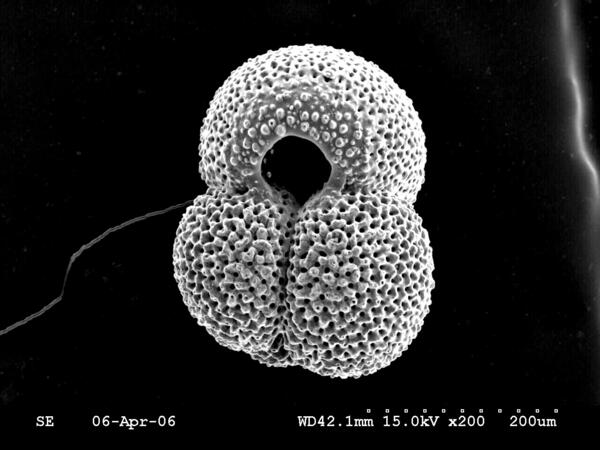
Scanning electron microsope image of the planktic foraminifer Globigerinoides ruber
Scanning electron microsope image of the planktic foraminifer Globigerinoides ruber

Underwater photograph of Tumon Bay Marine Reserve, Guam, showing some of the amazing biologic diversity of coral reefs.
Underwater photograph of Tumon Bay Marine Reserve, Guam, showing some of the amazing biologic diversity of coral reefs.