



Sample preparation and processing area in the K.O. Emery Geotechnical Wing at the Woods Hole Coastal and Marine Science Center, Woods Hole, MA
Images
Coastal and Marine Hazards and Resources Program images.
Filter Total Items: 2490

Sample preparation and processing area
Sample preparation and processing area in the K.O. Emery Geotechnical Wing at the Woods Hole Coastal and Marine Science Center, Woods Hole, MA

Arctica islandica shells
Three Arctica islandica shells that have been washed and set out to dry.
Three Arctica islandica shells that have been washed and set out to dry.

Eroding coastal bluff on Barter Island
Photograph from a mounted time-lapse camera looking eastward along Barter Island’s north shore document how the coastal bluffs and beach changed during a single summer. The photograph shows a summer storm from the west eroding the beach (July 25, 2014).
Photograph from a mounted time-lapse camera looking eastward along Barter Island’s north shore document how the coastal bluffs and beach changed during a single summer. The photograph shows a summer storm from the west eroding the beach (July 25, 2014).
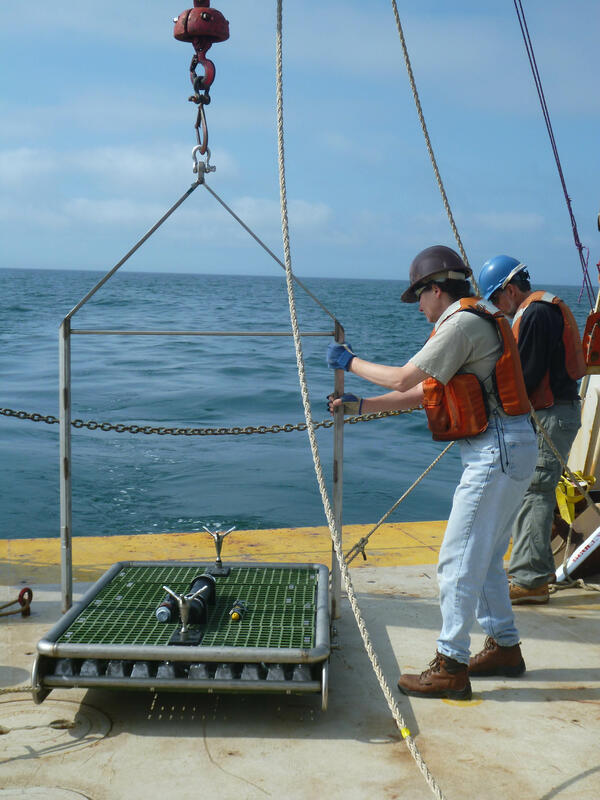
Marinna Martini prepares to deploy a NIMBBLE from the R/V Connecticut
Marinna Martini prepares to deploy a NIMBBLE from the R/V ConnecticutMarinna Martini prepares to deploy a NIMBBLE from the R/V Connecticut south of Martha's Vineyard
Marinna Martini prepares to deploy a NIMBBLE from the R/V Connecticut
Marinna Martini prepares to deploy a NIMBBLE from the R/V ConnecticutMarinna Martini prepares to deploy a NIMBBLE from the R/V Connecticut south of Martha's Vineyard

Collecting samples from a salt marsh
Jen Suttles collects water samples from a salt marsh tidal creek (East Falmouth, MA) for laboratory analysis of total organic carbon. These samples will be compared to data recorded by instrumentation deployed in an adjacent tidal creek as part of research efforts to quantify carbon dynamics in coastal ecosystems
Jen Suttles collects water samples from a salt marsh tidal creek (East Falmouth, MA) for laboratory analysis of total organic carbon. These samples will be compared to data recorded by instrumentation deployed in an adjacent tidal creek as part of research efforts to quantify carbon dynamics in coastal ecosystems

Salt Marsh Observatory at Sage Lot Pond in the Waquoit Bay, MA
Salt Marsh Observatory at Sage Lot Pond in the Waquoit Bay, MAThe Salt Marsh Observatory at Sage Lot Pond in the Waquoit Bay National Estuarine Research Reserve serves as an important platform for research in coastal salt marshes. Infrastrucutre in this marsh allows researchers to access sites while maintaining habitat and platform health.
Salt Marsh Observatory at Sage Lot Pond in the Waquoit Bay, MA
Salt Marsh Observatory at Sage Lot Pond in the Waquoit Bay, MAThe Salt Marsh Observatory at Sage Lot Pond in the Waquoit Bay National Estuarine Research Reserve serves as an important platform for research in coastal salt marshes. Infrastrucutre in this marsh allows researchers to access sites while maintaining habitat and platform health.

A Sontek IQ ADCP measures depth and velocity of a salt marsh creek
A Sontek IQ ADCP measures depth and velocity of a salt marsh creekA Sontek IQ ADCP measures depth and velocity of a salt marsh creek (Cape Cod, MA)
A Sontek IQ ADCP measures depth and velocity of a salt marsh creek
A Sontek IQ ADCP measures depth and velocity of a salt marsh creekA Sontek IQ ADCP measures depth and velocity of a salt marsh creek (Cape Cod, MA)

USGS studies long-term change of beaches and dunes at Fire Island
USGS studies long-term change of beaches and dunes at Fire IslandResearchers at the USGS study the long-term change of the beaches and dunes at Fire Island, NY.
USGS studies long-term change of beaches and dunes at Fire Island
USGS studies long-term change of beaches and dunes at Fire IslandResearchers at the USGS study the long-term change of the beaches and dunes at Fire Island, NY.

Sara Zeigler (USGS) uses the smartphone data collection app ‘iPlover’
Sara Zeigler (USGS) uses the smartphone data collection app ‘iPlover’Sara Zeigler (USGS) uses the smartphone data collection app ‘iPlover’ to classify the landscape characteristics in an area immediately surrounding a piping plover nest (here, protected with a black mesh predator exclosure).
Sara Zeigler (USGS) uses the smartphone data collection app ‘iPlover’
Sara Zeigler (USGS) uses the smartphone data collection app ‘iPlover’Sara Zeigler (USGS) uses the smartphone data collection app ‘iPlover’ to classify the landscape characteristics in an area immediately surrounding a piping plover nest (here, protected with a black mesh predator exclosure).


Area Closed
USGS scientists are working to model shorebird habitat availability both today and in the future, given processes like sea-level rise, in an effort to support the efficient management of beaches for both people and nesting shorebirds. This photo shows an area on the Rockaway Peninsula where high quality shorebird habitat has been closed off to beach recreation.
USGS scientists are working to model shorebird habitat availability both today and in the future, given processes like sea-level rise, in an effort to support the efficient management of beaches for both people and nesting shorebirds. This photo shows an area on the Rockaway Peninsula where high quality shorebird habitat has been closed off to beach recreation.

Gateway National Recreation Area shown here on the Rockaway Peninsula
Gateway National Recreation Area shown here on the Rockaway PeninsulaThe beach-dependent shorebirds project at the Woods Hole Coastal and Marine Science Center models current and future habitat availability for nesting shorebirds in an effort to map current and likely future habitat availability on a range of sites along the U.S. Atlantic coast.
Gateway National Recreation Area shown here on the Rockaway Peninsula
Gateway National Recreation Area shown here on the Rockaway PeninsulaThe beach-dependent shorebirds project at the Woods Hole Coastal and Marine Science Center models current and future habitat availability for nesting shorebirds in an effort to map current and likely future habitat availability on a range of sites along the U.S. Atlantic coast.

Polar bear in Chukchi Sea
Polar bear climbing onto the sea ice after a swim in the Chukchi Sea off the northwest coast of Alaska. USGS photograph taken June 15, 2014.
Polar bear climbing onto the sea ice after a swim in the Chukchi Sea off the northwest coast of Alaska. USGS photograph taken June 15, 2014.

Polar bear in Chukchi Sea
Polar bear lying on the sea ice to dry off after a swim in the Chukchi Sea, Alaska. USGS photograph taken June 15, 2014.
Polar bear lying on the sea ice to dry off after a swim in the Chukchi Sea, Alaska. USGS photograph taken June 15, 2014.

North shore of Barter Island on Alaska’s Arctic coast
North shore of Barter Island on Alaska’s Arctic coastPhoto from a time-lapse camera looking eastward along the north shore of Barter Island on Alaska’s Arctic coast, June 15, 2014. View the complete time-lapse sequence to see how the coastal bluffs and beach changed during a single summer.
North shore of Barter Island on Alaska’s Arctic coast
North shore of Barter Island on Alaska’s Arctic coastPhoto from a time-lapse camera looking eastward along the north shore of Barter Island on Alaska’s Arctic coast, June 15, 2014. View the complete time-lapse sequence to see how the coastal bluffs and beach changed during a single summer.

USGS collects repeat geophysical data in the nearshore at Fire Island
USGS collects repeat geophysical data in the nearshore at Fire IslandUSGS researchers collect repeat geophysical data from the nearshore at Fire Island, NY to study bathymetric change over time.
USGS collects repeat geophysical data in the nearshore at Fire Island
USGS collects repeat geophysical data in the nearshore at Fire IslandUSGS researchers collect repeat geophysical data from the nearshore at Fire Island, NY to study bathymetric change over time.

The U.S. Army Corps of Engineers’ Lighter Amphibious Resupply Cargo
The U.S. Army Corps of Engineers’ Lighter Amphibious Resupply CargoThe U.S. Army Corps of Engineers’ Lighter Amphibious Resupply Cargo (LARC) survey vessel towed an Edgetech chirp 512i subbottom profiler mounted on a catamaran sled.
The U.S. Army Corps of Engineers’ Lighter Amphibious Resupply Cargo
The U.S. Army Corps of Engineers’ Lighter Amphibious Resupply CargoThe U.S. Army Corps of Engineers’ Lighter Amphibious Resupply Cargo (LARC) survey vessel towed an Edgetech chirp 512i subbottom profiler mounted on a catamaran sled.

Amphibious vehicle used to collect shoreface sub-bottom data
Amphibious vehicle used to collect shoreface sub-bottom dataUSGS scientist Jennifer Miselis stands on board the US Army Corps of Engineers' (USACE) Lighter Amphibious Resupply Cargo (LARC). USGS collaborated with USACE to analyze coastal change due to Hurricane Sandy. Miselis is preparing to deploy a Chirp sub-bottom profiling system with a towfish attached in between the pontoons to collect sub-seafloor geological data.
Amphibious vehicle used to collect shoreface sub-bottom data
Amphibious vehicle used to collect shoreface sub-bottom dataUSGS scientist Jennifer Miselis stands on board the US Army Corps of Engineers' (USACE) Lighter Amphibious Resupply Cargo (LARC). USGS collaborated with USACE to analyze coastal change due to Hurricane Sandy. Miselis is preparing to deploy a Chirp sub-bottom profiling system with a towfish attached in between the pontoons to collect sub-seafloor geological data.

Eroded dunes on Fire Island, New York, two years after Hurricane Sandy
Eroded dunes on Fire Island, New York, two years after Hurricane SandyEroded dunes on Fire Island, New York, nearly two years after Hurricane Sandy.
Eroded dunes on Fire Island, New York, two years after Hurricane Sandy
Eroded dunes on Fire Island, New York, two years after Hurricane SandyEroded dunes on Fire Island, New York, nearly two years after Hurricane Sandy.

Preparing for Coastal Research at Fire Island
A crew of USGS scientists prepares equipment, including personal watercraft, to collect nearshore bathymetry and sub-surface geology data to assess the impacts of Hurricane Sandy.
A crew of USGS scientists prepares equipment, including personal watercraft, to collect nearshore bathymetry and sub-surface geology data to assess the impacts of Hurricane Sandy.

Bird Island
Highly diverse and resilient reef within Bird Island Marine Protected Area, Saipan, Commonwealth of the Northern Marianas Islands.
Highly diverse and resilient reef within Bird Island Marine Protected Area, Saipan, Commonwealth of the Northern Marianas Islands.