U.S. flag

An official website of the United States government

Images

Coastal and Marine Hazards and Resources Program images.

Filter Total Items: 2387
Map showing the thickness of a relatively young Pleistocene outwash lobe
Map showing the thickness of a relatively young Pleistocene outwash


Map showing the thickness of a relatively young Pleistocene outwash lobe in meters mapped using chirp seismic-reflection profiles collected in 2011, overlain on acoustic backscatter imagery. Regional bathymetric contours are in meters.


Map showing the thickness of a relatively young Pleistocene outwash lobe in meters mapped using chirp seismic-reflection profiles collected in 2011, overlain on acoustic backscatter imagery. Regional bathymetric contours are in meters.

Numerical model grids

Numerical model grids showing downscaling from larger regional grid (far right) to more refined coastal grid (left). Colors are bathymetry (m).

Numerical model grids showing downscaling from larger regional grid (far right) to more refined coastal grid (left). Colors are bathymetry (m).

Example of a rip current experiment.

Example of a rip current experiment. Colors show bathymetry and arrows show velocity vectors after 1 h of model simulation. Similar to results in Kumar and others, 2012.

Example of a rip current experiment. Colors show bathymetry and arrows show velocity vectors after 1 h of model simulation. Similar to results in Kumar and others, 2012.

2 images of the same section of coastline before and after the storm; an arrow shows the same feature on each
Oblique aerial photographs of Ocracoke Island, NC

Oblique aerial photographs of Ocracoke Island, NC, from May 6, 2008 (top, pre-storm) and August 30, 2011 (bottom, post-storm, acquired three days after landfall of Hurricane Irene). The yellow arrow in each image points to the same feature. Overwash deposits of sand extend over the road after the storm.

Oblique aerial photographs of Ocracoke Island, NC, from May 6, 2008 (top, pre-storm) and August 30, 2011 (bottom, post-storm, acquired three days after landfall of Hurricane Irene). The yellow arrow in each image points to the same feature. Overwash deposits of sand extend over the road after the storm.

3 images of the same section of coastline pre- and post-storm with enlarged details; an arrow shows the same feature on each
Oblique aerial photograph from Rodanthe, NC, with enlarged details

Upper image: Oblique aerial photograph near Rodanthe, NC, looking south along the coast on August 30, 2011, three days after landfall of Hurricane Irene. Center: Oblique aerial photograph of central part of upper image from May 6, 2008, pre-storm; and August 31, 2011, post-storm. The yellow arrow in each image points to the same cottage.

Upper image: Oblique aerial photograph near Rodanthe, NC, looking south along the coast on August 30, 2011, three days after landfall of Hurricane Irene. Center: Oblique aerial photograph of central part of upper image from May 6, 2008, pre-storm; and August 31, 2011, post-storm. The yellow arrow in each image points to the same cottage.

3 images of the same section of coastline pre- and post-storm with enlarged details; an arrow shows the same feature on each
Oblique aerial photograph from Pea Island, NC, with enlarged details

Upper image: Oblique aerial photograph of Pea Island National Wildlife Refuge, NC, looking north along the coast on August 30, 2011, three days after landfall of Hurricane Irene.

Schematic of system designed to control movement and logging of data

Schematic of system designed to control movement and logging of data collected by the Moving Arm Tripod at Martha's Vineyard Coastal Observatory in 2011.


A smiling woman crouching down on a tile floor points to a fossil that is embedded within one of the tiles.
Ammonite fossil in Washington DC office building

Susan Russell-Robinson points out a fossil ammonite in the limestone floor tiles of the Eisenhower Executive Office Building in Washington, D.C.

Map showing Holocene (modern) sediment thickness in meters
Map showing Holocene (modern) sediment thickness

Map showing Holocene (modern) sediment thickness in meters overlain on bathymetry. Regional bathymetric contours are in meters. Note the shoreface-attached sand ridges west of Watch Hill.

Map showing Holocene (modern) sediment thickness in meters overlain on bathymetry. Regional bathymetric contours are in meters. Note the shoreface-attached sand ridges west of Watch Hill.

Computer-generated illustration of high-resolution seafloor maps created with data collected.
San Diego Trough fault

Bird's-eye view map of a section of the seafloor off southern California, made with depth data. The map shows a channel wall that has been cut by the San Diego Trough fault and moved about 20 meters. This feature is about 1,000 meters below sea level.

Bird's-eye view map of a section of the seafloor off southern California, made with depth data. The map shows a channel wall that has been cut by the San Diego Trough fault and moved about 20 meters. This feature is about 1,000 meters below sea level.

Map of backscatter intensity and sun-illuminated topography on Stellwagen Bank
Backscatter intensity on Stellwagen Bank

Map C.  Backscatter intensity and sun-illuminated topography.  Blue= "soft" seabed, Green, orange = "hard" seabed

2 images of the same section of coastline before and after the storm; an arrow shows the same feature on each
Oblique aerial photographs of Hatteras Village, NC

Oblique aerial photographs of Hatteras Village, NC, from May 6, 2008 (top, pre-storm) and August 30, 2011(bottom, post-storm, acquired three days after landfall of Hurricane Irene). The yellow arrow in each image points to the same cottage.

Oblique aerial photographs of Hatteras Village, NC, from May 6, 2008 (top, pre-storm) and August 30, 2011(bottom, post-storm, acquired three days after landfall of Hurricane Irene). The yellow arrow in each image points to the same cottage.

Satellite image of an island showing its terrain, some land features like runways and towns, and the bright shallow waters.
Guam satellite image

Satellite photo of Guam from NASA’s Earth Observing-1 (EO-1) satellite's Advanced Land Imager.

Satellite photo of Guam from NASA’s Earth Observing-1 (EO-1) satellite's Advanced Land Imager.

A steel-hulled boat motors slowly through a waterway surrounded by marsh grasses.
R/V Parke Snavely in Alviso Slough

USGS Pacific Coastal and Marine Science Center's research vessel R/V Parke Sanvely motors through Alviso Slough in the southern end of San Francisco Bay. Scientists were collecting depth data to make a detailed bathymetric map of the Bay.

USGS Pacific Coastal and Marine Science Center's research vessel R/V Parke Sanvely motors through Alviso Slough in the southern end of San Francisco Bay. Scientists were collecting depth data to make a detailed bathymetric map of the Bay.

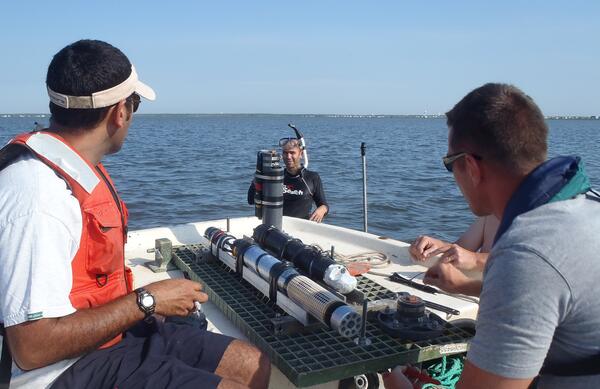
Image of oceanographic equipment platform deployed off the coast of Martha's Vineyard
Oceanographic equipment customized to reach the benthic boundary layer

Steaming to the deployment site south of Martha's Vineyard, MA in 2011. The platform shown was specially adapted so the arm cycles up and down through the Benthic Boubdary Layer while deployed on the seafloor.  For more information see https://soundwaves.usgs.gov/2011/11/fieldwork2.html.

Was this page helpful?