
Minerals Resources Life Cycle Integrated Science Team
Sampling in the Animas River, Colorado
The Minerals Resources Life Cycle Integrated Science Team focuses on contaminant exposures in the environment that might originate from mineral resource activities including, transportation, storage, extraction and waste management. Perceived health risks to humans and other organisms will be distinguished from actual risks, if any. If actual risks are identified the science produced by this team can inform how to economically and effectively minimize exposures by providing scientific data and understandings about the environmental transport, fate, and exposure pathways of contaminants.
Mineral mining is an essential part of a healthy economy. U.S. mines produced an estimated \$75.2 billion in nonfuel minerals during 2017 including industrial minerals, aggregates, and metals. The mining industry and government regulators work together to prevent the release of contaminants such as metals into the environment from mining activities.
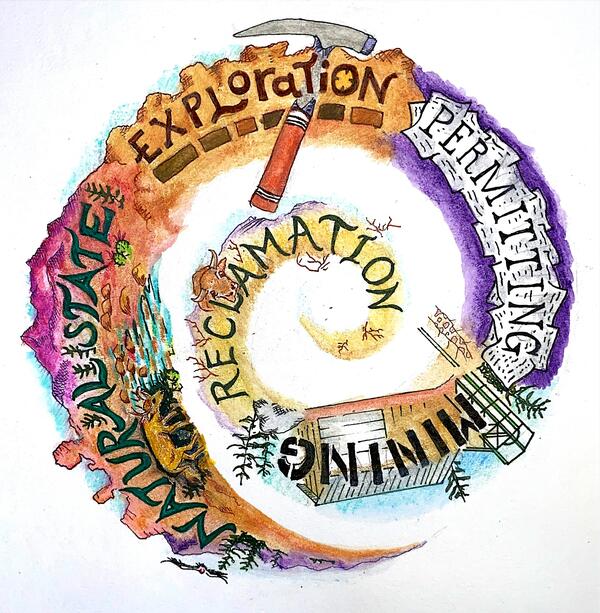
The USGS Minerals Integrated Science Team (IST), a part of the Environmental Health Program, in the Ecosystems Mission Area focuses on the lifecycle of metals and radionuclides in the environment to inform best management practices for waste materials associated with mineral extraction including transportation, storage, recycling of materials, and other activities where there are perceived or actual hazards from contaminant exposures originating from mineral resource activities.
The team works to distinguish naturally sourced toxicants in the environment from those that may originate from mineral resource activities. They use this information to understand fish, wildlife, and human exposure and to determine If their are health risks upon exposure. If health risks are identified, this Team will inform how to economically and effectively minimize risk by providing scientific data and understandings about the environmental transport, fate, and exposure pathways of contaminants. The team also directly addresses the 2012 DOI Record of Decision to understand actual versus perceived risks due to uranium mining in the Grand Canyon region. Much of this work is driven by concerns over potential mining impacts to the Grand Canyon, its natural resources, and Tribal members.
Research is accomplished at a range of scales, including laboratory-based studies, modeling, and targeted field studies in watersheds across the Nation to collectively deliver science on exposures and risks to wildlife, humans, ecosystems, and water resources. The team is unique in that it bring together geologists, hydrologists, biologists, chemists, microbiologists, ecologists, toxicologists, and geophysicists from across USGS to address this science.
The team provides science to support the utilization and protection of our Nation’s resources.
- Identify hydrologic, geochemical and biological processes that govern the source, transport, and fate of metals and radionuclides as determinants of ecosystem health
- Characterize the geochemical and biological processes governing the environmental fate, exposure, bioaccumulation, and effects of metals to reduce uncertainty and to inform risk assessment
- Characterize transport pathways of mining-related contaminants in abiotic and biotic media to improve understanding of exposure pathways and biological effects of uranium and co-occurring elements related to uranium mines in the Grand Canyon watershed.
- Develop methods and execute a geo-environmental assessment of developing undiscovered uranium deposits in the Texas Gulf coast uranium province
- Investigate multi-metal exposures, critical minerals, and multi-stressor effects on ecosystems influenced by mineral resource extraction and processing
Uranium in Springs Sampled Near the Grand Canyon Likely from Natural Sources
Processes Controlling Groundwater Quality in Uranium In-Situ Recovery (ISR) Mining
Uranium in Groundwater
Study Reveals Processes that Control Uranium Bioavailability in a Freshwater Snail—Relevance to Aquatic Biota in the Grand Canyon Area
Assessing Impacts to Ecosystems from Uranium Mining in the Grand Canyon Region
Watershed Contamination from Metal and Uranium Mining
U.S. Geological Survey Develops Approach to Assess Baseline Chemical and Radiological Conditions Prior to Uranium Mining near Grand Canyon National Park
The following are the data releases from this science team’s research activities.
Chemistry data for assessment of the containment pond at Pinyon Plain Mine, 2023-2024 Chemistry data for assessment of the containment pond at Pinyon Plain Mine, 2023-2024
Atmospheric fallout radionuclide data for soil cores from four uranium mine sites, Mohave County, Arizona, November 2018 Atmospheric fallout radionuclide data for soil cores from four uranium mine sites, Mohave County, Arizona, November 2018
Low flow water quality data for the Animas River, Arrastra Creek to Silverton, Colorado, September 2021 Low flow water quality data for the Animas River, Arrastra Creek to Silverton, Colorado, September 2021
Chemistry data for assessment of the containment pond at Pinyon Plain Mine, 2022 Chemistry data for assessment of the containment pond at Pinyon Plain Mine, 2022
Chemistry data for assessment of the containment pond at Pinyon Plain Mine, 2021 Chemistry data for assessment of the containment pond at Pinyon Plain Mine, 2021
Data used for developing a composite hydrogeologic framework for inclusion in a geoenvironmental assessment of undiscovered uranium resources in Pliocene- to Pleistocene-age geologic units of the Texas Coastal Plain Data used for developing a composite hydrogeologic framework for inclusion in a geoenvironmental assessment of undiscovered uranium resources in Pliocene- to Pleistocene-age geologic units of the Texas Coastal Plain
Data Compiled on historical water use, spatial land disturbance, aquifer disturbance and uranium produced by In Situ Recovery of Uranium from Sandstone Hosted Uranium Deposits in the South Texas Coastal Plain, USA Data Compiled on historical water use, spatial land disturbance, aquifer disturbance and uranium produced by In Situ Recovery of Uranium from Sandstone Hosted Uranium Deposits in the South Texas Coastal Plain, USA
Biogeochemical data of water, sediments, periphyton, and macroinvertebrates collected from springs in and near Grand Canyon National Park, Arizona (ver. 4.0, October 2022) Biogeochemical data of water, sediments, periphyton, and macroinvertebrates collected from springs in and near Grand Canyon National Park, Arizona (ver. 4.0, October 2022)
Hydrologic and Geochemical Data and Models Supporting Integrated Evaluation of the Captain Jack Superfund Site, Boulder County, Colorado Hydrologic and Geochemical Data and Models Supporting Integrated Evaluation of the Captain Jack Superfund Site, Boulder County, Colorado
Data acquired in laboratory experiments conducted with the stonefly Zapada sp. and the ephemerellid mayflies Drunella sp. and Ephemerella tibialis to characterize uptake and surface adsorption after short aqueous exposures to uranium, 2017-2019 Data acquired in laboratory experiments conducted with the stonefly Zapada sp. and the ephemerellid mayflies Drunella sp. and Ephemerella tibialis to characterize uptake and surface adsorption after short aqueous exposures to uranium, 2017-2019
Stream discharge, sodium, bromide, and specific conductance data for stream and hyporheic zone samples affected by injection of sodium bromide tracer, Leavenworth Creek, Clear Creek County, Colorado, August 2012 Stream discharge, sodium, bromide, and specific conductance data for stream and hyporheic zone samples affected by injection of sodium bromide tracer, Leavenworth Creek, Clear Creek County, Colorado, August 2012
U-Pb age determinations of uraninite by electron microprobe analyses of ore samples from two solution-collapse breccia pipe uranium deposits, Grand Canyon region, northwest Arizona, USA U-Pb age determinations of uraninite by electron microprobe analyses of ore samples from two solution-collapse breccia pipe uranium deposits, Grand Canyon region, northwest Arizona, USA
Below are publications associated with this science team.
Water resources related to breccia pipe uranium mining in the Grand Canyon region Water resources related to breccia pipe uranium mining in the Grand Canyon region
Uranium mining, the Grand Canyon region, and the science of an ecosystem Uranium mining, the Grand Canyon region, and the science of an ecosystem
Tracing metal sources and groundwater flow paths in the Upper Animas River watershed using rare earth elements and stable isotopes Tracing metal sources and groundwater flow paths in the Upper Animas River watershed using rare earth elements and stable isotopes
Balancing natural resource use and extraction of uranium and other elements in the Grand Canyon region Balancing natural resource use and extraction of uranium and other elements in the Grand Canyon region
Havasuw baj gwawg gnavg Havasuw baj gwawg gnavg
Conceptual risk framework—Havasupai perspective Conceptual risk framework—Havasupai perspective
Contaminant exposure framework—Havasupai perspective Contaminant exposure framework—Havasupai perspective
PFAS river export analysis highlights the urgent need for catchment-scale mass loading data PFAS river export analysis highlights the urgent need for catchment-scale mass loading data
Expanded conceptual risk framework for uranium mining in Grand Canyon watershed—Inclusion of the Havasupai Tribe perspective Expanded conceptual risk framework for uranium mining in Grand Canyon watershed—Inclusion of the Havasupai Tribe perspective
Nitrate-stimulated release of naturally occurring sedimentary uranium Nitrate-stimulated release of naturally occurring sedimentary uranium
Hydrologic compartmentalization and analytic-element groundwater-flow simulations for a draining mine tunnel Hydrologic compartmentalization and analytic-element groundwater-flow simulations for a draining mine tunnel
Outlining potential biomarkers of exposure and effect to critical minerals: Nutritionally essential trace elements and the rare earth elements Outlining potential biomarkers of exposure and effect to critical minerals: Nutritionally essential trace elements and the rare earth elements
The Minerals Resources Life Cycle Integrated Science Team focuses on contaminant exposures in the environment that might originate from mineral resource activities including, transportation, storage, extraction and waste management. Perceived health risks to humans and other organisms will be distinguished from actual risks, if any. If actual risks are identified the science produced by this team can inform how to economically and effectively minimize exposures by providing scientific data and understandings about the environmental transport, fate, and exposure pathways of contaminants.
Mineral mining is an essential part of a healthy economy. U.S. mines produced an estimated \$75.2 billion in nonfuel minerals during 2017 including industrial minerals, aggregates, and metals. The mining industry and government regulators work together to prevent the release of contaminants such as metals into the environment from mining activities.
The USGS Minerals Integrated Science Team (IST), a part of the Environmental Health Program, in the Ecosystems Mission Area focuses on the lifecycle of metals and radionuclides in the environment to inform best management practices for waste materials associated with mineral extraction including transportation, storage, recycling of materials, and other activities where there are perceived or actual hazards from contaminant exposures originating from mineral resource activities.
The team works to distinguish naturally sourced toxicants in the environment from those that may originate from mineral resource activities. They use this information to understand fish, wildlife, and human exposure and to determine If their are health risks upon exposure. If health risks are identified, this Team will inform how to economically and effectively minimize risk by providing scientific data and understandings about the environmental transport, fate, and exposure pathways of contaminants. The team also directly addresses the 2012 DOI Record of Decision to understand actual versus perceived risks due to uranium mining in the Grand Canyon region. Much of this work is driven by concerns over potential mining impacts to the Grand Canyon, its natural resources, and Tribal members.
Research is accomplished at a range of scales, including laboratory-based studies, modeling, and targeted field studies in watersheds across the Nation to collectively deliver science on exposures and risks to wildlife, humans, ecosystems, and water resources. The team is unique in that it bring together geologists, hydrologists, biologists, chemists, microbiologists, ecologists, toxicologists, and geophysicists from across USGS to address this science.
The team provides science to support the utilization and protection of our Nation’s resources.
- Identify hydrologic, geochemical and biological processes that govern the source, transport, and fate of metals and radionuclides as determinants of ecosystem health
- Characterize the geochemical and biological processes governing the environmental fate, exposure, bioaccumulation, and effects of metals to reduce uncertainty and to inform risk assessment
- Characterize transport pathways of mining-related contaminants in abiotic and biotic media to improve understanding of exposure pathways and biological effects of uranium and co-occurring elements related to uranium mines in the Grand Canyon watershed.
- Develop methods and execute a geo-environmental assessment of developing undiscovered uranium deposits in the Texas Gulf coast uranium province
- Investigate multi-metal exposures, critical minerals, and multi-stressor effects on ecosystems influenced by mineral resource extraction and processing
Uranium in Springs Sampled Near the Grand Canyon Likely from Natural Sources
Processes Controlling Groundwater Quality in Uranium In-Situ Recovery (ISR) Mining
Uranium in Groundwater
Study Reveals Processes that Control Uranium Bioavailability in a Freshwater Snail—Relevance to Aquatic Biota in the Grand Canyon Area
Assessing Impacts to Ecosystems from Uranium Mining in the Grand Canyon Region
Watershed Contamination from Metal and Uranium Mining
U.S. Geological Survey Develops Approach to Assess Baseline Chemical and Radiological Conditions Prior to Uranium Mining near Grand Canyon National Park
The following are the data releases from this science team’s research activities.
Chemistry data for assessment of the containment pond at Pinyon Plain Mine, 2023-2024 Chemistry data for assessment of the containment pond at Pinyon Plain Mine, 2023-2024
Atmospheric fallout radionuclide data for soil cores from four uranium mine sites, Mohave County, Arizona, November 2018 Atmospheric fallout radionuclide data for soil cores from four uranium mine sites, Mohave County, Arizona, November 2018
Low flow water quality data for the Animas River, Arrastra Creek to Silverton, Colorado, September 2021 Low flow water quality data for the Animas River, Arrastra Creek to Silverton, Colorado, September 2021
Chemistry data for assessment of the containment pond at Pinyon Plain Mine, 2022 Chemistry data for assessment of the containment pond at Pinyon Plain Mine, 2022
Chemistry data for assessment of the containment pond at Pinyon Plain Mine, 2021 Chemistry data for assessment of the containment pond at Pinyon Plain Mine, 2021
Data used for developing a composite hydrogeologic framework for inclusion in a geoenvironmental assessment of undiscovered uranium resources in Pliocene- to Pleistocene-age geologic units of the Texas Coastal Plain Data used for developing a composite hydrogeologic framework for inclusion in a geoenvironmental assessment of undiscovered uranium resources in Pliocene- to Pleistocene-age geologic units of the Texas Coastal Plain
Data Compiled on historical water use, spatial land disturbance, aquifer disturbance and uranium produced by In Situ Recovery of Uranium from Sandstone Hosted Uranium Deposits in the South Texas Coastal Plain, USA Data Compiled on historical water use, spatial land disturbance, aquifer disturbance and uranium produced by In Situ Recovery of Uranium from Sandstone Hosted Uranium Deposits in the South Texas Coastal Plain, USA
Biogeochemical data of water, sediments, periphyton, and macroinvertebrates collected from springs in and near Grand Canyon National Park, Arizona (ver. 4.0, October 2022) Biogeochemical data of water, sediments, periphyton, and macroinvertebrates collected from springs in and near Grand Canyon National Park, Arizona (ver. 4.0, October 2022)
Hydrologic and Geochemical Data and Models Supporting Integrated Evaluation of the Captain Jack Superfund Site, Boulder County, Colorado Hydrologic and Geochemical Data and Models Supporting Integrated Evaluation of the Captain Jack Superfund Site, Boulder County, Colorado
Data acquired in laboratory experiments conducted with the stonefly Zapada sp. and the ephemerellid mayflies Drunella sp. and Ephemerella tibialis to characterize uptake and surface adsorption after short aqueous exposures to uranium, 2017-2019 Data acquired in laboratory experiments conducted with the stonefly Zapada sp. and the ephemerellid mayflies Drunella sp. and Ephemerella tibialis to characterize uptake and surface adsorption after short aqueous exposures to uranium, 2017-2019
Stream discharge, sodium, bromide, and specific conductance data for stream and hyporheic zone samples affected by injection of sodium bromide tracer, Leavenworth Creek, Clear Creek County, Colorado, August 2012 Stream discharge, sodium, bromide, and specific conductance data for stream and hyporheic zone samples affected by injection of sodium bromide tracer, Leavenworth Creek, Clear Creek County, Colorado, August 2012
U-Pb age determinations of uraninite by electron microprobe analyses of ore samples from two solution-collapse breccia pipe uranium deposits, Grand Canyon region, northwest Arizona, USA U-Pb age determinations of uraninite by electron microprobe analyses of ore samples from two solution-collapse breccia pipe uranium deposits, Grand Canyon region, northwest Arizona, USA
Below are publications associated with this science team.