Updating methods for postfire debris-flow hazard assessment
Updating methods for postfire debris-flow hazard assessmentFor more than a decade, the U.S.


Official websites use .gov
A .gov website belongs to an official government organization in the United States.

Secure .gov websites use HTTPS
A lock () or https:// means you’ve safely connected to the .gov website. Share sensitive information only on official, secure websites.

Browse our videos of landslide research and post-landslide investigations.

For more than a decade, the U.S.
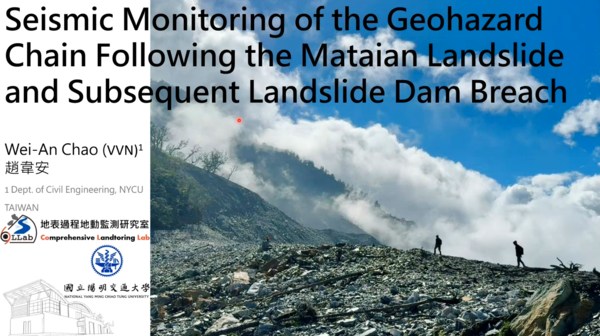
The 2025 Matai’an landslide in eastern Taiwan represents the largest landslide event ever recorded in the region and initiated a cascading hazard sequence involving landslide-dam formation and repeated dam-breach floods.
The 2025 Matai’an landslide in eastern Taiwan represents the largest landslide event ever recorded in the region and initiated a cascading hazard sequence involving landslide-dam formation and repeated dam-breach floods.
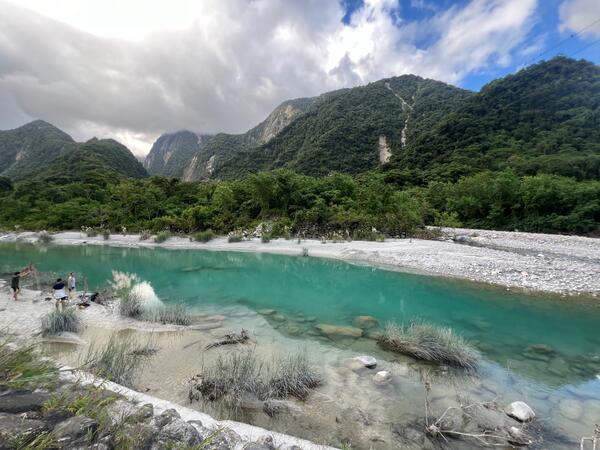
This talk focuses on cascading river hazards in Taiwan generated by landslides triggered by earthquakes and tropical cyclones. Drawing on case studies from Typhoon Morakot and the 2024 Hualien earthquake, I explore how sediment pulses move through river systems, reshaping channels and sustaining hazard long after the initial event.
This talk focuses on cascading river hazards in Taiwan generated by landslides triggered by earthquakes and tropical cyclones. Drawing on case studies from Typhoon Morakot and the 2024 Hualien earthquake, I explore how sediment pulses move through river systems, reshaping channels and sustaining hazard long after the initial event.
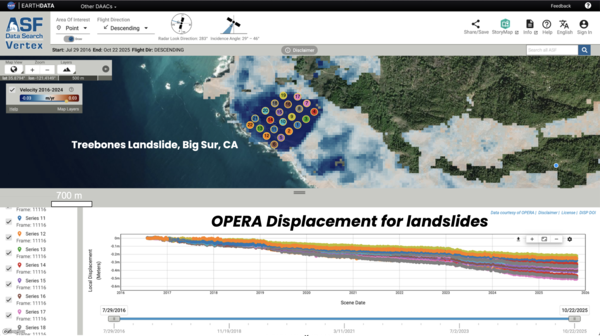
This presentation introduces NASA’s Observational Products for End-Users from Remote Sensing Analysis (OPERA) project and its suite of freely available satellite-derived products.
This presentation introduces NASA’s Observational Products for End-Users from Remote Sensing Analysis (OPERA) project and its suite of freely available satellite-derived products.

Postfire debris flows pose a hazard to human life, property, and infrastructure when they travel from steep source areas to urbanized alluvial fans or other developed areas.
Postfire debris flows pose a hazard to human life, property, and infrastructure when they travel from steep source areas to urbanized alluvial fans or other developed areas.
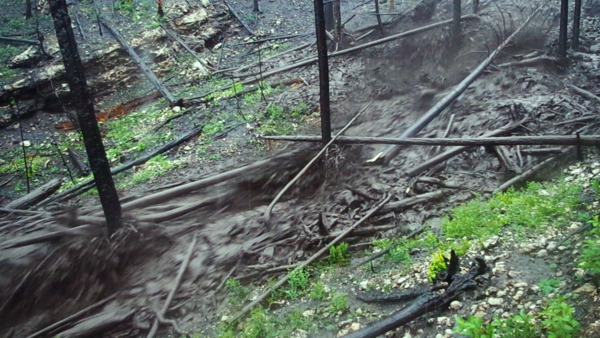
A debris flow recorded by a USGS Landslide Monitoring Station in the 2024 Elk Fire burn area near Dayton, Wyoming. The flow was triggered by intense rainfall during a thunderstorm on the evening of July 15, 2025.
A debris flow recorded by a USGS Landslide Monitoring Station in the 2024 Elk Fire burn area near Dayton, Wyoming. The flow was triggered by intense rainfall during a thunderstorm on the evening of July 15, 2025.

The frequency and scale of landslides in a region are determined by both external forcing and inherent, site-specific susceptibility.
The frequency and scale of landslides in a region are determined by both external forcing and inherent, site-specific susceptibility.

The effects of deglaciation on the slope stability of glacial valleys have increasing importance in the context of climate change, with a role on the susceptibility to large-volume rock slides or rock avalanches and catastrophic cascading geohazards.
The effects of deglaciation on the slope stability of glacial valleys have increasing importance in the context of climate change, with a role on the susceptibility to large-volume rock slides or rock avalanches and catastrophic cascading geohazards.

Wildfire often amplifies the likelihood and magnitude of debris flows in steep terrain. In arid climates (e.g. US Mountain West and Southwest), post-fire debris flows typically occur during the first rains following fire, suggesting that rainfall-driven erosion is a strong control on in-channel preconditioning and triggering of these hazards.
Wildfire often amplifies the likelihood and magnitude of debris flows in steep terrain. In arid climates (e.g. US Mountain West and Southwest), post-fire debris flows typically occur during the first rains following fire, suggesting that rainfall-driven erosion is a strong control on in-channel preconditioning and triggering of these hazards.

Atmospheric rivers (ARs) are transient channels of intense horizontal water vapor transport in the lower atmosphere.
Atmospheric rivers (ARs) are transient channels of intense horizontal water vapor transport in the lower atmosphere.

The development of a Geologic Hazards Program for the USDA Forest Service is a challenging undertaking.
The development of a Geologic Hazards Program for the USDA Forest Service is a challenging undertaking.

Debris flows occur as a result of glacial outburst floods or intense fall storms prior to snow accumulations and occur commonly at the glaciated Mount Rainier, WA. Over 60 such events have been documented since 1928, 35+ of which have occurred in Tahoma Creek on the southwest side of the park.
Debris flows occur as a result of glacial outburst floods or intense fall storms prior to snow accumulations and occur commonly at the glaciated Mount Rainier, WA. Over 60 such events have been documented since 1928, 35+ of which have occurred in Tahoma Creek on the southwest side of the park.

This video provides a brief overview of the Prince William Sound Landslide Hazards Project in Alaska. The video describes each of the congressional mandates that makes up the project tasks. This is the first video in a series about the project.
This video provides a brief overview of the Prince William Sound Landslide Hazards Project in Alaska. The video describes each of the congressional mandates that makes up the project tasks. This is the first video in a series about the project.
In the Barry Arm fjord of Alaska, repeat, high-resolution aerial and satellite data provide a unique opportunity to learn how a large bedrock landslide with a receding and thinning glacier at the toe is deforming.
In the Barry Arm fjord of Alaska, repeat, high-resolution aerial and satellite data provide a unique opportunity to learn how a large bedrock landslide with a receding and thinning glacier at the toe is deforming.

How debris flows erode and deposit material along their paths is difficult to determine in natural settings due to the lack of warning and the rapid pace at which they occur. Post-event field measurements or controlled flume experiments are commonly used to evaluate debris flows between the head and the distalmost deposit.
How debris flows erode and deposit material along their paths is difficult to determine in natural settings due to the lack of warning and the rapid pace at which they occur. Post-event field measurements or controlled flume experiments are commonly used to evaluate debris flows between the head and the distalmost deposit.

The Washington Geological Survey works to increase public and scientific understanding of landslide hazards in Washington State. One of the ways that we do this is through use of interpretive maps, illustrations, and other types of graphics. I will show several examples of these products and will discuss some of the methods used to construct them.
The Washington Geological Survey works to increase public and scientific understanding of landslide hazards in Washington State. One of the ways that we do this is through use of interpretive maps, illustrations, and other types of graphics. I will show several examples of these products and will discuss some of the methods used to construct them.

Gravity Never Sleeps - Landslide Science and Risk Reduction
By Jonathan Godt, USGS Landslide Hazards Program Coordinator
Learn About:
Gravity Never Sleeps - Landslide Science and Risk Reduction
By Jonathan Godt, USGS Landslide Hazards Program Coordinator
Learn About:

While California has been known to experience a fire-flood cycle for about a century, post-fire flood and debris-flow risks are increasing due to increases in the frequency and intensity of wildfires and storms and urbanization in fire- and flood-prone areas.
While California has been known to experience a fire-flood cycle for about a century, post-fire flood and debris-flow risks are increasing due to increases in the frequency and intensity of wildfires and storms and urbanization in fire- and flood-prone areas.

A range of flow types can be observed in steep, recently-burned terrain, but predicting the spatial distribution of debris flows resulting from a single storm event remains challenging.
A range of flow types can be observed in steep, recently-burned terrain, but predicting the spatial distribution of debris flows resulting from a single storm event remains challenging.

Optical remote sensing observations of the 2019 Ridgecrest, California, earthquake sequence revealed a significant amount of surface ejecta in the nearby Searles Lake, including one area where the surface ejecta was arranged in a repeating hexagonal “honeycomb” pattern.
Optical remote sensing observations of the 2019 Ridgecrest, California, earthquake sequence revealed a significant amount of surface ejecta in the nearby Searles Lake, including one area where the surface ejecta was arranged in a repeating hexagonal “honeycomb” pattern.

In the mid-1980s, Art Schultz (USGS, ret.) drew on experiences in the Colorado Front Range to identify numerous large, stratigraphically intact, kilometer-scale bedrock landslides on interbedded sandstone-shale dip slopes in the Virginia Valley and Ridge.
In the mid-1980s, Art Schultz (USGS, ret.) drew on experiences in the Colorado Front Range to identify numerous large, stratigraphically intact, kilometer-scale bedrock landslides on interbedded sandstone-shale dip slopes in the Virginia Valley and Ridge.