



A low-flying helicopter towing a geophysical device collects scientific data on groundwater and geology. Information collected during these surveys can help with studying critical mineral resources, natural hazards and groundwater potential.
Images
Mineral Resources Program images.
Filter Total Items: 272

Airborne Geophysical Survey Helicopter in Nevada
A low-flying helicopter towing a geophysical device collects scientific data on groundwater and geology. Information collected during these surveys can help with studying critical mineral resources, natural hazards and groundwater potential.

Critical Minerals in Landsat 9
Landsat 9 is the latest in a prestigious line of satellites that have been watching our planet for nearly 50 years. They have monitored changes on land and made that information freely available to users around the world.
Landsat 9 is the latest in a prestigious line of satellites that have been watching our planet for nearly 50 years. They have monitored changes on land and made that information freely available to users around the world.

Evidence of previous exploration
A geologist, George Case, stands in front of an adit, an entrance to an underground mine, in the Graphite Creek Deposit on the Seward Peninsula, Alaska.
A geologist, George Case, stands in front of an adit, an entrance to an underground mine, in the Graphite Creek Deposit on the Seward Peninsula, Alaska.

Navigating a slippery slope at Graphite Creek Deposit
Navigating a slippery slope at Graphite Creek DepositGeologist, Sue Karl, at Graphite Creek Deposit on the Seward Peninsula, Alaska. She is making field observations and measurements about the flake graphite deposit and the surrounding host rocks. These observations were used in developing a model of flake graphite genesis. Graphite is a critical mineral which the US depends entirely on imports.
Navigating a slippery slope at Graphite Creek Deposit
Navigating a slippery slope at Graphite Creek DepositGeologist, Sue Karl, at Graphite Creek Deposit on the Seward Peninsula, Alaska. She is making field observations and measurements about the flake graphite deposit and the surrounding host rocks. These observations were used in developing a model of flake graphite genesis. Graphite is a critical mineral which the US depends entirely on imports.

Kigluaik Mountains Gneiss Dome
View of the Kigluaik Mountains gneiss dome which is the location of the Graphite Creek Deposit. The rocks of the gneiss dome were metamorphosed to as high as granulite facies during the middle Cretaceous (ca. 100 – 90 Ma), forming flake graphite ore in the process.
View of the Kigluaik Mountains gneiss dome which is the location of the Graphite Creek Deposit. The rocks of the gneiss dome were metamorphosed to as high as granulite facies during the middle Cretaceous (ca. 100 – 90 Ma), forming flake graphite ore in the process.

A Seward Peninsula Vista
Scenic view of the Seward Peninsula, Alaska. Photo taken from a ridge above Graphite Creek, looking northwest towards the Imruk Basin. This area of the Seward Peninsula holds the largest graphite deposit in the US known as the Graphite Creek Deposit.
Scenic view of the Seward Peninsula, Alaska. Photo taken from a ridge above Graphite Creek, looking northwest towards the Imruk Basin. This area of the Seward Peninsula holds the largest graphite deposit in the US known as the Graphite Creek Deposit.

Mineral Commodity Summary February 2021
The 26th annual Mineral Commodity Summaries report from the U.S. Geological Survey National Minerals Information Center is the earliest comprehensive source of 2020 mineral production data for the world.
The 26th annual Mineral Commodity Summaries report from the U.S. Geological Survey National Minerals Information Center is the earliest comprehensive source of 2020 mineral production data for the world.

US Minerals Net Import Reliance in 2020
The United States continues to rely on foreign sources for some raw and processed mineral materials, including some critical minerals. This map shows the countries that supply mineral commodities for which the United States was more than 50% net import reliant in 2020.
The United States continues to rely on foreign sources for some raw and processed mineral materials, including some critical minerals. This map shows the countries that supply mineral commodities for which the United States was more than 50% net import reliant in 2020.
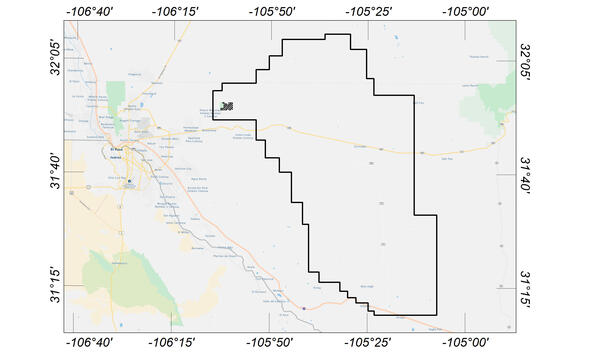
Flight area for Trans-Pecos aeromagnetic and radiometric survey
Flight area for Trans-Pecos aeromagnetic and radiometric surveyMap indicating flight area for Trans-Pecos aeromagnetic and radiometric survey. The survey area includes parts of El Paso and Hudspeth counties, Texas, and Otero County, New Mexico. Flights will begin in November 2020 and are expected to conclude in mid-January 2021.
Flight area for Trans-Pecos aeromagnetic and radiometric survey
Flight area for Trans-Pecos aeromagnetic and radiometric surveyMap indicating flight area for Trans-Pecos aeromagnetic and radiometric survey. The survey area includes parts of El Paso and Hudspeth counties, Texas, and Otero County, New Mexico. Flights will begin in November 2020 and are expected to conclude in mid-January 2021.

What minerals produce the colors in fireworks?
Mineral elements provide the color in fireworks. Barium produces bright greens; strontium yields deep reds; copper produces blues; and sodium yields yellow. Other colors can be made by mixing elements: strontium and sodium produce brilliant orange; titanium, zirconium, and magnesium alloys make silvery white; copper and strontium make lavender.
Mineral elements provide the color in fireworks. Barium produces bright greens; strontium yields deep reds; copper produces blues; and sodium yields yellow. Other colors can be made by mixing elements: strontium and sodium produce brilliant orange; titanium, zirconium, and magnesium alloys make silvery white; copper and strontium make lavender.

Mineral Commodities February 2020
The 43rd annual Mineral Commodity Summaries report from the USGS National Minerals Information Center is the earliest comprehensive source of 2019 world mineral production data.
The 43rd annual Mineral Commodity Summaries report from the USGS National Minerals Information Center is the earliest comprehensive source of 2019 world mineral production data.

Bokan Mountain, Alaska
Bokan Mountain, Alaska.

Gas Hydrates in Alaska 2019
The Alaska North Slope is rich in gas hydrate-bearing formations which contain significant natural gas resources. The USGS has released a geologically based assessment for how much of these resources is technically recoverable.
The Alaska North Slope is rich in gas hydrate-bearing formations which contain significant natural gas resources. The USGS has released a geologically based assessment for how much of these resources is technically recoverable.

Critical Mineral Commodities in Renewable Energy
To make America’s economy and defense more secure, the Administration has released “A Federal Strategy to Ensure Secure and Reliable Supplies of Critical Minerals.” Among other roles, these mineral commodities are vital to renewable energy infrastructure like solar panels, wind turbines, and batteries.
To make America’s economy and defense more secure, the Administration has released “A Federal Strategy to Ensure Secure and Reliable Supplies of Critical Minerals.” Among other roles, these mineral commodities are vital to renewable energy infrastructure like solar panels, wind turbines, and batteries.

Earth MRI Fact Sheet 2019-3007 Figure 1
Figure 1 from USGS Fact Sheet 2019-3007 The Earth Mapping Resources Initiative (Earth MRI): Mapping the Nation’s Critical Mineral Resources.
Figure 1 from USGS Fact Sheet 2019-3007 The Earth Mapping Resources Initiative (Earth MRI): Mapping the Nation’s Critical Mineral Resources.

Sulfide minerals
Examples of sulfide minerals that occur at hydrothermal vents and are being studied by Amy Gartman: (left to right) sphalerite, an ore of zinc that often contains iron ([Zn,Fe]S); cubes of pyrite, rich in iron (FeS2); and covellite, containing copper and sulfur (CuS).The pyrite cubes are a little more than half an inch on a side.
Examples of sulfide minerals that occur at hydrothermal vents and are being studied by Amy Gartman: (left to right) sphalerite, an ore of zinc that often contains iron ([Zn,Fe]S); cubes of pyrite, rich in iron (FeS2); and covellite, containing copper and sulfur (CuS).The pyrite cubes are a little more than half an inch on a side.

Photographs of commercial, expanded vermiculite ore.
Photographs of commercial, expanded vermiculite ore.Figure 1. Photographs of commercial, expanded vermiculite ore from the four major historical sources: Libby, Montana; Palabora, South Africa; Louisa, Virginia; and Enoree, South Carolina. Scale of the rightmost image in each set is the same as the left image unless otherwise labeled.
Photographs of commercial, expanded vermiculite ore.
Photographs of commercial, expanded vermiculite ore.Figure 1. Photographs of commercial, expanded vermiculite ore from the four major historical sources: Libby, Montana; Palabora, South Africa; Louisa, Virginia; and Enoree, South Carolina. Scale of the rightmost image in each set is the same as the left image unless otherwise labeled.

SEM Photo of Monazite Grains with REE
Monazite grains with rare earth elements lanthenum, cerium and neodinium are associated with zirconium, pyrite and potassium feldspar. Mineral identification performed by a combination of scanning of electron microscopy (SEM) and electron microprobe.
Monazite grains with rare earth elements lanthenum, cerium and neodinium are associated with zirconium, pyrite and potassium feldspar. Mineral identification performed by a combination of scanning of electron microscopy (SEM) and electron microprobe.

Minerals in Mobile Devices — Infographic
This infographic displays the different minerals located in mobile devices. Included within this infographic are:
This infographic displays the different minerals located in mobile devices. Included within this infographic are:

Silicon Carbide
Mineral: Silicon Carbide
Mineral Origin: Sample donated by Norton Company
Primary Commodity: Silica (abrasive)
Primary Commodity Uses: Just as their name implies, abrasives are used to abrade, clean, etch, grind, polish, scour, or otherwise remove material
Mineral: Silicon Carbide
Mineral Origin: Sample donated by Norton Company
Primary Commodity: Silica (abrasive)
Primary Commodity Uses: Just as their name implies, abrasives are used to abrade, clean, etch, grind, polish, scour, or otherwise remove material

Alumina-Zirconia Abrasive
Mineral: Alumina-Zirconia Abrasive
Mineral Origin: Manufactured in Huntsville, AL (Sample on loan from J.B. Hedrick)
Primary Commodity: Aluminum and zirconia
Primary Commodity Uses: This abrasive is primarily used in metal casting and the foundry process
Mineral: Alumina-Zirconia Abrasive
Mineral Origin: Manufactured in Huntsville, AL (Sample on loan from J.B. Hedrick)
Primary Commodity: Aluminum and zirconia
Primary Commodity Uses: This abrasive is primarily used in metal casting and the foundry process