U.S. flag

An official website of the United States government

Images

The National Land Imaging Program supports a variety of geospatial data programs and projects, including the USGS Landsat Program. Browse the images below to see some of the imagery produced using NLI-supported data sources.

Filter Total Items: 501
Landsat 5 Image of the Great Salt Lake in July, 1986

Natural color Landsat 5 image of the Great Salt Lake acquired on July 1, 1986. In 1986, the lake was at a record high and covered approximately 2,300 square miles and contained 30 million acre-feet of water (an acre-foot is the amount of water necessary to cover 1 acre of land with water 1 foot in depth or about 326,000 gallons).

Natural color Landsat 5 image of the Great Salt Lake acquired on July 1, 1986. In 1986, the lake was at a record high and covered approximately 2,300 square miles and contained 30 million acre-feet of water (an acre-foot is the amount of water necessary to cover 1 acre of land with water 1 foot in depth or about 326,000 gallons).

Satellite image showing algae growth
Volga River Delta at the Caspian Sea

The Volga River is the longest river in Europe and empties into the northwestern part of the Caspian Sea. The green in this image is algal bloom mixed with mud, the result of the chemical pollutants deposited in the Delta.

The Volga River is the longest river in Europe and empties into the northwestern part of the Caspian Sea. The green in this image is algal bloom mixed with mud, the result of the chemical pollutants deposited in the Delta.

Mount Elgon
Mount Elgon
Mount Elgon
Mount Elgon

Clouds encircle the lofty rim of Africa's Mount Elgon, a huge, long-extinct volcano on the border between Uganda and Kenya. The solitary volcano has one of the world's largest intact calderas, a cauldron-like central depression.

Clouds encircle the lofty rim of Africa's Mount Elgon, a huge, long-extinct volcano on the border between Uganda and Kenya. The solitary volcano has one of the world's largest intact calderas, a cauldron-like central depression.

Landsat 4 First Light Image over western Lake Erie

Landsat 4's first light image captured eastern Lake Erie, and the cities of Toledo, Detroit, and Windsor on July 25, 1982. Although the Landsat program had been collecting images of the Earth since 1972, this was the first time that the data could be depicted as a natural color image due to the new Thematic Mapper sensor onboard Landsat 4.

Landsat 4's first light image captured eastern Lake Erie, and the cities of Toledo, Detroit, and Windsor on July 25, 1982. Although the Landsat program had been collecting images of the Earth since 1972, this was the first time that the data could be depicted as a natural color image due to the new Thematic Mapper sensor onboard Landsat 4.

Landsat 4 First Light Image of Detroit

The first Landsat 4 image was acquired over western Lake Erie on July 25, 1982, just 9 days after launch. This image shows the Detroit River dividing the metropolitan areas of Detroit, Michigan and Windsor, Ontario while acting as a strait between Lake Erie and Lake St. Clair.

The first Landsat 4 image was acquired over western Lake Erie on July 25, 1982, just 9 days after launch. This image shows the Detroit River dividing the metropolitan areas of Detroit, Michigan and Windsor, Ontario while acting as a strait between Lake Erie and Lake St. Clair.

Landsat 3 First Light Image
Landsat 3 First Light Image of Northern California

One of Landsat 3’s first images, captured by the Multispectral Scanner (MSS) 4 days after launch, features a slice of Northern California on March 7, 1978. San Jose sits in Santa Clara Valley touching the southernmost portion of San Francisco. This image showcases the urbanization of the valley, which exploded in the 1970s as Silicon Valley grew.

One of Landsat 3’s first images, captured by the Multispectral Scanner (MSS) 4 days after launch, features a slice of Northern California on March 7, 1978. San Jose sits in Santa Clara Valley touching the southernmost portion of San Francisco. This image showcases the urbanization of the valley, which exploded in the 1970s as Silicon Valley grew.

Landsat 2 image of Washington DC and Baltimore area

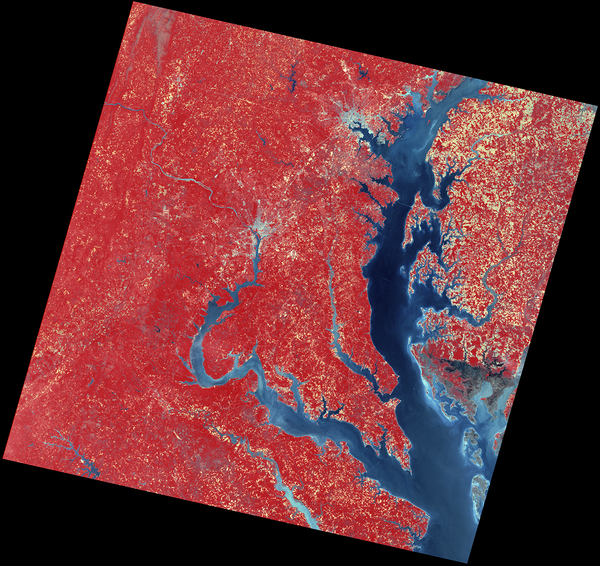
The Multispectral Scanner (MSS) onboard the Landsat 2 satellite captured the data used to create this color infrared image on May 15,1975. Chesapeake Bay leads up the image to Baltimore, Maryland, and the Potomac River leads west and north up to Washington, DC. 

The Multispectral Scanner (MSS) onboard the Landsat 2 satellite captured the data used to create this color infrared image on May 15,1975. Chesapeake Bay leads up the image to Baltimore, Maryland, and the Potomac River leads west and north up to Washington, DC. 

green and white satellite
Landsat 2 First Light Image of Drayton Valley

Landsat 2’s first light image captured Drayton Valley in Alberta, Canada on January 24, 1975. Located along Canadian Highway 22, also known as Cowboy Trail, the town’s original economy thrived on faming and logging. The discovery of the Pembina oil field in 1953 contributed to explosive growth in the sparsely populated area, w

Landsat 2’s first light image captured Drayton Valley in Alberta, Canada on January 24, 1975. Located along Canadian Highway 22, also known as Cowboy Trail, the town’s original economy thrived on faming and logging. The discovery of the Pembina oil field in 1953 contributed to explosive growth in the sparsely populated area, w

Satellite image showing a blue river and green countryside
Landsat’s Early Look at the Yangtze Delta

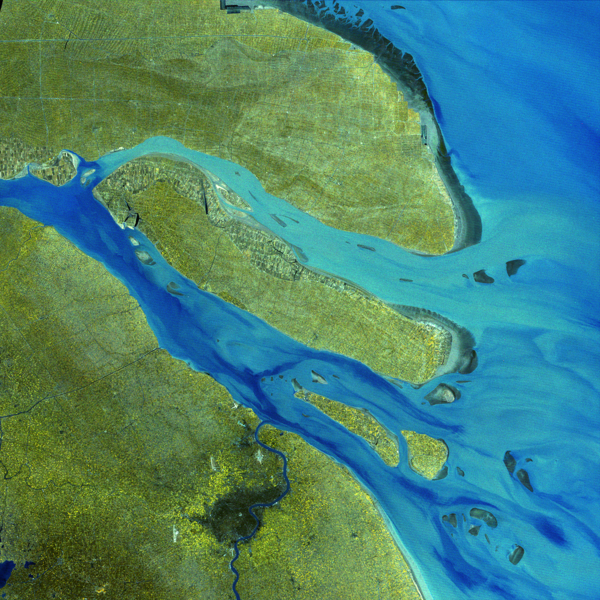
This false-color image, captured by Landsat 1 on February 13, 1974, shows the landscape around Shanghai and the Yangtze River Delta. Using bands 7 (near-infrared), 6 (red), and 5 (green), the image highlights water in dark blue, sediment-laden channels in lighter shades of blue, and vegetation in shades of yellow and green. 

This false-color image, captured by Landsat 1 on February 13, 1974, shows the landscape around Shanghai and the Yangtze River Delta. Using bands 7 (near-infrared), 6 (red), and 5 (green), the image highlights water in dark blue, sediment-laden channels in lighter shades of blue, and vegetation in shades of yellow and green. 

Landsat 2 First Light Image of Alberta Canada

Landsat 2’s first light image features a slice of Alberta, Canada, captured on January 24, 1975 on Path 047 Row 023. This false color images uses two near infrared bands and the red band (Bands 7,6,5).

Learn more about Landsat 2 by visiting the Landsat 2 Mission Web Page

Landsat 2’s first light image features a slice of Alberta, Canada, captured on January 24, 1975 on Path 047 Row 023. This false color images uses two near infrared bands and the red band (Bands 7,6,5).

Learn more about Landsat 2 by visiting the Landsat 2 Mission Web Page

Satellite image showing birds eyes views of ice, snow and water in shades of blues and black
Early Satellite View of Ross Island and McMurdo Sound

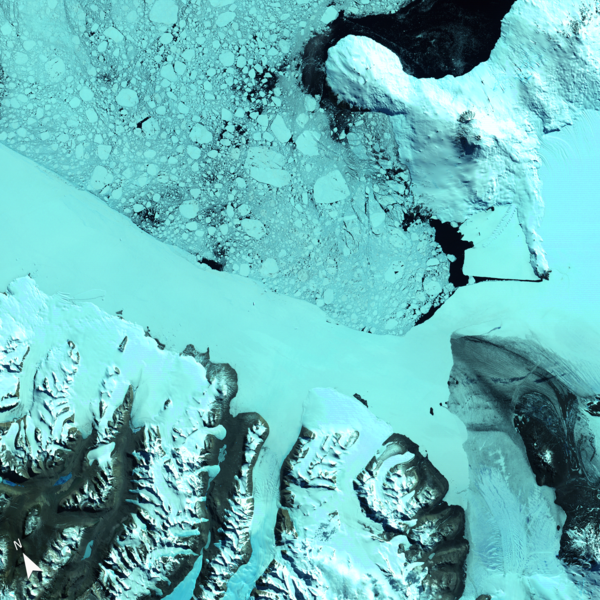
This Landsat 1 image, acquired on January 13, 1973, offers one of the earliest satellite perspectives of Antarctica’s Ross Island and McMurdo Sound. Captured using the Multispectral Scanner’s (MSS) near-infrared, red, and green bands (6, 5, 4), the image highlights the region's glaciated terrain, floating sea ice, and volcanic peaks.

This Landsat 1 image, acquired on January 13, 1973, offers one of the earliest satellite perspectives of Antarctica’s Ross Island and McMurdo Sound. Captured using the Multispectral Scanner’s (MSS) near-infrared, red, and green bands (6, 5, 4), the image highlights the region's glaciated terrain, floating sea ice, and volcanic peaks.

Satellite image of glaciers in Alaska show in colors of red and white
First Glimpse of Alaska’s Glaciers from Landsat

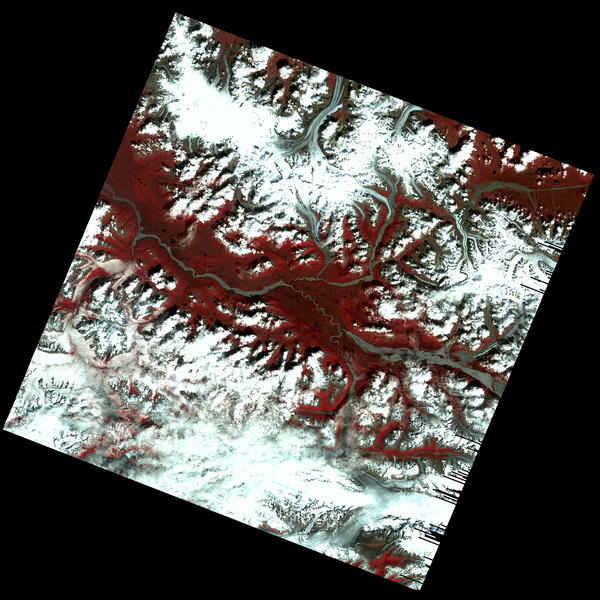
This early Landsat 1 image, acquired on July 31, 1972, captures the Kennicott, Nabesna, and Barnard Glaciers in southeastern Alaska—just a week after the satellite’s launch. Using bands 6, 5, and 4, the image reveals glacial ice, rugged mountain terrain, and braided rivers within the Wrangell–St. Elias region.

This early Landsat 1 image, acquired on July 31, 1972, captures the Kennicott, Nabesna, and Barnard Glaciers in southeastern Alaska—just a week after the satellite’s launch. Using bands 6, 5, and 4, the image reveals glacial ice, rugged mountain terrain, and braided rivers within the Wrangell–St. Elias region.

Landsat 1 image of the Dallas-Fort Worth Area

The very first image in the Landsat archive is the MSS image above, showing the Dallas - Fort Worth area of Texas on July 25, 1972. The resolution is 60 meters per pixel in this false-color image, where shades of red indicate vegetated land and grays and whites are urban or rocky surfaces.

The very first image in the Landsat archive is the MSS image above, showing the Dallas - Fort Worth area of Texas on July 25, 1972. The resolution is 60 meters per pixel in this false-color image, where shades of red indicate vegetated land and grays and whites are urban or rocky surfaces.

Landsat 1 first light image
Landsat 1 First Light Image of Texas

Dallas-Fort Worth, Texas, slid into Landsat 1's view on July 25, 1972. In this false-color image, shades of red indicate vegetated land and grays and whites are urban or rocky surfaces. The composite image is shown using the near-infrared, red and green bands (bands 7, 5, 4) at a 60 meter resolution.

Dallas-Fort Worth, Texas, slid into Landsat 1's view on July 25, 1972. In this false-color image, shades of red indicate vegetated land and grays and whites are urban or rocky surfaces. The composite image is shown using the near-infrared, red and green bands (bands 7, 5, 4) at a 60 meter resolution.

Image: Secretary Salazar Charts Future for Landsat Satellite Program
Secretary Salazar Charts Future for Landsat Satellite Program
Image: Secretary Salazar Charts Future for Landsat Satellite Program
Secretary Salazar Charts Future for Landsat Satellite Program

"As our future scientists, it is important that these students understand the Department's role in space-based science and how they can make a positive impact on the Colorado economy by pursuing high tech jobs," said Secretary Salazar. "I applaud schools like Skyline for providing the resources and training needed to create an innovative workforce."

"As our future scientists, it is important that these students understand the Department's role in space-based science and how they can make a positive impact on the Colorado economy by pursuing high tech jobs," said Secretary Salazar. "I applaud schools like Skyline for providing the resources and training needed to create an innovative workforce."

Was this page helpful?