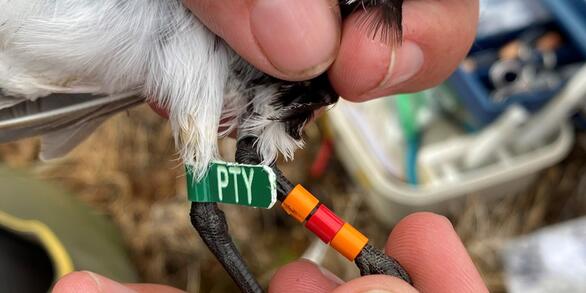
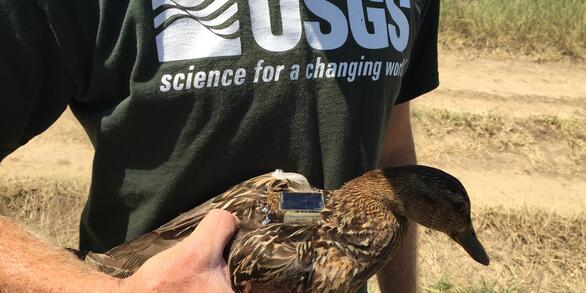
To understand information needs and respond to the many challenges in bird conservation, USGS scientists participate in Flyway committees, on Joint Venture boards and working groups, in professional organizations, and in other conservation partnerships. These activities connect USGS scientists to conservation partners with whom they work to address substantial challenges. More than one hundred USGS scientists are dedicated to the scientific study of birds.
Bird Research
Reproductive Success of Black-Crowned Night-Herons and Snowy Egrets on Alcatraz Island
Waterbird Distribution and Foraging Patterns on the Great Lakes with Respect to Avian Botulism
Boater Compliance with Established Voluntary Waterfowl Avoidance Areas on the Upper Mississippi River
Species Distributional Modeling and Spatial Patterns in Genetic Introgression: the Case of Golden-winged Warblers and Blue-winged Warblers
Evaluating Habitat Use by Pelagic Birds on the Western Great Lakes, and Airspace Use of Migrant Songbirds Near and Over the Western Great Lakes.
Energy development and the airspace
Birds as Indicators of Contaminant Exposure in the Great Lakes
The North American Breeding Bird Survey: Refining Scale to Provide New Insights
Ecology, Population Dynamics, and Translocation of the Endangered Laysan Teal
Movements and Demographic Factors Limiting Recovery of Endangered Koloa Maoli (Hawaiian Duck)
Tracking Nēnē Movements Across Park Boundaries
Status and Trends of Hawaiian Flora and Fauna
Identification of Previously Undocumented Florida Grasshopper Sparrow and Confirmation of the Current Population Status and Distribution
The ecology, behavior, and conservation of migratory birds
Monitoring Mercury's Risk to Wildlife in California Lakes
Highly Pathogenic Avian Influenza Detected for the First Time in Wild Birds in North America
Recent data (2020-2022) related to USGS migratory bird research is listed below. A complete listing of USGS migratory bird data is available from the button below.
Recent publications (2020-2022) related to USGS migratory bird research are listed below. A complete listing of USGS migratory bird publications is available from the button below.
U.S. Geological Survey—Northern Prairie Wildlife Research Center 2018 research activity report U.S. Geological Survey—Northern Prairie Wildlife Research Center 2018 research activity report
Nesting ecology of White-faced Ibis (Plegadis chihi) in Great Salt Lake, Utah Nesting ecology of White-faced Ibis (Plegadis chihi) in Great Salt Lake, Utah
GIS-Modeling of island hopping through the Philippines demonstrates trade-offs migrant grey-faced buzzards during oceanic crossings GIS-Modeling of island hopping through the Philippines demonstrates trade-offs migrant grey-faced buzzards during oceanic crossings
Migratory behavior and winter geography drive differential range shifts of eastern birds in response to recent climate change Migratory behavior and winter geography drive differential range shifts of eastern birds in response to recent climate change
Joint seasonality in geographic and ecological spaces, illustrated with a partially migratory bird Joint seasonality in geographic and ecological spaces, illustrated with a partially migratory bird
Red Knot (Calidris canutus) research—Preliminary results and future opportunities Red Knot (Calidris canutus) research—Preliminary results and future opportunities
Good prospects: High-resolution telemetry data suggests novel brood-site selection behavior in waterfowl Good prospects: High-resolution telemetry data suggests novel brood-site selection behavior in waterfowl
A red knot as a black swan: How a single bird shows navigational abilities during repeat crossings of the Greenland Icecap A red knot as a black swan: How a single bird shows navigational abilities during repeat crossings of the Greenland Icecap
Using value of information to prioritize research needs for migratory bird management under climate change: A case study using federal land acquisition in the United States Using value of information to prioritize research needs for migratory bird management under climate change: A case study using federal land acquisition in the United States
Tracking the migration of Pacific Golden-Plovers from nonbreeding grounds at Moorea, French Polynesia, using Pinpoint GPS-Argos tags Tracking the migration of Pacific Golden-Plovers from nonbreeding grounds at Moorea, French Polynesia, using Pinpoint GPS-Argos tags
A multiscale approach to understanding migratory land bird habitat use of functional stopover habitat types and management efforts A multiscale approach to understanding migratory land bird habitat use of functional stopover habitat types and management efforts
Integrating broad‐scale data to assess demographic and climatic contributions to population change in a declining songbird Integrating broad‐scale data to assess demographic and climatic contributions to population change in a declining songbird
Find out what's new!
To understand information needs and respond to the many challenges in bird conservation, USGS scientists participate in Flyway committees, on Joint Venture boards and working groups, in professional organizations, and in other conservation partnerships. These activities connect USGS scientists to conservation partners with whom they work to address substantial challenges. More than one hundred USGS scientists are dedicated to the scientific study of birds.
Bird Research
Reproductive Success of Black-Crowned Night-Herons and Snowy Egrets on Alcatraz Island
Waterbird Distribution and Foraging Patterns on the Great Lakes with Respect to Avian Botulism
Boater Compliance with Established Voluntary Waterfowl Avoidance Areas on the Upper Mississippi River
Species Distributional Modeling and Spatial Patterns in Genetic Introgression: the Case of Golden-winged Warblers and Blue-winged Warblers
Evaluating Habitat Use by Pelagic Birds on the Western Great Lakes, and Airspace Use of Migrant Songbirds Near and Over the Western Great Lakes.
Energy development and the airspace
Birds as Indicators of Contaminant Exposure in the Great Lakes
The North American Breeding Bird Survey: Refining Scale to Provide New Insights
Ecology, Population Dynamics, and Translocation of the Endangered Laysan Teal
Movements and Demographic Factors Limiting Recovery of Endangered Koloa Maoli (Hawaiian Duck)
Tracking Nēnē Movements Across Park Boundaries
Status and Trends of Hawaiian Flora and Fauna
Identification of Previously Undocumented Florida Grasshopper Sparrow and Confirmation of the Current Population Status and Distribution
The ecology, behavior, and conservation of migratory birds
Monitoring Mercury's Risk to Wildlife in California Lakes
Highly Pathogenic Avian Influenza Detected for the First Time in Wild Birds in North America
Recent data (2020-2022) related to USGS migratory bird research is listed below. A complete listing of USGS migratory bird data is available from the button below.
Recent publications (2020-2022) related to USGS migratory bird research are listed below. A complete listing of USGS migratory bird publications is available from the button below.
U.S. Geological Survey—Northern Prairie Wildlife Research Center 2018 research activity report U.S. Geological Survey—Northern Prairie Wildlife Research Center 2018 research activity report
Nesting ecology of White-faced Ibis (Plegadis chihi) in Great Salt Lake, Utah Nesting ecology of White-faced Ibis (Plegadis chihi) in Great Salt Lake, Utah
GIS-Modeling of island hopping through the Philippines demonstrates trade-offs migrant grey-faced buzzards during oceanic crossings GIS-Modeling of island hopping through the Philippines demonstrates trade-offs migrant grey-faced buzzards during oceanic crossings
Migratory behavior and winter geography drive differential range shifts of eastern birds in response to recent climate change Migratory behavior and winter geography drive differential range shifts of eastern birds in response to recent climate change
Joint seasonality in geographic and ecological spaces, illustrated with a partially migratory bird Joint seasonality in geographic and ecological spaces, illustrated with a partially migratory bird
Red Knot (Calidris canutus) research—Preliminary results and future opportunities Red Knot (Calidris canutus) research—Preliminary results and future opportunities
Good prospects: High-resolution telemetry data suggests novel brood-site selection behavior in waterfowl Good prospects: High-resolution telemetry data suggests novel brood-site selection behavior in waterfowl
A red knot as a black swan: How a single bird shows navigational abilities during repeat crossings of the Greenland Icecap A red knot as a black swan: How a single bird shows navigational abilities during repeat crossings of the Greenland Icecap
Using value of information to prioritize research needs for migratory bird management under climate change: A case study using federal land acquisition in the United States Using value of information to prioritize research needs for migratory bird management under climate change: A case study using federal land acquisition in the United States
Tracking the migration of Pacific Golden-Plovers from nonbreeding grounds at Moorea, French Polynesia, using Pinpoint GPS-Argos tags Tracking the migration of Pacific Golden-Plovers from nonbreeding grounds at Moorea, French Polynesia, using Pinpoint GPS-Argos tags
A multiscale approach to understanding migratory land bird habitat use of functional stopover habitat types and management efforts A multiscale approach to understanding migratory land bird habitat use of functional stopover habitat types and management efforts
Integrating broad‐scale data to assess demographic and climatic contributions to population change in a declining songbird Integrating broad‐scale data to assess demographic and climatic contributions to population change in a declining songbird
Find out what's new!