U.S. flag

An official website of the United States government

Images

Images

Filter Total Items: 466
USGS scientists evaluating the nebulizer assembly in a mixed mode ionization source of a triple quadrupole mass spectrometer
USGS scientists evaluating the nebulizer assembly

USGS scientists evaluating the nebulizer assembly in a mixed mode ionization source of a triple quadrupole mass spectrometer used to measure individual cyanotoxins

USGS scientists evaluating the nebulizer assembly in a mixed mode ionization source of a triple quadrupole mass spectrometer used to measure individual cyanotoxins

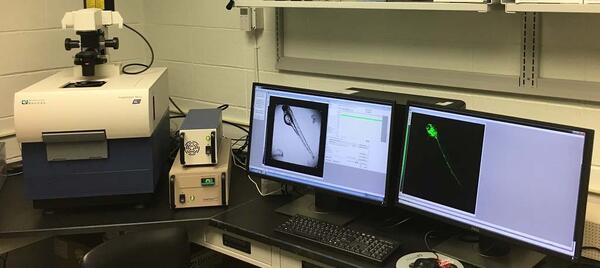
Molecular Devices ImageXpress† High-Content Imaging System

Molecular Devices ImageXpress High-Content Imaging System that can generate more than 25,000 images in less than 5 hours of automated image acquisition.

Using the 384-well plate format, a single zebrafish embryo is tested in each well
Using the 384-well plate format, a single zebrafish embryo is tested

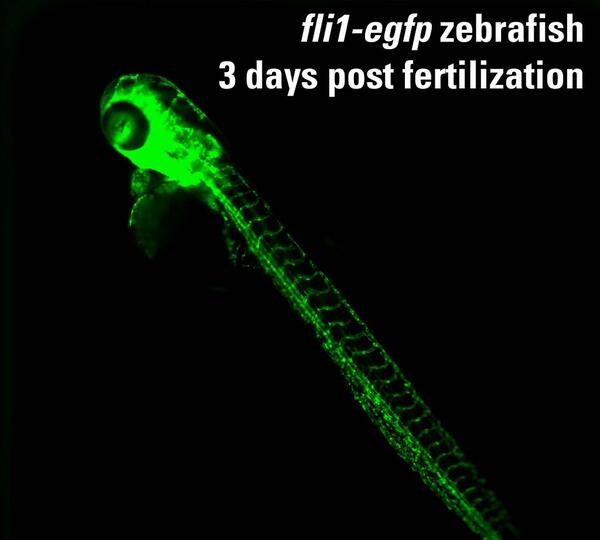
Using the 384-well plate format, a single zebrafish embryo is tested in each well. This is an example of a 72 hour post fertilization fli1:egfp zebrafish (3 millimeters long) imaged under a fluorescein isothiocyanate (FITC) filter.

Using the 384-well plate format, a single zebrafish embryo is tested in each well. This is an example of a 72 hour post fertilization fli1:egfp zebrafish (3 millimeters long) imaged under a fluorescein isothiocyanate (FITC) filter.

Dark sand surrounding the entrance to a harbor; a caution sign is featured in the foreground
Photograph of the entrance to Grand Traverse Bay Harbor

Photograph of the entrance to Grand Traverse Bay Harbor, located 8 kilometers downdrift of the spoils pile. Migration of the dark-colored stamp sands (moving from left to right) has buried the original beach, overtopped the wall, and partially blocked the channel.

Photograph of the entrance to Grand Traverse Bay Harbor, located 8 kilometers downdrift of the spoils pile. Migration of the dark-colored stamp sands (moving from left to right) has buried the original beach, overtopped the wall, and partially blocked the channel.

man holding up two small sample bags of larval fish
Collecting larval fish for the Dragonfly Mercury Project

Between 2009 and 2018, scientists conducted a national scale assessment of mercury accumulation in the National Park System using dragonfly larvae as biosentinels (species that accumulate a pollutant in their tissues as an index of exposure to other organisms without significant adverse effects to the biosentinel) through a citizen science network called the Dragonf

Between 2009 and 2018, scientists conducted a national scale assessment of mercury accumulation in the National Park System using dragonfly larvae as biosentinels (species that accumulate a pollutant in their tissues as an index of exposure to other organisms without significant adverse effects to the biosentinel) through a citizen science network called the Dragonf

Citizen Scientists identifying invertebrates collected in  Yellowstone National Park
Yellowstone National Park Dragonfly Mercury Project Sampling

This image shows citizen scientists along with National Park Service personnel identifying invertebrates as part of the Dragonfly Mercury Project.

View from the air across a tidal march, mudflat, and channels with bay water to the right and a city in the background.
Bair Island, Redwood City

After 100 years of restricted tidal activity to support agricultural use and salt harvesting, the tidal marshes around San Francisco Bay, like this one at Bair Island, are steadily rebuilding, returning to a stunning mosaic of marsh, mudflat, and channels.

After 100 years of restricted tidal activity to support agricultural use and salt harvesting, the tidal marshes around San Francisco Bay, like this one at Bair Island, are steadily rebuilding, returning to a stunning mosaic of marsh, mudflat, and channels.

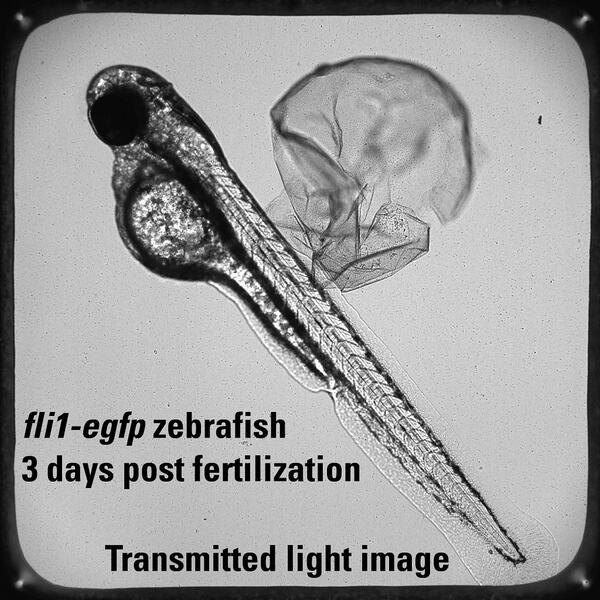
This is an example of a 72 hour post fertilization fli1:egfp zebrafish (3 millimeters long) imaged under transmitted light
This is an example of a 72 hour post fertilization

This is an example of a 72 hour post fertilization fli1:egfp zebrafish (3 millimeters long) imaged under transmitted light. The same imaging system with was used.

This is an example of a 72 hour post fertilization fli1:egfp zebrafish (3 millimeters long) imaged under transmitted light. The same imaging system with was used.

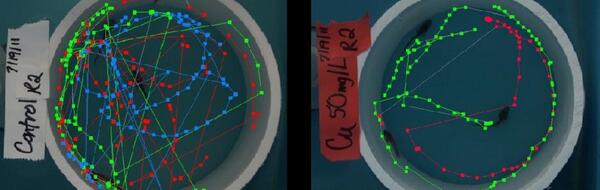
Behavioral Toxicology Laboratory -- Columbia, Missouri

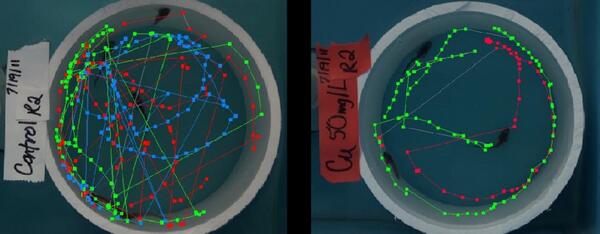
Behavioral Toxicology Laboratory -- Columbia, Missouri. Swimming paths of control (left) and copper (right) exposed fish

Swimming paths of control (left) and copper (right) exposed fish demonstrate changes in swimming behavior
Swimming paths of control (left) and copper (right) exposed fish

Behavioral Toxicology Laboratory — Columbia, Missouri. Swimming paths of control (left) and copper (right) exposed fish demonstrate changes in swimming behavior detected following exposure to metals. Such changes can impact ability of fish to survive.

Behavioral Toxicology Laboratory — Columbia, Missouri. Swimming paths of control (left) and copper (right) exposed fish demonstrate changes in swimming behavior detected following exposure to metals. Such changes can impact ability of fish to survive.

The zebrafish developmental cardiovascular toxicity high-content screening assay uses a 384-well plate format
TZebrafish developmental cardiovascular toxicity high-content screen

The zebrafish developmental cardiovascular toxicity high-content screening assay uses a 384-well plate format to maximize number of treatments and replicates possible on each plate.

Molecular Devices ImageXpress† High-Content Imaging System

High-Content Screening Laboratory — Columbia, Missouri. Molecular Devices ImageXpress High-Content Imaging System

Was this page helpful?