
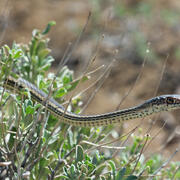
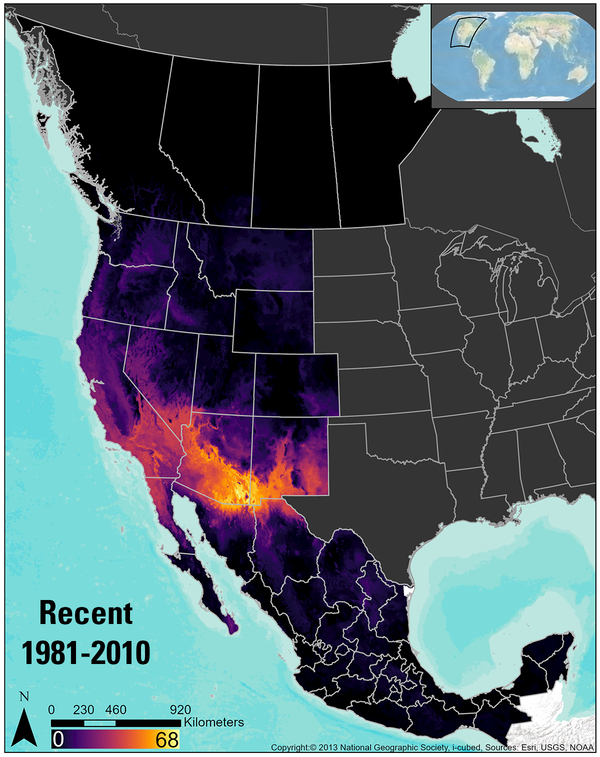
The climate-niche distribution--or the areas with suitable climate for survival--were mapped 130 reptile species in the recent time period and predicted for the late-century time period under the RCP 8.5 climate scenario. The RCP 8.5 scenario assumes carbon emissions continue at their current levels.
David S Pilliod
My research focuses on species conservation, habitat management, and effectiveness of restoration in a variety of terrestrial and aquatic ecosystems. I also co-lead the Pacific Northwest Environmental DNA Laboratory.
Wildlife Ecology and Conservation Biology Team (FRESC)
Pacific Northwest Environmental DNA Laboratory
I lead a team of scientists that develop tools and models to improve understanding of ecological systems and solve challenging problems in natural resource management. We primarily address questions related to species conservation, wildlife habitat, and restoration. We combine molecular methods, remote sensing, field studies, and statistical modeling. Our research team also develops data management and decision support systems to facilitate adaptive management, especially in western rangelands. We primarily work on issues affecting the Intermountain West and Great Basin regions of the U.S.
Professional Experience
2006 - Present: USGS. Forest and Rangeland Ecosystem Science Center, Supervisory Research Ecologist, Boise, Idaho
Education and Certifications
Ph.D., Ecology, Idaho State University, Pocatello, ID (2001)
B.A., Biology, University of California, Santa Cruz, CA (1991)
Science and Products
Wildlife Ecology and Conservation Biology Team (FRESC)
LTDL and LTET Team (FRESC)
Project ROAM
Proof of concept airborne eDNA testing to detect invasive species in shipping containers
Fuel Break Science in the Great Basin
Systematic Review and Analysis of Seeding and Herbicide Treatment in the Sagebrush Steppe
Using Pollinator Environmental DNA to Assess the Ecological Resilience of America’s Grasslands
Dakota Skipper Surveillance, Monitoring, and Assessment
Using Artificial Flowers to Survey for Pollinators
Wildland Fire Trends Tool
READI-Net: Providing Tools for the Early Detection and Management of Aquatic Invasive Species
GIS Clipping and Summarization Tool for Points, Lines, Polygons, and Rasters
The Wildfire Trends Tool: A data visualization and analysis tool to meet land management needs and facilitate scientific inquiry
If you are unable to access or download a product, email fresc_outreach@usgs.gov a request, including the full citation, or call (541) 750-1030.
Temporal environmental DNA data collected from waters in Florida, Idaho, Montana and Wisconsin in 2022 Temporal environmental DNA data collected from waters in Florida, Idaho, Montana and Wisconsin in 2022
Rodent habitat and community data to evaluate outcomes of wildfire and post-fire restoration treatments Rodent habitat and community data to evaluate outcomes of wildfire and post-fire restoration treatments
Detection of Dakota skipper eDNA from inflorescences in the Upper Midwest, June and July 2022 Detection of Dakota skipper eDNA from inflorescences in the Upper Midwest, June and July 2022
Comparison of environmental DNA sampling protocols for detection of stream fishes in the Pacific Northwest, 2019 Comparison of environmental DNA sampling protocols for detection of stream fishes in the Pacific Northwest, 2019
eDNA and Visual Encounter Survey Detection of Amphibians and Chytrid Fungus in Colorado Canyonlands, 2019-2022 eDNA and Visual Encounter Survey Detection of Amphibians and Chytrid Fungus in Colorado Canyonlands, 2019-2022
Arthropod detections from eDNA metabarcoding of flower filtrate and DNA derived from bulk samples of insects Arthropod detections from eDNA metabarcoding of flower filtrate and DNA derived from bulk samples of insects
Environmental DNA qPCR detection results and covariates from Idaho, Missouri, Montana, and New York rivers sampled in 2023 Environmental DNA qPCR detection results and covariates from Idaho, Missouri, Montana, and New York rivers sampled in 2023
Fuel Break Treatments in the Sagebrush Biome of the Western United States, 1953 - 2018 Fuel Break Treatments in the Sagebrush Biome of the Western United States, 1953 - 2018
Western North America terrestrial reptile climate-niche rasters and summary data Western North America terrestrial reptile climate-niche rasters and summary data
Sagebrush recovery projections across the biome, 30 years after two seeding treatment applications, and associated model data (1986-2021) Sagebrush recovery projections across the biome, 30 years after two seeding treatment applications, and associated model data (1986-2021)
Microsatellite genotypes of Bombus occidentalis specimens (including Bombus mckayi) from 1960 to 2020 Microsatellite genotypes of Bombus occidentalis specimens (including Bombus mckayi) from 1960 to 2020
Characteristics, presence of erosional features, and cover of vegetation and bare ground on fields formerly enrolled in grassland, wetland, and wildlife practices of the Conservation Reserve Program in the central and western United States from 2017 to 20 Characteristics, presence of erosional features, and cover of vegetation and bare ground on fields formerly enrolled in grassland, wetland, and wildlife practices of the Conservation Reserve Program in the central and western United States from 2017 to 20
The climate-niche distribution--or the areas with suitable climate for survival--were mapped 130 reptile species in the recent time period and predicted for the late-century time period under the RCP 8.5 climate scenario. The RCP 8.5 scenario assumes carbon emissions continue at their current levels.
Researchers at the Pacific Northwest Environmental DNA Laboratory designed artificial flowers to attract pollinators. DNA left behind on the flowers can be collected and analyzed as a non-invasive way to survey for pollinator species diversity and abundance.
Bureau of Land Management truck sprays herbicide in southwestern Idaho as part of a restoration effort.
An examination of long-term data for lands managed by the Bureau of Land Management finds that land treatments in the southwestern United States are increasingly large, expensive and related to fire and invasive species control.
Bureau of Land Management truck sprays herbicide in southwestern Idaho as part of a restoration effort.
An examination of long-term data for lands managed by the Bureau of Land Management finds that land treatments in the southwestern United States are increasingly large, expensive and related to fire and invasive species control.
If you are unable to access or download a product, email fresc_outreach@usgs.gov a request, including the full citation, or call (541) 750-1030.
Supporting dryland restoration success with applied ecological forecasting of seeding outcomes Supporting dryland restoration success with applied ecological forecasting of seeding outcomes
Environmental drivers of Greater Sage-grouse population trends over 25 years in Idaho, USA Environmental drivers of Greater Sage-grouse population trends over 25 years in Idaho, USA
A 21st Century butterfly net: Using eDNA to detect the imperiled Dakota skipper A 21st Century butterfly net: Using eDNA to detect the imperiled Dakota skipper
A systematic review and meta-analysis of post-fire seeding and herbicide treatment effectiveness for controlling exotic annual grasses in the sagebrush biome A systematic review and meta-analysis of post-fire seeding and herbicide treatment effectiveness for controlling exotic annual grasses in the sagebrush biome
Metabarcoding analysis of arthropod pollinator diversity: A methodological comparison of eDNA derived from flowers and DNA derived from bulk samples of insects Metabarcoding analysis of arthropod pollinator diversity: A methodological comparison of eDNA derived from flowers and DNA derived from bulk samples of insects
Costs of land treatments on public lands in the western United States Costs of land treatments on public lands in the western United States
Evaluation of the gap intercept method to measure rangeland connectivity Evaluation of the gap intercept method to measure rangeland connectivity
Field trials of an autonomous eDNA sampler in lotic waters Field trials of an autonomous eDNA sampler in lotic waters
Leveraging extensive soil, vegetation, fire, and land treatment data to inform restoration across the sagebrush biome Leveraging extensive soil, vegetation, fire, and land treatment data to inform restoration across the sagebrush biome
Closing the conservation gap in the sagebrush biome: Spatial targeting and coordination are needed for conservation to keep pace with sagebrush losses Closing the conservation gap in the sagebrush biome: Spatial targeting and coordination are needed for conservation to keep pace with sagebrush losses
Propagating observation errors to enable scalable and rigorous enumeration of plant population abundance with aerial imagery Propagating observation errors to enable scalable and rigorous enumeration of plant population abundance with aerial imagery
Climate futures for lizards and snakes in western North America may result in new species management issues Climate futures for lizards and snakes in western North America may result in new species management issues
Non-USGS Publications**
**Disclaimer: The views expressed in Non-USGS publications are those of the author and do not represent the views of the USGS, Department of the Interior, or the U.S. Government.
If you are unable to access or download a product, email fresc_outreach@usgs.gov a request, including the full citation, or call (541) 750-1030.
Interactive Tableau supplement for 'Climate futures for lizards and snakes in western North America may result in new species management issues' Interactive Tableau supplement for 'Climate futures for lizards and snakes in western North America may result in new species management issues'
Amphibian and Reptile Species Distribution Explorer Amphibian and Reptile Species Distribution Explorer
Interactive Supplement - When and How Often do Seedings Experience a Wildfire? Interactive Supplement - When and How Often do Seedings Experience a Wildfire?
Wildland Fire Trends Tool Wildland Fire Trends Tool
Land Treatment Exploration Tool Land Treatment Exploration Tool
GIS Clipping and Summarization Toolbox GIS Clipping and Summarization Toolbox
To request an interview, contact fresc_outreach@usgs.gov or call (541) 750-1030.
Science and Products
Wildlife Ecology and Conservation Biology Team (FRESC)
LTDL and LTET Team (FRESC)
Project ROAM
Proof of concept airborne eDNA testing to detect invasive species in shipping containers
Fuel Break Science in the Great Basin
Systematic Review and Analysis of Seeding and Herbicide Treatment in the Sagebrush Steppe
Using Pollinator Environmental DNA to Assess the Ecological Resilience of America’s Grasslands
Dakota Skipper Surveillance, Monitoring, and Assessment
Using Artificial Flowers to Survey for Pollinators
Wildland Fire Trends Tool
READI-Net: Providing Tools for the Early Detection and Management of Aquatic Invasive Species
GIS Clipping and Summarization Tool for Points, Lines, Polygons, and Rasters
The Wildfire Trends Tool: A data visualization and analysis tool to meet land management needs and facilitate scientific inquiry
If you are unable to access or download a product, email fresc_outreach@usgs.gov a request, including the full citation, or call (541) 750-1030.
Temporal environmental DNA data collected from waters in Florida, Idaho, Montana and Wisconsin in 2022 Temporal environmental DNA data collected from waters in Florida, Idaho, Montana and Wisconsin in 2022
Rodent habitat and community data to evaluate outcomes of wildfire and post-fire restoration treatments Rodent habitat and community data to evaluate outcomes of wildfire and post-fire restoration treatments
Detection of Dakota skipper eDNA from inflorescences in the Upper Midwest, June and July 2022 Detection of Dakota skipper eDNA from inflorescences in the Upper Midwest, June and July 2022
Comparison of environmental DNA sampling protocols for detection of stream fishes in the Pacific Northwest, 2019 Comparison of environmental DNA sampling protocols for detection of stream fishes in the Pacific Northwest, 2019
eDNA and Visual Encounter Survey Detection of Amphibians and Chytrid Fungus in Colorado Canyonlands, 2019-2022 eDNA and Visual Encounter Survey Detection of Amphibians and Chytrid Fungus in Colorado Canyonlands, 2019-2022
Arthropod detections from eDNA metabarcoding of flower filtrate and DNA derived from bulk samples of insects Arthropod detections from eDNA metabarcoding of flower filtrate and DNA derived from bulk samples of insects
Environmental DNA qPCR detection results and covariates from Idaho, Missouri, Montana, and New York rivers sampled in 2023 Environmental DNA qPCR detection results and covariates from Idaho, Missouri, Montana, and New York rivers sampled in 2023
Fuel Break Treatments in the Sagebrush Biome of the Western United States, 1953 - 2018 Fuel Break Treatments in the Sagebrush Biome of the Western United States, 1953 - 2018
Western North America terrestrial reptile climate-niche rasters and summary data Western North America terrestrial reptile climate-niche rasters and summary data
Sagebrush recovery projections across the biome, 30 years after two seeding treatment applications, and associated model data (1986-2021) Sagebrush recovery projections across the biome, 30 years after two seeding treatment applications, and associated model data (1986-2021)
Microsatellite genotypes of Bombus occidentalis specimens (including Bombus mckayi) from 1960 to 2020 Microsatellite genotypes of Bombus occidentalis specimens (including Bombus mckayi) from 1960 to 2020
Characteristics, presence of erosional features, and cover of vegetation and bare ground on fields formerly enrolled in grassland, wetland, and wildlife practices of the Conservation Reserve Program in the central and western United States from 2017 to 20 Characteristics, presence of erosional features, and cover of vegetation and bare ground on fields formerly enrolled in grassland, wetland, and wildlife practices of the Conservation Reserve Program in the central and western United States from 2017 to 20
The climate-niche distribution--or the areas with suitable climate for survival--were mapped 130 reptile species in the recent time period and predicted for the late-century time period under the RCP 8.5 climate scenario. The RCP 8.5 scenario assumes carbon emissions continue at their current levels.
Researchers at the Pacific Northwest Environmental DNA Laboratory designed artificial flowers to attract pollinators. DNA left behind on the flowers can be collected and analyzed as a non-invasive way to survey for pollinator species diversity and abundance.
Bureau of Land Management truck sprays herbicide in southwestern Idaho as part of a restoration effort.
An examination of long-term data for lands managed by the Bureau of Land Management finds that land treatments in the southwestern United States are increasingly large, expensive and related to fire and invasive species control.
Bureau of Land Management truck sprays herbicide in southwestern Idaho as part of a restoration effort.
An examination of long-term data for lands managed by the Bureau of Land Management finds that land treatments in the southwestern United States are increasingly large, expensive and related to fire and invasive species control.
If you are unable to access or download a product, email fresc_outreach@usgs.gov a request, including the full citation, or call (541) 750-1030.
Supporting dryland restoration success with applied ecological forecasting of seeding outcomes Supporting dryland restoration success with applied ecological forecasting of seeding outcomes
Environmental drivers of Greater Sage-grouse population trends over 25 years in Idaho, USA Environmental drivers of Greater Sage-grouse population trends over 25 years in Idaho, USA
A 21st Century butterfly net: Using eDNA to detect the imperiled Dakota skipper A 21st Century butterfly net: Using eDNA to detect the imperiled Dakota skipper
A systematic review and meta-analysis of post-fire seeding and herbicide treatment effectiveness for controlling exotic annual grasses in the sagebrush biome A systematic review and meta-analysis of post-fire seeding and herbicide treatment effectiveness for controlling exotic annual grasses in the sagebrush biome
Metabarcoding analysis of arthropod pollinator diversity: A methodological comparison of eDNA derived from flowers and DNA derived from bulk samples of insects Metabarcoding analysis of arthropod pollinator diversity: A methodological comparison of eDNA derived from flowers and DNA derived from bulk samples of insects
Costs of land treatments on public lands in the western United States Costs of land treatments on public lands in the western United States
Evaluation of the gap intercept method to measure rangeland connectivity Evaluation of the gap intercept method to measure rangeland connectivity
Field trials of an autonomous eDNA sampler in lotic waters Field trials of an autonomous eDNA sampler in lotic waters
Leveraging extensive soil, vegetation, fire, and land treatment data to inform restoration across the sagebrush biome Leveraging extensive soil, vegetation, fire, and land treatment data to inform restoration across the sagebrush biome
Closing the conservation gap in the sagebrush biome: Spatial targeting and coordination are needed for conservation to keep pace with sagebrush losses Closing the conservation gap in the sagebrush biome: Spatial targeting and coordination are needed for conservation to keep pace with sagebrush losses
Propagating observation errors to enable scalable and rigorous enumeration of plant population abundance with aerial imagery Propagating observation errors to enable scalable and rigorous enumeration of plant population abundance with aerial imagery
Climate futures for lizards and snakes in western North America may result in new species management issues Climate futures for lizards and snakes in western North America may result in new species management issues
Non-USGS Publications**
**Disclaimer: The views expressed in Non-USGS publications are those of the author and do not represent the views of the USGS, Department of the Interior, or the U.S. Government.
If you are unable to access or download a product, email fresc_outreach@usgs.gov a request, including the full citation, or call (541) 750-1030.
Interactive Tableau supplement for 'Climate futures for lizards and snakes in western North America may result in new species management issues' Interactive Tableau supplement for 'Climate futures for lizards and snakes in western North America may result in new species management issues'
Amphibian and Reptile Species Distribution Explorer Amphibian and Reptile Species Distribution Explorer
Interactive Supplement - When and How Often do Seedings Experience a Wildfire? Interactive Supplement - When and How Often do Seedings Experience a Wildfire?
Wildland Fire Trends Tool Wildland Fire Trends Tool
Land Treatment Exploration Tool Land Treatment Exploration Tool
GIS Clipping and Summarization Toolbox GIS Clipping and Summarization Toolbox
To request an interview, contact fresc_outreach@usgs.gov or call (541) 750-1030.