Example of a three-dimensional QUIC-Fire simulation. The example site is located in the Dixie Fire, CA. QUIC-Fire is a fast, 3-D simulation tool for prescribed fire planning. It can help managers understand the complex and dynamic behavior of wildland fires.
Images
Browse images from a wide range of science topics covered by USGS. All items in this gallery are considered public domain unless otherwise noted.
Example of a three-dimensional QUIC-Fire simulation. The example site is located in the Dixie Fire, CA. QUIC-Fire is a fast, 3-D simulation tool for prescribed fire planning. It can help managers understand the complex and dynamic behavior of wildland fires.
Alaska locations of placer tailings sampling sites
Alaska locations of placer tailings sampling sitesMap showing locations of placer mines in the Alaska Resource Data File (ARDF, red crosses), primary mineral districts that contain targeted critical minerals (black boxes) and locations that were sampled by the USGS in 2022 and 2023 (yellow stars).
Alaska locations of placer tailings sampling sites
Alaska locations of placer tailings sampling sitesMap showing locations of placer mines in the Alaska Resource Data File (ARDF, red crosses), primary mineral districts that contain targeted critical minerals (black boxes) and locations that were sampled by the USGS in 2022 and 2023 (yellow stars).
An orange tributary of the Kugururok River, Noatak National Preserve, Alaska
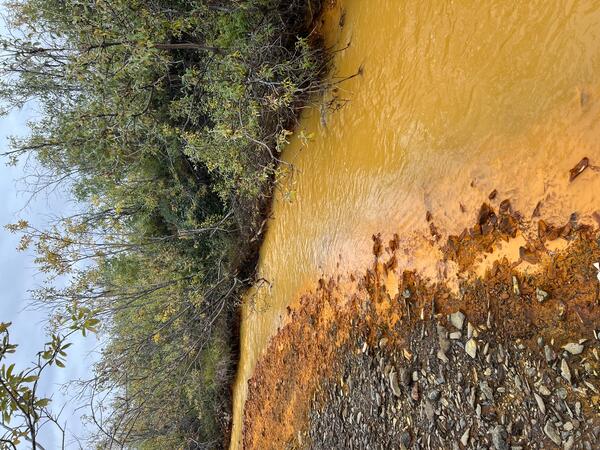
An orange tributary of the Kugururok River, Noatak National Preserve, AlaskaOrange streams are increasingly common in the Brooks Range of northern Alaska. The orange stream color reflects oxidized iron, but also often indicates elevated heavy metal concentrations. Our ongoing study aims to document these occurrences and the timing of their onset.
An orange tributary of the Kugururok River, Noatak National Preserve, Alaska
An orange tributary of the Kugururok River, Noatak National Preserve, AlaskaOrange streams are increasingly common in the Brooks Range of northern Alaska. The orange stream color reflects oxidized iron, but also often indicates elevated heavy metal concentrations. Our ongoing study aims to document these occurrences and the timing of their onset.
Scientist sieving a sample of gold placer tailings to analyze for critical mineral contents in Uhler Creek, a tributary to the South Fork of the Forty Mile River in east central Alaska.
A fluorite-lepidolite-wolframite vein intersected in drill core from the Lost River Sn-W mine, Seward Peninsula, Alaska. Lepidolite is a lithium-bearing mica, and wolframite an ore of tungsten.
Research scientists overlooking Iceberg Lake in Wrangell - St Elias National Park & Preserve, Alaska.
A fluorite-lepidolite-wolframite vein intersected in drill core from the Lost River Sn-W mine, Seward Peninsula, Alaska. Lepidolite is a lithium-bearing mica, and wolframite an ore of tungsten.
USGS researcher collecting samples in Kanuti, Alaska. The samples collected in this location were more resistant to weathering than the surrounding rock indicating a change in lithology.
Recording observations on the outcrop of the Kanuti Ophiolite
Recording observations on the outcrop of the Kanuti OphioliteUSGS researcher making observations and recording information on the outcrop of the Kanuti Ophiolite in Alaska. The Kanuti ophiolite is a mafic-ultramafic thrust sheet of probable Jurassic age, formerly considered to be the upper part of the Yukon-Koyukuk ophiolite (Angayucham terrane).
Recording observations on the outcrop of the Kanuti Ophiolite
Recording observations on the outcrop of the Kanuti OphioliteUSGS researcher making observations and recording information on the outcrop of the Kanuti Ophiolite in Alaska. The Kanuti ophiolite is a mafic-ultramafic thrust sheet of probable Jurassic age, formerly considered to be the upper part of the Yukon-Koyukuk ophiolite (Angayucham terrane).
Black-legged kittiwake adults and chicks on nests at Gull Island in Kachemak Bay, Alaska
Dwarf least cisco (Coregonus sardinella) were the primary diet item found in stomachs of lake trout (Salvelinus namaycush) from Nutuvukti Lake. These fish, measured at about 90 mm (3.5 in) in length, were reproductively mature.
Biologists jig for lake trout (Salvelinus namaycush) on Nutuvukti Lake, Gates of the Arctic National Park and Preserve. Thick smoke from wildfires in the Kobuk River and Koyukuk River valleys settled over the lake for a week during field sampling in August.
Emergent vegetation growing in the shallow water of Nutuvukti Lake, Gates of the Arctic National Park and Preserve. Emergent vegetation provides habitat for aquatic insects and small fishes.
USGS researcher collecting one more sample while waiting for the helicopter in Kanuti, Alaska. The Kanuti ophiolite is a mafic-ultramafic thrust sheet of probable Jurassic age, formerly considered to be the upper part of the Yukon-Koyukuk ophiolite (Angayucham terrane).
Timelapse imagery from Wolverine Glacier, Alaska (2012 - 2022)
Timelapse imagery from Wolverine Glacier, Alaska (2012 - 2022)The timelapse imagery provided here shows the lower half of Wolverine Glacier from 2012 to 2022. This imagery gives an intuitive view of the scale of change happening at glaciers across Alaska.
Timelapse imagery from Wolverine Glacier, Alaska (2012 - 2022)
Timelapse imagery from Wolverine Glacier, Alaska (2012 - 2022)The timelapse imagery provided here shows the lower half of Wolverine Glacier from 2012 to 2022. This imagery gives an intuitive view of the scale of change happening at glaciers across Alaska.
Demonstration of multibeam echosounder technology, Knik River near Palmer, Alaska
Demonstration of multibeam echosounder technology, Knik River near Palmer, AlaskaMike Knapp, hydraulic engineer with the Alaska Department of Transportation and Public Facilities (far right) introduces USGS hydrologist Taylor Dudunake (back to camera) for a demonstration of multibeam echosounder technology on the Knik River near Palmer, Alaska, July 27, 2023.
Demonstration of multibeam echosounder technology, Knik River near Palmer, Alaska
Demonstration of multibeam echosounder technology, Knik River near Palmer, AlaskaMike Knapp, hydraulic engineer with the Alaska Department of Transportation and Public Facilities (far right) introduces USGS hydrologist Taylor Dudunake (back to camera) for a demonstration of multibeam echosounder technology on the Knik River near Palmer, Alaska, July 27, 2023.
RV Norseman II ship track for the Pacific walrus research expedition in 2023. In collaboration with the U.S. Fish and Wildlife Service, the USGS conducted a research expedition to study Pacific walrus population dynamics. The ship departed Nome, AK on June 5, 2023, and returned to Nome on July 2, 2023.
A view of the old Lost River tin mine located on the Seward Peninsula, Alaska. The mine produced tin and tungsten from the early 20th century and ceased around 1955. The site is currently being studied by USGS for lithium potential.
Scientist sieving a sample of tin placer tailings in Cassiterite Creek on the western Seward Peninsula.
Antimicrobial resistance of clinical relevance may have important implications to human and animal health. In this photo, Laura Scott and Christina Ahlstrom (USGS – Alaska Science Center) are sampling surface waters for antimicrobial resistant bacteria at Exit Creek in Kenai Fjords National Park in Alaska.