



Decision Science and Quantitative Methods
Decision Science and Quantitative Methods
At the Eastern Ecological Science Center (EESC), we strive to provide world-class science to inform natural resource decisions that preserve and enhance our quality of life.
EESC Makes an Impact
EESC Makes an Impact
How does EESC decision science and quantitative methods help reduce management costs and increase efficiency?
EESC Makes an Impact
EESC Makes an Impact

How does EESC decision science and quantitative methods help preserve our hunting resources?

Filter Total Items: 68

Population Ecology of Florida Manatees
USGS is working with partners to understand how the federally protected Florida manatee ( Trichechus manatus latirostris) population changes over time and responds to threats.

Population Monitoring and Removal Strategies for Blue Catfish (Ictalurus furcatus) in Chesapeake Bay
USGS is helping with the design of a population survey and developing mathematical models to assess potential activities to manage the population of invasive blue catfish ( Ictalurus furcatus) in the Chesapeake Bay. This research will help managers determine the cost and feasibility of approaches to control this invasive species.

Production, Behavior, and Survival of Juvenile Shad and River Herring
USGS is conducting research to better understand biology, behavior, and survival of juvenile fishes that travel between fresh and saltwater to complete their lifecycles. Migratory fishes as such as herring and shad are vital components in riverine and coastal ecosystems, transporting food and nutrients between fresh rivers and the ocean. They are also an important forage fish for predators in...

Developing a Process for Listing Injurious Wildlife Species
This project will develop a transparent process for prioritizing species for listing as injurious, likely to cause damage or harm, under the Lacey Act. Building upon previously developed "horizon scan" and "watchlist" products, this process will identify potentially invasive species that present the greatest risk to lands, waters, and other assets managed by the U.S. Department of the Interior.

Using Multiple Indicators to Assess Stream Condition in the Chesapeake Bay
USGS is working with federal, state and local partners to develop multiple assessments of stream and river conditions in non-tidal areas of the Chesapeake Bay watershed. These assessments will help managers preserve stream health and improve biological conditions in impaired streams as the human population and climate continue to change in this region.

Sustaining Horseshoe Crabs and Supporting Migratory Shorebirds in the Delaware Bay
USGS is developing predictive models to inform sustainable harvest of horseshoe crabs ( Limulus polyphemus) in Delaware Bay to help managers make decisions to support needs of people and shorebirds including rufa red knot ( Calidris canutus rufa).

Northeast Amphibian Research and Monitoring Initiative
The U.S. Geological Survey’s Eastern Ecological Science Center is home to the Northeast Amphibian Research and Monitoring Initiative (NEARMI), one of 7 ARMI regions across the United States. NEARMI works on public lands in thirteen states from Maine to Virginia, including many National Parks and National Wildlife Refuges.

Disease Decision Analysis and Research
The Disease Decision Analysis and Research group is a multi-disciplinary team based out of the Eastern Ecological Science Center whose strengths are in ecology, decision sciences and quantitative modeling.

READI-Net: Providing Tools for the Early Detection and Management of Aquatic Invasive Species
The USGS has developed the Rapid environmental (e)DNA Assessment and Deployment Initiative & Network (READI-Net) to accelerate the implementation of environmental DNA (eDNA) analysis as a best practice for the early detection of aquatic biological threats. READI-Net provides tools and a strategy to collect and deliver early detection data for natural resource managers and public health protection...
By
Ecosystems Mission Area, Biological Threats and Invasive Species Research Program, Columbia Environmental Research Center, Eastern Ecological Science Center, Forest and Rangeland Ecosystem Science Center, New York Water Science Center, Northern Rocky Mountain Science Center, Upper Midwest Environmental Sciences Center, Wetland and Aquatic Research Center , Wyoming-Montana Water Science Center, Pacific Northwest Environmental DNA Laboratory, Infrastructure Investment Jobs Act

Eastern Ecological Science Center partnership with Atlantic States Marine Fisheries Commission
Collaboration between the world-class expertise of USGS scientists, the Atlantic States Marine Fisheries Commission’s Science Program, and state and federal fishery agencies demonstrates the power of partnerships to solve seemingly-insurmountable problems in sustainable and cooperative management of Atlantic coastal fisheries.

Decision Science Support for SARS-CoV-2 Risk to North American Bats
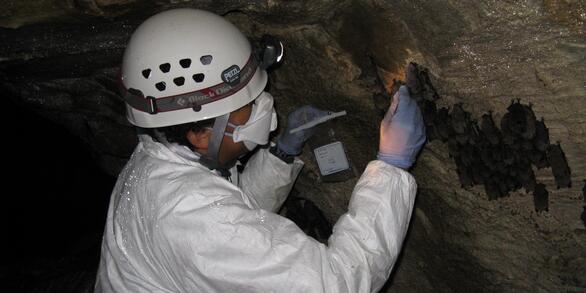
The Eastern Ecological Science Center is working closely with federal, state, and tribal partners to help inform decisions that reduce the risk of SARS-CoV-2 transmission from humans to North American wildlife, including bats.

Decision science support for Chronic Wasting Disease
Eastern Ecological Science Center adds the decision analytical skill set to the existing body of USGS expertise on Chronic Wasting Disease (CWD), in support of our sister DOI agencies.