



Fish and Aquatic Species
Fish and Aquatic Species
Filter Total Items: 32
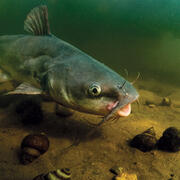
Contaminants in Blue Catfish: Implications for Human, Wildlife, and Environmental Health
As blue catfish become increasingly harvested, recent studies are showing signs that these fish may contain detectable levels of Per- and polyfluoroalkyl Substances (PFAS) and other contaminants. Measuring PFAS in their blood and heavy metals, Polychlorinated biphenyls (PCBs), and microplastics from filets will help determine potential health effects for people, animals, and the environment.

Advancing the Environmental DNA Toolkit for Ecosystem Monitoring and Management
The emerging field of Environmental DNA (eDNA) analysis allows characterization of species presence and community biodiversity by identifying trace amounts of genetic material left behind as organisms move through their environments. EESC scientists have been using eDNA technologies to detect native and rare species and as community biomonitoring tools.
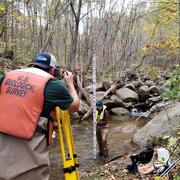
Using monitoring data to measure conditions over time in Chesapeake Bay streams
This study provides a comprehensive assessment of the health of streams throughout the Chesapeake Bay. Monitoring data were used to assess seven key indicators of stream condition, revealing consistent patterns of degradation in urban and agricultural areas. The findings offer critical insights that can inform watershed restoration efforts and improve long-term monitoring strategies.
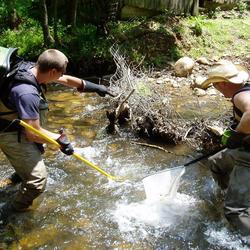
EESC Makes an Impact: Enhancing Recreational & Commercial Fishing
The USGS Eastern Ecological Science Center (EESC) provides world-class science to inform natural resource decisions on aquatic ecosystems, species populations and management, disease, and invasive species. Our scientific products represent critical contributions that enhance the ecological and economic sustainability of recreational and commercial fishing. In the United States, anglers contribute...

Key Values of a Century of EESC Science
The USGS Eastern Ecological Science Center (EESC) is rooted in a proud tradition of service to the nation—advancing science that informs the conservation and management of fish, wildlife, and habitats across the eastern United States and beyond. Our mission is clear: deliver reliable, partner-driven science that supports natural resource decisions today, while ensuring these resources remain...
EESC Makes an Impact: Restoring the Chesapeake Bay Watershed
The Chesapeake Bay provides over $100 billion in annual economic value and is home to 18 million people. The USGS, including scientists from the Eastern Ecological Science Center (EESC), works with Federal, State, local, and academic partners to provide research and monitoring and to communicate results to inform management for the Chesapeake and other important landscapes across the Nation.

Alosine Genetic Stock Identification and Tissue Repository
American Shad ( Alosa sapidissima), Blueback Herring ( Alosa aestivalis), and Alewife ( Alosa pseudoharengus; collectively “alosines”) once supported large fisheries along the U.S. Atlantic Coast. However, impassable migration barriers, declines in habitat quality, and exploitation have led to declines in many spawning populations. Substantial resources have been invested to support the recovery...

Sturgeon Occurrence and Behavior in the Outer Continental Shelf
A new study aims to collect information on sturgeon temporal and spatial distribution to inform offshore wind energy and sand leasing operations.

Supporting Interstate Conservation of Atlantic Sturgeon (Acipenser o. oxyrinchus) Using Genetics, Telemetry, and Side-scan Sonar
USGS scientists are using innovative combinations of telemetry, genetics, and side-scan Sonar to support conservation of endangered Atlantic sturgeon ( Acipenser o. oxyrinchus).

Conservation Genetics of American Shad (Alosa sapidissima) and River Herring (Alosa aestivalis and Alosa pseudoharengus)
USGS scientists are studying American shad ( Alosa sapidissima), blueback herring ( Alosa aestivalis), and alewife ( Alosa pseudoharengus; collectively “alosines”) to develop robust genetic baselines that will inform management practices for individual species.

Fish Passage Research to Identify the Ideal Fishway Entrance for River Herring (Alosa spp)
USGS is working to identify an improved fishway entrance design for two at-risk species, blueback herring ( Alosa aestivalis) and alewife ( Alosa pseudoharengus).

Development and Evaluation of the Novel East Coast Fish Ladder
USGS is working to establish a new East Coast fish ladder design that would help a multitude of aquatic species move easier in our waterways.