Many new big sagebrush (Artemisia tridentata) plants that have just sprouted from the ground in the Morley Nelson Snake River Birds of Prey National Conservation Area in Idaho.
Images
If you are unable to access or download a product, email fresc_outreach@usgs.gov a request, including the full citation, or call (541) 750-1030.
Many new big sagebrush (Artemisia tridentata) plants that have just sprouted from the ground in the Morley Nelson Snake River Birds of Prey National Conservation Area in Idaho.
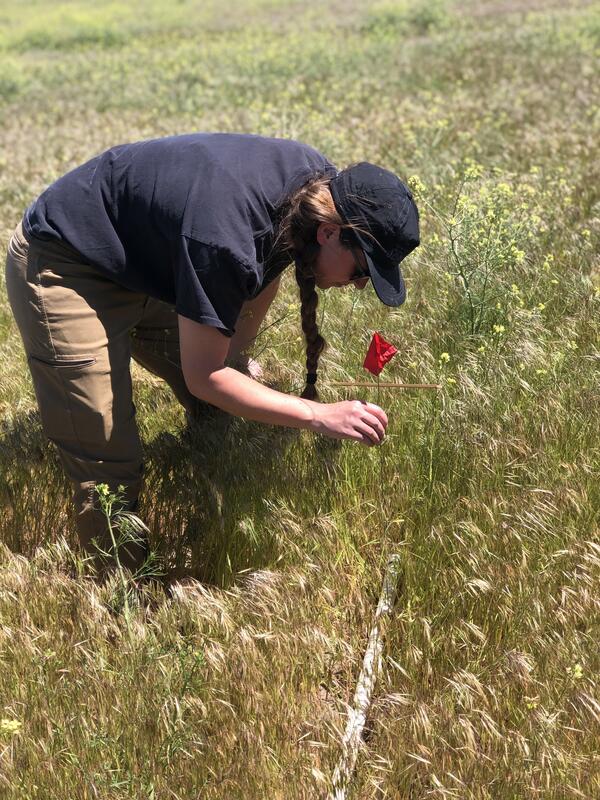
A field crew member collecting stick-point intercept data at a Project ROAM (Rapid and Other Methods for Assessment and Monitoring) plot. A meter-long 'stick' is dropped and five recordings of vegetation are collected by dropping a pin flag along the stick. The vegetation it comes into contact with is recorded to estimate cover.
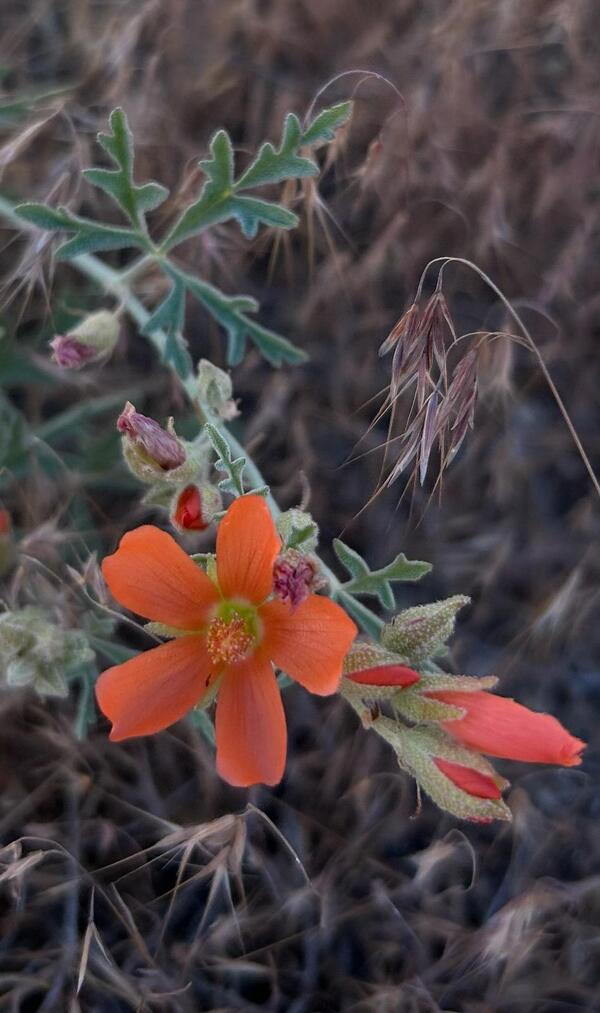
A scarlet globemallow (Sphaeralcea coccinea) photographed during a Project ROAM (Rapid and Other Methods for Assessment and Monitoring) survey in the Morley Nelson Snake River Birds of Prey National Conservation Area. ROAM protocols are tailored to detect uncommon species, such as native forbs.
In collaboration with USFS-RMRS researchers, the FIREss team planted Rabbitbrush (Ericameria nauseosa) collected from across the West of different populations.
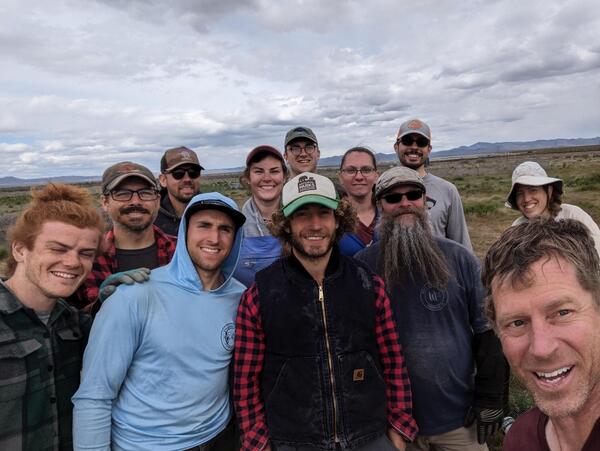
The FIREss team after planting rabbitbrush in collaboration with USFS-RMRS researchers. Rabbitbrush is a foundational shrub of desert, woodland, and montane habitats that provides habitat and resources for birds, mammals, and insects.
A hovercraft glides over the surface of Summer Lake, Oregon
A hovercraft glides over the surface of Summer Lake, OregonSummer Lake, Oregon is one of the 20 terminal lakes identified by USGS partners as priority ecosystems for study by the Saline Lakes Ecosystems IWAA.
A hovercraft glides over the surface of Summer Lake, Oregon
A hovercraft glides over the surface of Summer Lake, OregonSummer Lake, Oregon is one of the 20 terminal lakes identified by USGS partners as priority ecosystems for study by the Saline Lakes Ecosystems IWAA.
An adult Oregon spotted frog basking in the sun in wetland habitat in the Klamath Basin of Oregon. At this site on a private ranch, the owner is collaborating with researchers and wildlife managers to remove invasive American bullfrogs and restore aquatic habitat.
Jill Shaffer and Todd Katzner at the Eagles of the Palearctic Conference in Kazakhstan
Jill Shaffer and Todd Katzner at the Eagles of the Palearctic Conference in KazakhstanJill Shaffer and Todd Katzner presented three talks at the Eagles of the Palearctic Conference in Almaty, Kazakhstan in September 2023 as part of the Embassy Science Fellowship program.
Jill Shaffer and Todd Katzner at the Eagles of the Palearctic Conference in Kazakhstan
Jill Shaffer and Todd Katzner at the Eagles of the Palearctic Conference in KazakhstanJill Shaffer and Todd Katzner presented three talks at the Eagles of the Palearctic Conference in Almaty, Kazakhstan in September 2023 as part of the Embassy Science Fellowship program.
Jill Shaffer presenting on the impacts of renewable energy on golden eagles in the U.S. at the Eagles of the Palearctic Conference in Almaty, Kazakhstan, in September 2023.
USGS scientist Jennifer Fredrickson using radio telemetry to track northwestern pond turtles at Fall Creek Reservoir in Oregon.
Visiting Chokpak Ornithological Station in Kazakhstan
Visiting Chokpak Ornithological Station in KazakhstanUSGS scientists Jill Shaffer (left), Todd Katzner (right), and University of Maryland graduate student Nicole Ibrahim (center) take a break from netting and banding birds at Chokpak Ornithological Research Station in Kazakhstan. The Tian Shan Mountains are visible in the background.
Visiting Chokpak Ornithological Station in Kazakhstan
Visiting Chokpak Ornithological Station in KazakhstanUSGS scientists Jill Shaffer (left), Todd Katzner (right), and University of Maryland graduate student Nicole Ibrahim (center) take a break from netting and banding birds at Chokpak Ornithological Research Station in Kazakhstan. The Tian Shan Mountains are visible in the background.
Learning about bird banding and feather sampling techniques at Chokpak Ornithological Station
Learning about bird banding and feather sampling techniques at Chokpak Ornithological StationTodd Katzner confers with two graduate student collaborators, Nicole Ibrahim from the University of Maryland and Bekzhan Berdikul from the Institute of Zoology in Kazakhstan, on techniques for banding and sampling feathers for stable-isotope research at Chokpak Ornithological Station in Chokpak, Kazakhstan.
Learning about bird banding and feather sampling techniques at Chokpak Ornithological Station
Learning about bird banding and feather sampling techniques at Chokpak Ornithological StationTodd Katzner confers with two graduate student collaborators, Nicole Ibrahim from the University of Maryland and Bekzhan Berdikul from the Institute of Zoology in Kazakhstan, on techniques for banding and sampling feathers for stable-isotope research at Chokpak Ornithological Station in Chokpak, Kazakhstan.
Jill Shaffer beneath a Heligoland net in Kazakhstan
Jill Shaffer beneath a Heligoland net in KazakhstanJill Shaffer stands below Heligoland nets used to capture migrating birds for banding efforts at Chokpak Ornithological Station in Chokpak, Kazakhstan. Heligoland nets are installed on top of hills or mountains, where they act as funnels, directing birds into a cage.
Jill Shaffer beneath a Heligoland net in Kazakhstan
Jill Shaffer beneath a Heligoland net in KazakhstanJill Shaffer stands below Heligoland nets used to capture migrating birds for banding efforts at Chokpak Ornithological Station in Chokpak, Kazakhstan. Heligoland nets are installed on top of hills or mountains, where they act as funnels, directing birds into a cage.
A Motus tower installed on the spillway of the former Glines Canyon Dam in Olympic National Park. The solar-powered array of radio antennae will detect the signals send by tiny transmitters known as “nanotags” that have been attached to small flying animals. This tower was installed to study bat movement behavior.
Researchers examine a bat wing while in the process of capturing bats to attach tiny Motus radio tags to track their movements.
Researcher holds myotis bat during the process of tagging
Researcher holds myotis bat during the process of taggingA researcher holds a myotis bat during the process of capturing bats to fit them with Motus transmitters.
Researcher holds myotis bat during the process of tagging
Researcher holds myotis bat during the process of taggingA researcher holds a myotis bat during the process of capturing bats to fit them with Motus transmitters.
A scientist carefully collects a soil sample to determine soil density. Accurate soil density measurements are required for scaling soil carbon from the plot to the landscape.
A team of biologists prepares to measure, weigh, and tag a captured bats. On the left, USGS biologist Gabe Reyes has a bat in a bag, used to separate and calm the bats. USGS biologist Julia Ersan is holding some alcohol used to ensure clean instruments and work surfaces, and USGS biologist Austin Waag is getting something out of a backpack.
A sagebrush steppe landscape in northern Nevada, photographed during field work near Owyhee.
A plot that was sprayed with herbicides to control invasion of exotic annual grasses after the Martin Fire in northern Nevada. The white line defines the boundaries of the plot.
Scientists using binoculars and radio telemetry to survey for northwestern pond turtles at Hills Creek Reservoir in Oregon. USGS is collaborating with the U.S. Army Corps of Engineers to study turtle movements in reservoirs in response to fluctuating water levels.