U.S. flag

An official website of the United States government

Images

If you are unable to access or download a product, email fresc_outreach@usgs.gov a request, including the full citation, or call (541) 750-1030.

Filter Total Items: 418
Shows a screenshot of the conservation efforts database sagebrush module, there are pink shapes indicating restoration areas
CED Sagebrush Module

Screenshot of the Conservation Efforts Database sagebrush module. The interactive map shows different kinds of sagebrush restoration projects currently in the database and where they are. 

Screenshot of the Conservation Efforts Database sagebrush module. The interactive map shows different kinds of sagebrush restoration projects currently in the database and where they are. 

image of a Lahontan cutthroat trout in stream bed full of rocks and moss
Cutthroat trout in stream

Image of a Lahontan cutthroat trout swimming in a stream. Image taken by Justin Welty. 

Image of a Lahontan cutthroat trout swimming in a stream. Image taken by Justin Welty. 

map of western North America showing that climate-niche space for reptiles will shift northward in the future
Reptile climate-niche species richness change with full dispersal

Climate-niche species richness for 130 lizard and snake species between recent and late-century future climate scenario if animals are able to disperse freely to areas with suitable climate. Areas in dark brown have fewer species in the future and areas in teal gained climate-niche space for novel species.

Climate-niche species richness for 130 lizard and snake species between recent and late-century future climate scenario if animals are able to disperse freely to areas with suitable climate. Areas in dark brown have fewer species in the future and areas in teal gained climate-niche space for novel species.

gif showing the contraction of the northern rubber boa's climate-niche
Northern rubber boa climate-niche shift

The northern rubber boa is an example of a species predicted to have a smaller climate-niche space by the end of the century. Under climate scenario RCP 8.5--which assumes carbon emissions stay near current levels--this species' range could be reduced from most of the northwestern U.S. to only a small portion of British Columbia.

The northern rubber boa is an example of a species predicted to have a smaller climate-niche space by the end of the century. Under climate scenario RCP 8.5--which assumes carbon emissions stay near current levels--this species' range could be reduced from most of the northwestern U.S. to only a small portion of British Columbia.

map of western North America showing high concentration of reptile species in the southwest U.S.
Reptile climate-niche species richness if no dispersal is possible

If dispersal is not possible, reptile species-richness will remain concentrated in the southwest U.S. and northern Mexico as the climate changes. Areas shaded in dark brown show a loss of reptile species, which may happen if the climate becomes too warm. Areas in white have no change in species richness.

If dispersal is not possible, reptile species-richness will remain concentrated in the southwest U.S. and northern Mexico as the climate changes. Areas shaded in dark brown show a loss of reptile species, which may happen if the climate becomes too warm. Areas in white have no change in species richness.

the range of the Gila monster shifting towards the north by the end of the century
Gila monster climate-niche shift

The Gila monster is an example of a species predicted to have an expanded climate-niche space by the end of the century. Under climate scenario RCP 8.5--which assumes carbon emissions stay near current levels--this species' range could expand as far north as Washington State.

The Gila monster is an example of a species predicted to have an expanded climate-niche space by the end of the century. Under climate scenario RCP 8.5--which assumes carbon emissions stay near current levels--this species' range could expand as far north as Washington State.

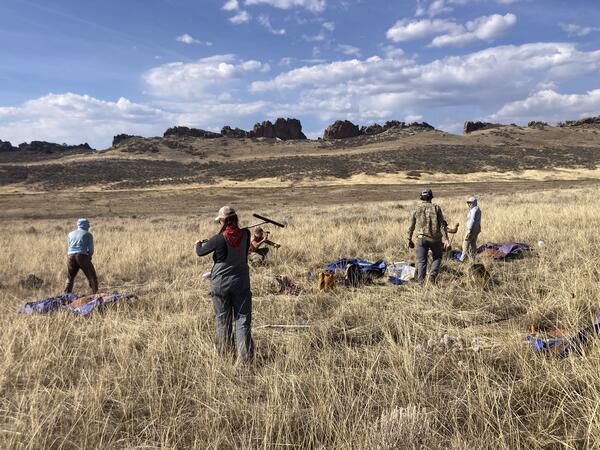
four people standing in a field of brown grass facing bare dirt hills, surrounded by equipment such as tarps and backpacks
Soil sampling in Colorado

A USGS field crew working on soil sampling, plant community monitoring, and soil water infiltration in the Colorado 'front range.'

A USGS field crew working on soil sampling, plant community monitoring, and soil water infiltration in the Colorado 'front range.'

a pile of soil on a blue tarp sitting next to a small hole marked by a red flag
Pit for sampling soil carbon

USGS scientists dig small ‘micro pits' to collect soil for testing. The team is careful to minimize the impact to the environment. Soil is stored on a tarp while sampling so it can be returned to the pit afterwards.

USGS scientists dig small ‘micro pits' to collect soil for testing. The team is careful to minimize the impact to the environment. Soil is stored on a tarp while sampling so it can be returned to the pit afterwards.

a person sitting in a field of brown grass holding a cylinder shaped device
Measuring soil water infiltration

A USGS scientist prepares a mini-disc infiltrometer to assess soil water infiltration. The degree to which water can infiltrate soil is closely tied to soil carbon content.

A USGS scientist prepares a mini-disc infiltrometer to assess soil water infiltration. The degree to which water can infiltrate soil is closely tied to soil carbon content.

a person crouches down in a field of brown grass and examines a blade of grass next to a white grid
Plant community monitoring in Colorado

A USGS scientist uses the grid-point intercept method to characterize plant communities in Larimer County, Colorado. The grid-point intercept method uses points along a grid to sample plant species or ground cover within a larger plot.

A USGS scientist uses the grid-point intercept method to characterize plant communities in Larimer County, Colorado. The grid-point intercept method uses points along a grid to sample plant species or ground cover within a larger plot.

a person kneels down in a field of brown grass and holds a blade of grass up to their face
Identifying grass species in Colorado

USGS scientists identifying plant community composition in Larimer County, Colorado. Information on plant community composition is critical for understanding differences in soil carbon-responses to exotic annual grass invasion between sites. 

USGS scientists identifying plant community composition in Larimer County, Colorado. Information on plant community composition is critical for understanding differences in soil carbon-responses to exotic annual grass invasion between sites. 

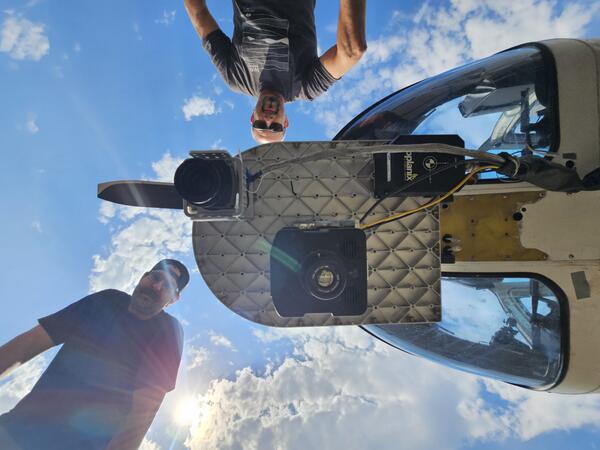
Underside of Bell Jet Helicopter with thermal infrared and true-color image sensors and JN and M.D.
a partially dead juniper tree surrounded by dead juniper and brown grass
Juniper tree in the Stinkingwater Mountains of Oregon

A tall, partially dead western juniper (Juniperus occidentalis) surrounded by smaller, dead juniper trees. Project ROAM (Rapid and Other Methods for Assessment and Monitoring) plots are sampled across a variety of rangeland ecosystems and treatment prescriptions, including juniper removal.

A tall, partially dead western juniper (Juniperus occidentalis) surrounded by smaller, dead juniper trees. Project ROAM (Rapid and Other Methods for Assessment and Monitoring) plots are sampled across a variety of rangeland ecosystems and treatment prescriptions, including juniper removal.

Bell Jet Helicopter with a thermal infrared and true-color sensor co-mounted to the underside
View of nose of Bell Jet Helicopter with a thermal infrared and true-color sensor co-mounted to the underside

Profile view of a Bell Jet Helicopter with a thermal infrared and true-color sensor co-mounted to the underside of the nose. These sensors are used in airborne thermal infrared surveys for remotely sensing land/water surface temperature.

Scientist processing water samples sitting behind a vehicle in front of a field
Water quality sampling near Hart Lake

USGS scientist processing water quality samples near Hart Lake. Water quality can have huge impacts on hydrologic processes, food web characteristics, and prey availability.  

USGS scientist processing water quality samples near Hart Lake. Water quality can have huge impacts on hydrologic processes, food web characteristics, and prey availability.  

a field of sagebrush and yellow flowers under a dark sky full of clouds
Field sampling in Montana

A landscape of sagebrush (Artemisia tridentada) and yellow sweet clover (Melilotus officinalis) on the Charles M. Russell National Wildlife Refuge in Montana.

A landscape of sagebrush (Artemisia tridentada) and yellow sweet clover (Melilotus officinalis) on the Charles M. Russell National Wildlife Refuge in Montana.

rain falling from dark storm clouds over a field of sagebrush and grasses
Storm over sagebrush steppe in Montana

A storm rolls in during field work at the Charles M. Russell National Wildlife Refuge in Montana. Crews were measuring plant cover and other site characteristics. Sagebrush and yellow sweet clover are visible.

A storm rolls in during field work at the Charles M. Russell National Wildlife Refuge in Montana. Crews were measuring plant cover and other site characteristics. Sagebrush and yellow sweet clover are visible.

A clearing of nearly bare dirt surrounded by low, green vegetation. A person wearing a hat is crouched down touching a plant
ROAM field data collection

A five-person USGS crew collecting Rapid and Other Assessment and Monitoring (ROAM) density data in southwest Idaho. One person is inspecting a plant in the foreground, while the rest of the team are identifying and counting individual plants during a radial density belt. 

A five-person USGS crew collecting Rapid and Other Assessment and Monitoring (ROAM) density data in southwest Idaho. One person is inspecting a plant in the foreground, while the rest of the team are identifying and counting individual plants during a radial density belt. 

a white plastic pole and tape mark the location of a sampling plot. The ground is mostly bare dirt with a few small sagebrush
Downward facing photo within a ROAM plot

A downward-facing photo taken on a Rapid and Other Methods for Assessment and Monitoring (ROAM) plot that is within a fuel break. The photo includes a lot of gravel and bare ground, with intermixed small grasses, forbs, and shrubs. 

A downward-facing photo taken on a Rapid and Other Methods for Assessment and Monitoring (ROAM) plot that is within a fuel break. The photo includes a lot of gravel and bare ground, with intermixed small grasses, forbs, and shrubs. 

Was this page helpful?