Funding for the USGS Tunison Laboratory's UV water treatment facility and salmon rearing capabilities come from the Great Lakes Restoration Initiative and from a 2005 Congressional appropriation. Herring splash in oudoor containment channels beside the new facility.
Images
Images
Funding for the USGS Tunison Laboratory's UV water treatment facility and salmon rearing capabilities come from the Great Lakes Restoration Initiative and from a 2005 Congressional appropriation. Herring splash in oudoor containment channels beside the new facility.
Specialized tanks at the USGS Tunison Lab hold young Atlantic salmon until they are released in Lake Ontario tributaries.
A new, sophisticated fish rearing facility in Cortland, N.Y. will help restore Atlantic salmon, bloater, and lake herring to Lake Ontario, strengthening the local ecosystem and economy.
Specialized tanks at the USGS Tunison Lab hold young Atlantic salmon until they are released in Lake Ontario tributaries.
A new, sophisticated fish rearing facility in Cortland, N.Y. will help restore Atlantic salmon, bloater, and lake herring to Lake Ontario, strengthening the local ecosystem and economy.
Coral reef affected by Montipora White Syndrome. Note the large swath of white skeleton tissue surrounded by normal (brown) corals.
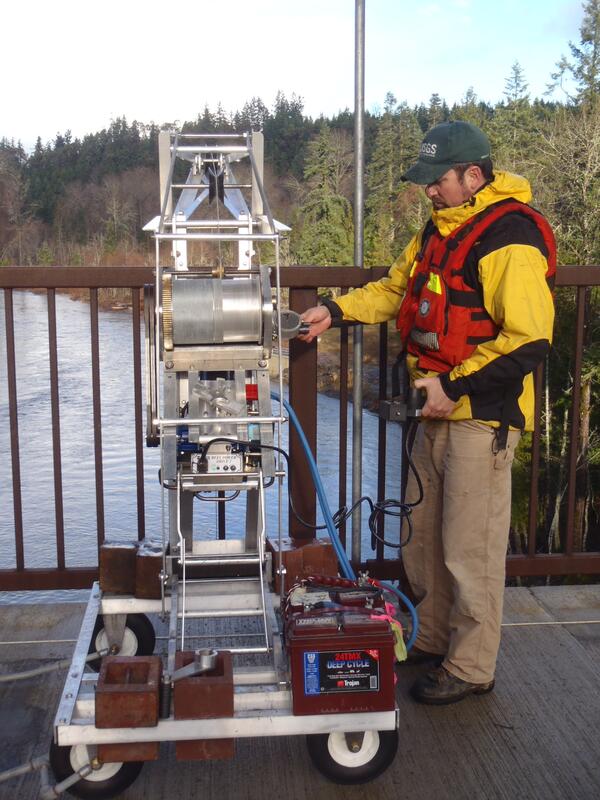
Operating Sediment-sampling Reel, Elwha River, Washington
Operating Sediment-sampling Reel, Elwha River, WashingtonUSGS hydrologic technician James Foreman operates an electronic deployment reel from a bridge over the Elwha River, Washington. Two large dams on the Elwha River are being incrementally removed from 2011 to 2013 to restore river function in an important salmon-bearing river.
Operating Sediment-sampling Reel, Elwha River, Washington
Operating Sediment-sampling Reel, Elwha River, WashingtonUSGS hydrologic technician James Foreman operates an electronic deployment reel from a bridge over the Elwha River, Washington. Two large dams on the Elwha River are being incrementally removed from 2011 to 2013 to restore river function in an important salmon-bearing river.
Researchers use a net to pull an endangered wild manatee onto the beach in order to conduct a physical examination. Information on manatee biology in Crystal River enables biologists to better understand the complex issues confronting this fragile species.
Two of the USGS GLSC's vessels, the R/V Sturgeon and R/V Grayling docked at the Cheboygan Vessel Base in Cheboygan, MI
Elk in the Beartooth Mountains, Wyoming. The USGS and partners study the effects of climate change on the Greater Yellowstone Ecosystem.
Benbrook Lake, December 2011. Photograph by Glenn Harwell, U.S. Geological Survey.
SIR 2012–5202
Benbrook Lake, December 2011. Photograph by Glenn Harwell, U.S. Geological Survey.
SIR 2012–5202
This image of a dusty plume produced by rocks collapsing from the wall of the eruptive vent within Kīlauea Volcano’s Halema‘uma‘u Crater was captured by a USGS time-lapse camera on December 21, 2011. Vigorous spattering on the lava lake deep within the vent created the orange glow visible at the base of the plume.
Source: USGS National Wetlands Research Center. Photographer: Brad M. Glorioso. Calling male; Coldwater River National Wildlife Refuge, Mississippi
Anaxyrus fowleri - Fowler's Toad
Source: USGS National Wetlands Research Center. Photographer: Brad M. Glorioso. Calling male; Coldwater River National Wildlife Refuge, Mississippi
Anaxyrus fowleri - Fowler's Toad
Studying Trench for Possible Earthquake-related Deformation
Studying Trench for Possible Earthquake-related DeformationUSGS geoscientists Wright Horton, Richard Harrison, and Anjana Shah (left to right) are studying an exploratory trench for possible earthquake-related deformation.
Studying Trench for Possible Earthquake-related Deformation
Studying Trench for Possible Earthquake-related DeformationUSGS geoscientists Wright Horton, Richard Harrison, and Anjana Shah (left to right) are studying an exploratory trench for possible earthquake-related deformation.
USGS geophysicist Steve Snyder is measuring gravity, for information on geology beneath the surface, and the GPS location of this measurement in the earthquake area.
Constructed channel features and changes in the Phase 1A side channel restoration area of the Kootenai River near Bonners Ferry, Idaho. The Kootenai Tribe of Idaho is managing a large-scale, ecosystem-based river habitat restoration effort that will be implemented over a period of 10 to 15 years across a 55-mile reach of the Kootenai River in northern Idaho.
Gage house for the streamgage on the Souris River above Minot, North Dakota. Note the highwater marks on the posts.
Fishing guide Camp Walker, Catalyst Charters, of Islamorada, Fla., took this photo of a Burmese python swimming in Florida Bay from the end of Twisty Channel toward End Key on Nov. 16, 2011.
The streamgage housing on the Souris River near Bantry, North Dakota. When the picture was taken streamflow was 307 cubic feet per second and the gage height was 5.45 feet.
House damage in central Oklahoma from the magnitude 5.6 earthquake on Nov. 6, 2011. Research conducted by USGS geophysicist Elizabeth Cochran and her university-based colleagues suggests that this earthquake was induced by injection into deep disposal wells in the Wilzetta North field.
View of Boulder Basin, Lake Mead from Fortification Hill.
Sabrina Davenport and Caleb Troutt, Five Rivers Services, LLC biologists performing work on the Missouri River for the CERC, hold pallid sturgeon PLS09-012 recaptured on November 1, 2011 near Nebraska City, Nebraska. Female pallid sturgeon PLS09-012 is in reproductive condition and will spawn in the spring of 2012.
This setup is used for processing water-quality samples at Sowats Point on the Kaibab Plateau.