U.S. flag

An official website of the United States government

Environmental Health Program

The Environmental Health Program (Contaminant Biology and Toxic Substances Hydrology) supports integrated natural science expertise and capabilities across the USGS related to environmental contaminants and pathogens. This source-to-receptor approach recognizes the interdependence of human and animal health and the health of ecosystems that they share.

News

Addressing Knowledge Gaps on the Potential Effects of Critical Minerals on Aquatic Life

Addressing Knowledge Gaps on the Potential Effects of Critical Minerals on Aquatic Life

EcoNews - Vol. 7 | Issue 2

EcoNews - Vol. 7 | Issue 2

Amphibian Week with USGS: Science for Healthy Habitats

Amphibian Week with USGS: Science for Healthy Habitats

Publications

Per- and polyfluoroalkyl substances in waters associated with oil and gas development in the Denver Basin Per- and polyfluoroalkyl substances in waters associated with oil and gas development in the Denver Basin

Use of per- and polyfluoroalkyl substances (PFAS) in the petroleum industry could be a cause for concern due to the large volumes of produced water (PW) generated during oil and gas extraction, the reuse of these wastes in water-stressed regions, and adverse health outcomes related to PFAS exposures. However, PW PFAS characterization is nearly absent in the literature, and hydraulic...
Authors
Matthew S. Varonka, Aaron M. Jubb, Bonnie McDevitt, Jenna L. Shelton, Elliott P. Barnhart, Denise M. Akob, Isabelle M. Cozzarelli

Pathways for potential exposure to onshore oil and gas wastewater: What we need to know to protect human health Pathways for potential exposure to onshore oil and gas wastewater: What we need to know to protect human health

Produced water is a chemically complex waste stream generated during oil and gas development. Roughly four trillion liters were generated onshore in the United States in 2021 (ALL Consulting, 2022, https://www.gwpc.org/wp-content/uploads/2021/09/2021_Produced_Water_Volumes.pdf). Efforts are underway to expand historic uses of produced water to offset freshwater needs in water-stressed...
Authors
Ayusha Ariana, Isabelle M. Cozzarelli, Cloelle Danforth, Bonnie McDevitt, Anna Rosofsky, Donna Vorhees

A multidisciplinary approach that considers occurrence, geochemistry, bioavailability, and toxicity to prioritize critical minerals for environmental research A multidisciplinary approach that considers occurrence, geochemistry, bioavailability, and toxicity to prioritize critical minerals for environmental research

Critical minerals (or critical elements) are minerals or elements that are essential to global security and development and have supply chains vulnerable to disruption. In general, knowledge of the environmental behavior and health effects of critical elements is needed to support the development of safe and environmentally responsible supplies. This knowledge includes identifying...
Authors
Sarah Jane White, Tyler Kane, Kate M. Campbell, Marie Noele Croteau, Michael G. Iacchetta, Johanna Blake, Charles A. Cravotta, Bethany K. Kunz, Charles N. Alpers, Jill Jenkins, Katherine Walton-Day

Science

Not All PFAS Are Alike: Fish Responses Reveal The Importance Of Real-World Mixtures
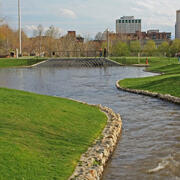
A USGS study demonstrates the importance of monitoring not just the amount of PFAS in groundwater, but the PFAS mixture present. Building on two decades of experience conducting mobile laboratory experiments, USGS researchers applied this approach at a contaminated fire training area to evaluate how fish respond to complex PFAS mixtures, providing important scientific evidence that can improve how...
Not All PFAS Are Alike: Fish Responses Reveal The Importance Of Real-World Mixtures

Not All PFAS Are Alike: Fish Responses Reveal The Importance Of Real-World Mixtures

A USGS study demonstrates the importance of monitoring not just the amount of PFAS in groundwater, but the PFAS mixture present. Building on two decades of experience conducting mobile laboratory experiments, USGS researchers applied this approach at a contaminated fire training area to evaluate how fish respond to complex PFAS mixtures, providing important scientific evidence that can improve how...
Learn More

A Decade of Data Reveals Imidacloprid (a common insecticide) is Increasing in American Rivers

Imidacloprid, a commonly used insecticide in both agricultural and urban settings, is reaching rivers and streams across the country, where it can potentially harm the aquatic insects and other organisms that support healthy freshwater ecosystems. A decade‑long USGS study found this insecticide in nearly half of all samples, often at levels above chronic health benchmarks and present throughout...
A Decade of Data Reveals Imidacloprid (a common insecticide) is Increasing in American Rivers

A Decade of Data Reveals Imidacloprid (a common insecticide) is Increasing in American Rivers

Imidacloprid, a commonly used insecticide in both agricultural and urban settings, is reaching rivers and streams across the country, where it can potentially harm the aquatic insects and other organisms that support healthy freshwater ecosystems. A decade‑long USGS study found this insecticide in nearly half of all samples, often at levels above chronic health benchmarks and present throughout...
Learn More

Land application of waste to US farmland: Understanding the scope and environmental implications to aid best practices

USGS is studying how different waste materials are reused on farmland and what they might mean for people and the environment. These wastes can offer benefits, but they can also carry substances we don’t fully understand. Because little is known about what’s in these waste materials or how they move through soil and water, more information is needed. USGS research helps fill these gaps so...
Land application of waste to US farmland: Understanding the scope and environmental implications to aid best practices

Land application of waste to US farmland: Understanding the scope and environmental implications to aid best practices

USGS is studying how different waste materials are reused on farmland and what they might mean for people and the environment. These wastes can offer benefits, but they can also carry substances we don’t fully understand. Because little is known about what’s in these waste materials or how they move through soil and water, more information is needed. USGS research helps fill these gaps so...
Learn More
Was this page helpful?