Five ways climate change is affecting Salmon.
Graphic by Courtenay Duzet, USGS.
An official website of the United States government
Here's how you know
Official websites use .gov
A .gov website belongs to an official government organization in the United States.
Secure .gov websites use HTTPS
A lock () or https:// means you’ve safely connected to the .gov website. Share sensitive information only on official, secure websites.
Explore photos, graphics, and illustrations related to projects from across the CASC Network. And be sure to check out our Climate Illustrations page, featuring free-to-download illustrations that help describe tricky climate concepts and explain how climate change affects the world around us.
Five ways climate change is affecting Salmon.
Graphic by Courtenay Duzet, USGS.
Five ways climate change is affecting Salmon.
Graphic by Courtenay Duzet, USGS.
Looking down from the lookout point at Brink of Lower Falls, over the Yellowstone River, as it flows south into the distance.
A scenic view of Gothic Mountain in the Elk Mountains of Colorado. USGS scientists captured this photo while collecting soil sample data in the area.
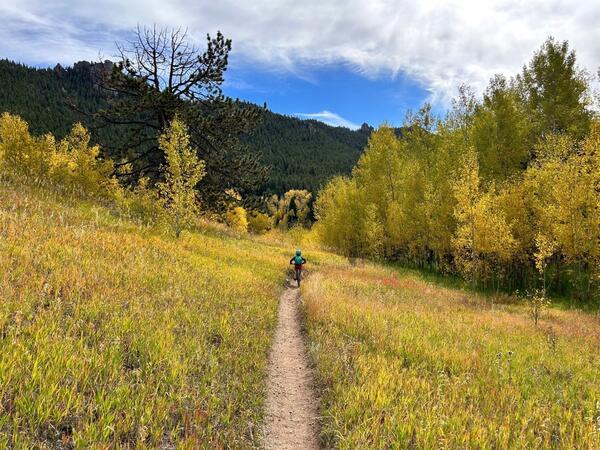
A child riding a mountain bike on a trail in Golden Gate State Park in Colorado amidst the vibrant yellow colors of fall.
A forest trail meanders through a grove of Aspen trees in Colorado during early autumn.
Similar nearby headwater streams are being evaluated to determine how shifts in habitat availability and connectivity in drought years affect fish populations (Carbon County, Wyoming). Photo by Patrick Anderson (USGS).
CASC Senior Administrator Doug Beard co-chaired the working group that led to the IPBES Assessment Report on invasive species which provides management tools and policymaking options to deal with the challenges of biological invasions.
A rooftop patio at the National Center for Ecological Analysis and Synthesis (NCEAS) in Santa Barbara, California.

A view of the southeast side of Olosega Island (foreground), with Ofu Island visible in the background. These volcanoes have steep cliffs and are separated by a 50-foot (15 meter) channel. The steep cliff in the photo is a dike sticking out into the ocean that has been more resistant to weathering than surrounding lava flows. USGS photo by D. Downs.
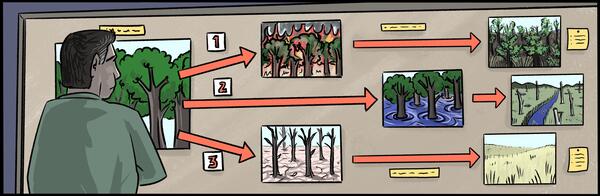
Using climate change scenario planning, managers think about many possible ways their resources could look in the future, and plan for many different eventualities.
Field of invasive annual grasses. Photo by Janet Prevéy (USGS - Fort Collins Science Center).
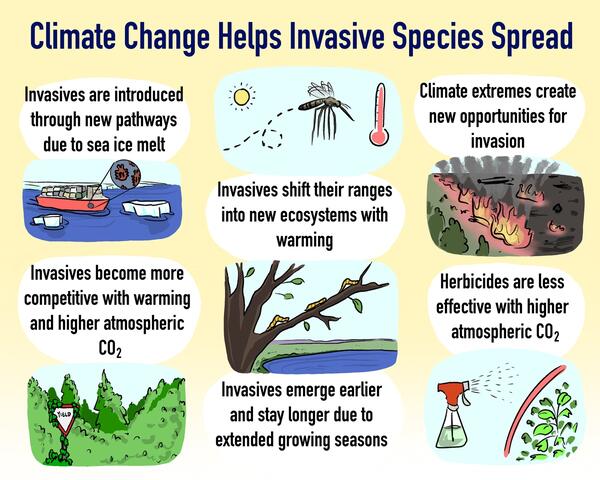
Climate change is impacting invasive species in many ways, including:
Interior Secretary, Deb Haaland, presented with lei by David Phillips, Deputy Scientist-in-Charge of the USGS Hawaiian Volcano Observatory, during a ceremony to celebrate the creation of a new facility that will monitor volcanoes and support conservation science.
Streamgage 04060993 overlooks the Brule River at highway 2 near Florence, Wisconsin on an overcast day in June.
Yellow-headed blackbirds can be found in the spring and summer in the marshes of terminal lakes and wetlands. Common sightings occur in the Klamath, Summer, Malheur and Harney lake basins.
A stormdrain receiving water input during a high-precipitation storm in Massachusetts.
A meadow in City of Rocks National Reserve full of native shrubs and grasses, as well as penstemon (purple), paintbrush (orange), and hooker's balsam (yellow). This healthy meadow ecosystem is bordered by pinyon pine trees.
Planting butterfly-friendly plants in your yard or balcony (especially monarch favorites like native milkweeds), reducing harmful chemical use in your lawns and gardens, and “leaving the leaves” in the fall to protect overwintering pupae can all promote butterfly populations in your area!
Drawing showing climate change impacts to each life cycle stage of monarchs: 1) Butterflies lay fewer eggs in wetter conditions, 2) Warmer temperatures reduce milkweed growth, leaving caterpillars hungry, 3) Erratic winters freeze overwintering pupae, 4) Shifting seasons disrupt migrations.
In this sagebrush community, there are intact biological soil crusts that are composed of cyanobacteria, lichens and mosses. Phlox sp. are growing abundantly on these biocrust communities.
An infographic detailing five ways climate change affects amphibians.
Created by Courtenay Duzet & Louise Johansson, USGS, May 2023.
An infographic detailing five ways climate change affects amphibians.
Created by Courtenay Duzet & Louise Johansson, USGS, May 2023.