



A close up of the southwest portion of the lava lake within Halema‘uma‘u, just south of the west fissure. The lava lake at Kīlauea's summit is perched, and is contained by a steep levee 2-3 meters (yards) high. USGS photo by M. Patrick.
Images
Explore our planet through photography and imagery, including climate change and water all the way back to the 1800s when the USGS was surveying the country by horse and buggy.
Filter Total Items: 21394

Halema‘uma‘u lava lake - 01/18/2021
A close up of the southwest portion of the lava lake within Halema‘uma‘u, just south of the west fissure. The lava lake at Kīlauea's summit is perched, and is contained by a steep levee 2-3 meters (yards) high. USGS photo by M. Patrick.

Recent change in Halema‘uma‘u vent configuration - 01/18/2021
Recent change in Halema‘uma‘u vent configuration - 01/18/2021A close up of the vent area at the western fissure within Halema‘uma‘u at Kīlauea's summit. The two main vents were exhibiting low fountaining while a small vent in the middle had sporadic, weak spattering. USGS photo by M. Patrick.
Recent change in Halema‘uma‘u vent configuration - 01/18/2021
Recent change in Halema‘uma‘u vent configuration - 01/18/2021A close up of the vent area at the western fissure within Halema‘uma‘u at Kīlauea's summit. The two main vents were exhibiting low fountaining while a small vent in the middle had sporadic, weak spattering. USGS photo by M. Patrick.

Recent change in Halema‘uma‘u vent configuration - 01/18/2021
Recent change in Halema‘uma‘u vent configuration - 01/18/2021On the evening of January 17, the vent on the north side of the western fissure in Halema‘uma‘u at Kīlauea's summit activated and seemed to become the dominant vent overnight. This vent is the one on the right in this photo. The vent on the left, which was the dominant vent over the past week, seemed less energetic today. USGS photo by M. Patrick.
Recent change in Halema‘uma‘u vent configuration - 01/18/2021
Recent change in Halema‘uma‘u vent configuration - 01/18/2021On the evening of January 17, the vent on the north side of the western fissure in Halema‘uma‘u at Kīlauea's summit activated and seemed to become the dominant vent overnight. This vent is the one on the right in this photo. The vent on the left, which was the dominant vent over the past week, seemed less energetic today. USGS photo by M. Patrick.

Low fountaining continues at the western fissure in Kīlauea's summit
Low fountaining continues at the western fissure in Kīlauea's summitSunlight interacts with volcanic gas from Kīlauea's summit lava lake and western fissure in this late afternoon view. The western fissure has built a spatter cone on the steep walls of Halema‘uma‘u, with lava spilling into the active lake, which forms the lower right portion of the photo.
Low fountaining continues at the western fissure in Kīlauea's summit
Low fountaining continues at the western fissure in Kīlauea's summitSunlight interacts with volcanic gas from Kīlauea's summit lava lake and western fissure in this late afternoon view. The western fissure has built a spatter cone on the steep walls of Halema‘uma‘u, with lava spilling into the active lake, which forms the lower right portion of the photo.

Low fountaining continues at the western fissure in Kīlauea's summit
Low fountaining continues at the western fissure in Kīlauea's summitA closer view of the low fountaining at the western fissure in Halema‘uma‘u at Kīlauea's summit. The rim of the cone is built from accumulated deposits of spatter, and large chunks of the cone rim were observed to collapse from time to time. USGS photo by M. Patrick
Low fountaining continues at the western fissure in Kīlauea's summit
Low fountaining continues at the western fissure in Kīlauea's summitA closer view of the low fountaining at the western fissure in Halema‘uma‘u at Kīlauea's summit. The rim of the cone is built from accumulated deposits of spatter, and large chunks of the cone rim were observed to collapse from time to time. USGS photo by M. Patrick

Low fountaining continues at the western fissure in Kīlauea's summit
Low fountaining continues at the western fissure in Kīlauea's summitLow fountaining continues at the western fissure, supplying lava to the lava lake in Halema‘uma‘u crater, at the summit of Kīlauea. The vent has formed a spatter cone around the fountaining, with lava spilling into an open channel that plunges into the lake.
Low fountaining continues at the western fissure in Kīlauea's summit
Low fountaining continues at the western fissure in Kīlauea's summitLow fountaining continues at the western fissure, supplying lava to the lava lake in Halema‘uma‘u crater, at the summit of Kīlauea. The vent has formed a spatter cone around the fountaining, with lava spilling into an open channel that plunges into the lake.

Drilling through Ice
Drilling through ice on the Green River.
Drilling through ice on the Green River.

Mudpot located near Mud Volcano in Yellowstone National Park
Mudpot located near Mud Volcano in Yellowstone National ParkMudpot located in the Mud Volcano thermal area of Yellowstone National Park. This type of thermal feature indicates an acid-sulfate system.
Mudpot located near Mud Volcano in Yellowstone National Park
Mudpot located near Mud Volcano in Yellowstone National ParkMudpot located in the Mud Volcano thermal area of Yellowstone National Park. This type of thermal feature indicates an acid-sulfate system.

Steam vents along the Yellowstone River near Mud Volcano thermal area
Steam vents along the Yellowstone River near Mud Volcano thermal areaSteam vents along the Yellowstone River near Mud Volcano thermal area, Yellowstone National Park.
Steam vents along the Yellowstone River near Mud Volcano thermal area
Steam vents along the Yellowstone River near Mud Volcano thermal areaSteam vents along the Yellowstone River near Mud Volcano thermal area, Yellowstone National Park.

Structure 77 on the Caloosahatchee River at Moore Haven, Florid
Structure 77 on the Caloosahatchee River at Moore Haven, FloridStructure 77 (S-77) on the Caloosahatchee River at Moore Haven, Florida.
Structure 77 on the Caloosahatchee River at Moore Haven, Florid
Structure 77 on the Caloosahatchee River at Moore Haven, FloridStructure 77 (S-77) on the Caloosahatchee River at Moore Haven, Florida.

USGS technician holding a bottle containing a sediment sample
USGS technician holding a bottle containing a sediment sampleHydrologic Technician Alan Cressler holding a bottle containing a sediment sample. Photo taken on the Caloosahatchee River below Structure 77, Moore Haven, Florida.
USGS technician holding a bottle containing a sediment sample
USGS technician holding a bottle containing a sediment sampleHydrologic Technician Alan Cressler holding a bottle containing a sediment sample. Photo taken on the Caloosahatchee River below Structure 77, Moore Haven, Florida.

USGS technician loading a bottle into a DH-95 water-quality sampler
USGS technician loading a bottle into a DH-95 water-quality samplerHydrologic Technician Alan Cressler loading a bottle into a DH-95 water-quality sampler. Photo taken on the Caloosahatchee River below Structure 77, Moore Haven, Florida
USGS technician loading a bottle into a DH-95 water-quality sampler
USGS technician loading a bottle into a DH-95 water-quality samplerHydrologic Technician Alan Cressler loading a bottle into a DH-95 water-quality sampler. Photo taken on the Caloosahatchee River below Structure 77, Moore Haven, Florida

Kīlauea eruption in Halemaʻumaʻu on January 11, 2021
Kīlauea eruption in Halemaʻumaʻu on January 11, 2021The west vent in Halemaʻumaʻu erupting and building a spatter cone complex, with lava cascades feeding a growing lava lake at Kīlauea summit. USGS photograph from January 11, 2021, by B. Carr.
Kīlauea eruption in Halemaʻumaʻu on January 11, 2021
Kīlauea eruption in Halemaʻumaʻu on January 11, 2021The west vent in Halemaʻumaʻu erupting and building a spatter cone complex, with lava cascades feeding a growing lava lake at Kīlauea summit. USGS photograph from January 11, 2021, by B. Carr.

Dusk view of Halema‘uma‘u lava lake, Saturday, January 9, 2021
Dusk view of Halema‘uma‘u lava lake, Saturday, January 9, 2021Around sunset on Saturday (January 9, 2021), a break in the rain allowed HVO scientists to visit and monitor the ongoing eruption in Halema‘uma‘u. The west vent is still actively effusing lava, but outflow into the lava lake is increasingly sluggish, as evidenced by slow-moving crustal plates near the once-vigorous vent outlet.
Dusk view of Halema‘uma‘u lava lake, Saturday, January 9, 2021
Dusk view of Halema‘uma‘u lava lake, Saturday, January 9, 2021Around sunset on Saturday (January 9, 2021), a break in the rain allowed HVO scientists to visit and monitor the ongoing eruption in Halema‘uma‘u. The west vent is still actively effusing lava, but outflow into the lava lake is increasingly sluggish, as evidenced by slow-moving crustal plates near the once-vigorous vent outlet.

Evening view of Halema‘uma‘u lava lake, Saturday, January 9, 2021
Evening view of Halema‘uma‘u lava lake, Saturday, January 9, 2021The arrival of nightfall at Halema‘uma‘u on January 9, 2021, provided a clearer view of ongoing eruptive activity for USGS scientists monitoring the eruption this Saturday evening.
Evening view of Halema‘uma‘u lava lake, Saturday, January 9, 2021
Evening view of Halema‘uma‘u lava lake, Saturday, January 9, 2021The arrival of nightfall at Halema‘uma‘u on January 9, 2021, provided a clearer view of ongoing eruptive activity for USGS scientists monitoring the eruption this Saturday evening.
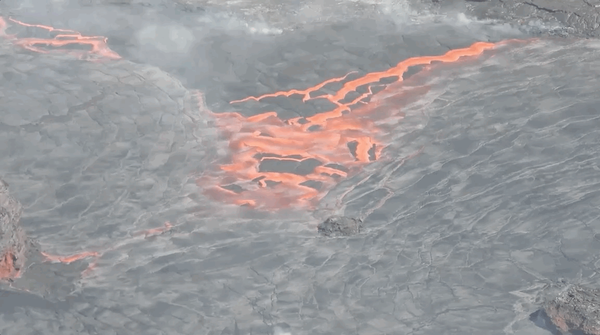
Crustal Overturning (4x speed of original video)
This animated GIF was created from a clip within the original video showing crustal overturning at Kīlauea Volcano in Hawaii. The original video was at 20x the speed of the event, and this animation 4x faster.
This animated GIF was created from a clip within the original video showing crustal overturning at Kīlauea Volcano in Hawaii. The original video was at 20x the speed of the event, and this animation 4x faster.
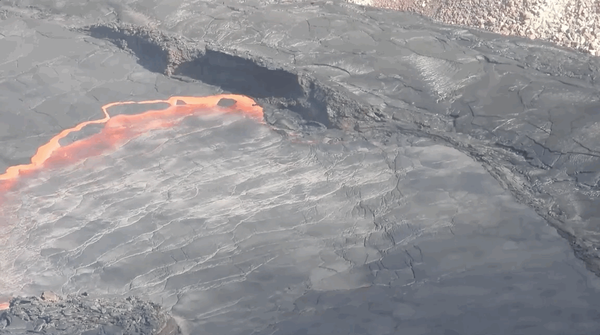
Crustal Overturning (4x speed of original video)
This animated GIF was created from a clip within the original video showing crustal overturning at Kīlauea Volcano in Hawaii. The original video was at 20x the speed of the event, and this animation 4x faster.
This animated GIF was created from a clip within the original video showing crustal overturning at Kīlauea Volcano in Hawaii. The original video was at 20x the speed of the event, and this animation 4x faster.

Halema‘uma‘u just after sunset on January 8, 2021
Kīlauea’s summit lava lake, in Halema‘uma‘u, just after sunset on January 8, 2021. This view is to the north, from the south rim of the crater. HVO scientists continue to monitor the eruption within an area of Hawai‘i Volcanoes National Park that remains closed to the public for safety reasons. USGS image by N. Deligne.
Kīlauea’s summit lava lake, in Halema‘uma‘u, just after sunset on January 8, 2021. This view is to the north, from the south rim of the crater. HVO scientists continue to monitor the eruption within an area of Hawai‘i Volcanoes National Park that remains closed to the public for safety reasons. USGS image by N. Deligne.

Irrigated Land Use, Adelaida Area, San Luis Obispo County, CA
Irrigated Land Use, Adelaida Area, San Luis Obispo County, CAIrrigated land-use in the Adelaida Area of San Luis Obisbo County, CA for 1984, 1996, 2004, 2014, and 2016. Numbers indicate acres and percent of total acres.
Irrigated Land Use, Adelaida Area, San Luis Obispo County, CA
Irrigated Land Use, Adelaida Area, San Luis Obispo County, CAIrrigated land-use in the Adelaida Area of San Luis Obisbo County, CA for 1984, 1996, 2004, 2014, and 2016. Numbers indicate acres and percent of total acres.

Islands in Halemaumau and Kilauea Volcano lava lake, 1917 & 2021
Islands in Halemaumau and Kilauea Volcano lava lake, 1917 & 2021Islands have been observed in Kīlauea lava lakes for more than 100 years—some move and some are moored. These two photographs of Halemaʻumaʻu crater from 1917 (top) and 2021 (bottom) show islands floating in lava lakes.
Islands in Halemaumau and Kilauea Volcano lava lake, 1917 & 2021
Islands in Halemaumau and Kilauea Volcano lava lake, 1917 & 2021Islands have been observed in Kīlauea lava lakes for more than 100 years—some move and some are moored. These two photographs of Halemaʻumaʻu crater from 1917 (top) and 2021 (bottom) show islands floating in lava lakes.

Kīlauea summit aerial imagery - January 7, 2021
This photo, taken during an overflight of Kīlauea's summit this morning (January 7, 2021), shows the southeast margin of Halemaʻumaʻu's growing lava lake. The photo shows the boundary between the active portion of the lava lake (left) and the subtle levee around the lake perimeter that allows the lake to be slightly perched.
This photo, taken during an overflight of Kīlauea's summit this morning (January 7, 2021), shows the southeast margin of Halemaʻumaʻu's growing lava lake. The photo shows the boundary between the active portion of the lava lake (left) and the subtle levee around the lake perimeter that allows the lake to be slightly perched.