U.S. flag

An official website of the United States government

Videos

Explore a diverse collection of engaging videos showcasing the latest research, discoveries, and educational content from the U.S. Geological Survey. Dive into the fascinating world of geology, hydrology, ecology, and natural hazards as we bring science to life. Stay informed and inspired by our visual storytelling that highlights the vital work of USGS scientists and their impact on the planet.

Filter Total Items: 2905
September 29, 2021 — Kīlauea eruption dominant fountain

A new Kīlauea summit eruption within Halema‘uma‘u crater began at approximately 3:20 p.m. HST on September 29, 2021, with fountains appearing on the central crater floor, creating a new lava lake. This video shows the dominant fountain, south of the lake center, on the evening of September 29, 2021. USGS video by M. Patrick.

A new Kīlauea summit eruption within Halema‘uma‘u crater began at approximately 3:20 p.m. HST on September 29, 2021, with fountains appearing on the central crater floor, creating a new lava lake. This video shows the dominant fountain, south of the lake center, on the evening of September 29, 2021. USGS video by M. Patrick.

September 29, 2021 — Kīlauea eruption west vent

A new Kīlauea summit eruption within Halema‘uma‘u crater began at approximately 3:20 p.m. HST on September 29, 2021, with fountains appearing on the central crater floor, where a lava lake had been active from December 2020 until May 2021. Just after 4:40 p.m., a new vent opened on the west wall of the crater, and the initial moments were captured in this video.

A new Kīlauea summit eruption within Halema‘uma‘u crater began at approximately 3:20 p.m. HST on September 29, 2021, with fountains appearing on the central crater floor, where a lava lake had been active from December 2020 until May 2021. Just after 4:40 p.m., a new vent opened on the west wall of the crater, and the initial moments were captured in this video.

Natural resource economist Natural resource economist
I Am A...Natural Resource Economist

Welcome to the “I Am A(n)..." series, a whiteboard animation video series highlighting USGS careers.

Welcome to the “I Am A(n)..." series, a whiteboard animation video series highlighting USGS careers.

A Legacy Continues with Landsat 9 Launch

Landsat 9 is a partnership between NASA and USGS. The satellite will continue the Landsat program’s mission to capture repeat snapshots of Earth to monitor, understand and manage natural resources.

Landsat 9 is a partnership between NASA and USGS. The satellite will continue the Landsat program’s mission to capture repeat snapshots of Earth to monitor, understand and manage natural resources.

PubTalk - 9/2021: Modernizing the National Water Information System

Modernizing the National Water Information System: Charting the Course for Delivering Water Data in the 21st Century

By: Daniel Pearson, USGS NWIS Modernization Program Manager, Water Mission Area

Modernizing the National Water Information System: Charting the Course for Delivering Water Data in the 21st Century

By: Daniel Pearson, USGS NWIS Modernization Program Manager, Water Mission Area

Landsat 9 Launch Trajectory Animation

When #Landsat9 is launched from Lompoc, CA, a ULA Atlas V booster will lift it out over the Pacific Ocean, over 2,500 miles away in the first 15 minutes, rising quickly. If all goes as expected, about an hour later Landsat 9 will be in orbit, 438 miles high, falling around the Earth at 16,760 miles per hour, positioned to capture years of imagery.

When #Landsat9 is launched from Lompoc, CA, a ULA Atlas V booster will lift it out over the Pacific Ocean, over 2,500 miles away in the first 15 minutes, rising quickly. If all goes as expected, about an hour later Landsat 9 will be in orbit, 438 miles high, falling around the Earth at 16,760 miles per hour, positioned to capture years of imagery.

Landsat Launches - Looking Back

A short look back at the the history of Landsat launches through the historic articles of the Lompoc Record publication.

View AD version.

Landsat Launches - Looking Back (AD)

[Audio Descriptions]
A short look back at the the history of Landsat launches through the historic articles of the Lompoc Record publication.

View non-AD version.


Earth Observation User Case Study: Power of the Pixel - 1972 to 2021

Social scientists at the U.S. Geological Survey (USGS) Fort Collins Science Center – in collaboration with the USGS National Land Imaging Program – conduct Earth observation user case studies using qualitative research methods.

Snow avalanches: A hazard and driver of landscape change

Snow avalanches kill, on average, 27 people in the United States each year and impact infrastructure and commerce in mountainous areas.

Installing Coastal Camera Tower

Time-lapse of USGS researchers raising a mechanical mast with a high-resolution camera mounted on top, which was deployed atop a dune in the U.S.

Time-lapse of USGS researchers raising a mechanical mast with a high-resolution camera mounted on top, which was deployed atop a dune in the U.S.

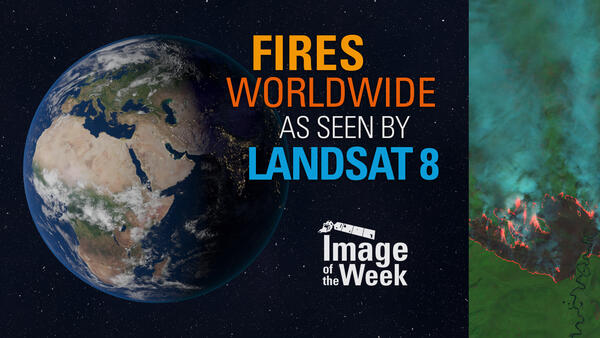
Image of the Week - Fires Worldwide as Seen by Landsat 8

Landsat satellites acquire useful data on wildfires around the world. Their near infrared and shortwave infrared imaging allows for detection and mapping of fire, smoke, and burn scars often in remote areas.

In California: the Dixie Fire near Lake Almanor and the Caldor Fire near Lake Tahoe.

Landsat satellites acquire useful data on wildfires around the world. Their near infrared and shortwave infrared imaging allows for detection and mapping of fire, smoke, and burn scars often in remote areas.

In California: the Dixie Fire near Lake Almanor and the Caldor Fire near Lake Tahoe.

Lees Ferry - 100 Years of Streamflow Monitoring

On October 1, 2021, the U.S. Geological Survey Colorado River streamflow gaging site (USGS 09380000) at Lees Ferry will mark its 100-year anniversary of recording continuous streamflow data.

On October 1, 2021, the U.S. Geological Survey Colorado River streamflow gaging site (USGS 09380000) at Lees Ferry will mark its 100-year anniversary of recording continuous streamflow data.

Hudson River Spatial Mapping Trip

This is a video recording taken during a spatial mapping boat trip of about 50 miles on the Hudson River from New Hamburg to Yonkers, NY, passing through the Hudson Highlands, West Point, and the Tappan Zee.

This is a video recording taken during a spatial mapping boat trip of about 50 miles on the Hudson River from New Hamburg to Yonkers, NY, passing through the Hudson Highlands, West Point, and the Tappan Zee.

Water, sediment supply reqs—post-wildfire debris flows in western U.S.

We sometimes fall back on an implicit model that post-wildfire debris flows are only triggered once a certain level of saturation or rainfall is reached, and that the sediment supply is soon exhausted and future flows are unlikely until it recharges.

We sometimes fall back on an implicit model that post-wildfire debris flows are only triggered once a certain level of saturation or rainfall is reached, and that the sediment supply is soon exhausted and future flows are unlikely until it recharges.

Image of the Week - Ida Rains on Eastern Pennsylvania

The remnants of Hurricane Ida dumped several inches of rain on eastern Pennsylvania.

These Landsat images show the Schuylkill River west of Philadelphia where muddied waters rose in several communities.

This image from August 26th shows typical river levels in the Phoenixville area.

The remnants of Hurricane Ida dumped several inches of rain on eastern Pennsylvania.

These Landsat images show the Schuylkill River west of Philadelphia where muddied waters rose in several communities.

This image from August 26th shows typical river levels in the Phoenixville area.

Image of the Week - Caldor Fire Expands Toward Lake Tahoe

The Caldor fire in California started on August 14, 2021 and quickly spread in high winds.

The fire continues to expand toward the Lake Tahoe area as residents evacuate.

This image was captured on August 21, the 8th day.

Landsat 8's near infrared and shortwave infrared bands reveal active fire, burn scars, and smoke.

The Caldor fire in California started on August 14, 2021 and quickly spread in high winds.

The fire continues to expand toward the Lake Tahoe area as residents evacuate.

This image was captured on August 21, the 8th day.

Landsat 8's near infrared and shortwave infrared bands reveal active fire, burn scars, and smoke.

Yellowstone Volcano Update for August 2021

Yellowstone Volcano Observatory scientist-in-charge Mike Poland tells the story behind the color change of Morning Glory Pool and shows how to recognize seasonal changes in ground deformation data in this September 1, 2021 video update of volcano and earthquake activity at Yellowstone Volcano.

Yellowstone Volcano Observatory scientist-in-charge Mike Poland tells the story behind the color change of Morning Glory Pool and shows how to recognize seasonal changes in ground deformation data in this September 1, 2021 video update of volcano and earthquake activity at Yellowstone Volcano.

Was this page helpful?