



A vibracore being deployed by USGS staff from the FSU R/V Apalachee for the Naval Research Laboratory (NRL). The objective of this field effort was to establish a baseline environmental characterization for a test bed to predict mobility and burial of unexploded ordnance (UXO) in response to waves and currents.
Images
Coastal and Marine Hazards and Resources Program images.
Filter Total Items: 2491

Vibracore in shallow water
A vibracore being deployed by USGS staff from the FSU R/V Apalachee for the Naval Research Laboratory (NRL). The objective of this field effort was to establish a baseline environmental characterization for a test bed to predict mobility and burial of unexploded ordnance (UXO) in response to waves and currents.

Retrieving a sediment trap on the R/V Weatherbird II
Retrieving a sediment trap on the R/V Weatherbird IICaitlin Reynolds retrieving one of the sediment traps used by USGS to study sediment flux in the Gulf of America on board the Research Vessel (R/V) Weatherbird II (Florida Institute of Oceanography).
Retrieving a sediment trap on the R/V Weatherbird II
Retrieving a sediment trap on the R/V Weatherbird IICaitlin Reynolds retrieving one of the sediment traps used by USGS to study sediment flux in the Gulf of America on board the Research Vessel (R/V) Weatherbird II (Florida Institute of Oceanography).

Taking water samples from a CTD-rosette
Eckerd College students taking water samples from a CTD-rosette on board the R/V Weatherbird
Eckerd College students taking water samples from a CTD-rosette on board the R/V Weatherbird

Coastal erosion model outreach activity
An erosion model activity used by the St. Petersburg Coastal and Marine Science Center to showcase how hurricane-force winds can cause damage to coastal environments.
An erosion model activity used by the St. Petersburg Coastal and Marine Science Center to showcase how hurricane-force winds can cause damage to coastal environments.

SQUID-5 test near the St. Pete Pier
The SQUID-5, or Structure-from-motion (SfM) Quantitative Underwater Imaging Device with 5 cameras test in Tampa Bay.
The SQUID-5, or Structure-from-motion (SfM) Quantitative Underwater Imaging Device with 5 cameras test in Tampa Bay.

Dr. Legna Torres-García conducts outreach
Dr. Legna Torres-García conducts an erosion model activity at the LCC Day School in St. Petersburg, FL, to showcase how hurricane-force winds can cause damage to coastal environments.
Dr. Legna Torres-García conducts an erosion model activity at the LCC Day School in St. Petersburg, FL, to showcase how hurricane-force winds can cause damage to coastal environments.

SQUID-5 deployment in Tampa Bay
The SQUID-5, or Structure-from-motion (SfM) Quantitative Underwater Imaging Device with 5 cameras, being deployed by Mitch Lemon (SPCMSC, on the left) and Gerry Hatcher (PCMSC, on the right) in Tampa Bay for testing.
The SQUID-5, or Structure-from-motion (SfM) Quantitative Underwater Imaging Device with 5 cameras, being deployed by Mitch Lemon (SPCMSC, on the left) and Gerry Hatcher (PCMSC, on the right) in Tampa Bay for testing.

USGS Ocean Research
Our coasts, the most familiar part of the ocean are the gateway to the larger deeper ocean world. USGS studies processes and hazards in the coastal zone and how they affect people, wildlife, and ecosystems.
Our coasts, the most familiar part of the ocean are the gateway to the larger deeper ocean world. USGS studies processes and hazards in the coastal zone and how they affect people, wildlife, and ecosystems.

SQUID-5 being prepped for a test run
The SQUID-5, or Structure-from-motion (SfM) Quantitative Underwater Imaging Device with 5 cameras, shown being staged for a test run at the St. Petersburg Coastal and Marine Science Center. In the background, Andy Farmer (SPCMSC) and Gerry Hatcher (PCMSC) prep the R/V Sallenger, the vessel being used to tow the device.
The SQUID-5, or Structure-from-motion (SfM) Quantitative Underwater Imaging Device with 5 cameras, shown being staged for a test run at the St. Petersburg Coastal and Marine Science Center. In the background, Andy Farmer (SPCMSC) and Gerry Hatcher (PCMSC) prep the R/V Sallenger, the vessel being used to tow the device.

R/V Weatherbird II in port
The R/V Weatherbird II docked at the Florida Institute of Oceanography at University of South Florida (USF) College of Marine Science in St. Petersburg, Florida. USGS scientists and partners at Eckerd College and USF load the vessel in preparation for a research cruise as part of a National Science Foundation (NSF)-funded Scientists-at-Sea program.
The R/V Weatherbird II docked at the Florida Institute of Oceanography at University of South Florida (USF) College of Marine Science in St. Petersburg, Florida. USGS scientists and partners at Eckerd College and USF load the vessel in preparation for a research cruise as part of a National Science Foundation (NSF)-funded Scientists-at-Sea program.

Screenshot of the Coastal Change Hazards Portal showing historical shoreline change for Puerto Rico
Screenshot of the Coastal Change Hazards Portal showing historical shoreline change for Puerto RicoThe USGS Coastal Change Hazards Portal contains an interactive map of historical shoreline positions and shoreline change rates for Puerto Rico.
Screenshot of the Coastal Change Hazards Portal showing historical shoreline change for Puerto Rico
Screenshot of the Coastal Change Hazards Portal showing historical shoreline change for Puerto RicoThe USGS Coastal Change Hazards Portal contains an interactive map of historical shoreline positions and shoreline change rates for Puerto Rico.

Idealized animation of tsunamis in the Kingdom of Tonga
Idealized animation of tsunamis in the Kingdom of TongaIdealized animation of tsunamis produced by the 15 January 2022 eruption of Hunga Tonga-Hunga Ha‛apai volcano in the Kingdom of Tonga. View to the southeast.
Idealized animation of tsunamis in the Kingdom of Tonga
Idealized animation of tsunamis in the Kingdom of TongaIdealized animation of tsunamis produced by the 15 January 2022 eruption of Hunga Tonga-Hunga Ha‛apai volcano in the Kingdom of Tonga. View to the southeast.

Screenshot of a simulated tsunami animation
Screenshot of an idealized animation of tsunamis produced by the 15 January 2022 eruption of Hunga Tonga-Hunga Haʻapai volcano in the Kingdom of Tonga. View to the north-northeast. The fastest water wave to radiate away from the eruption is being pushed by an atmospheric wave triggered by the explosion.
Screenshot of an idealized animation of tsunamis produced by the 15 January 2022 eruption of Hunga Tonga-Hunga Haʻapai volcano in the Kingdom of Tonga. View to the north-northeast. The fastest water wave to radiate away from the eruption is being pushed by an atmospheric wave triggered by the explosion.
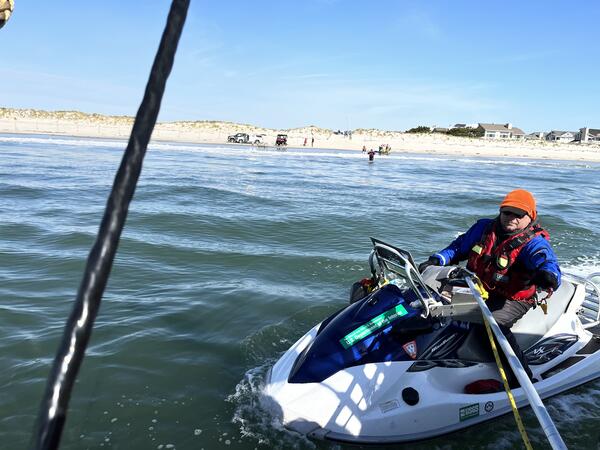
Multiple gears used to collect data on the Seven Mile Island shoreface
Multiple gears used to collect data on the Seven Mile Island shorefaceBJ Reynolds of the St. Petersburg Coastal and Marine Science Center operates a personal watercraft near the shoreline of Seven Mile Island, New Jersey. This vessel is used to collect single beam bathymetry (depth and seafloor shape) in the nearshore, and the equipment on the shoreline is used to collect chirp seismic reflection on the shoreface and inner shelf.
Multiple gears used to collect data on the Seven Mile Island shoreface
Multiple gears used to collect data on the Seven Mile Island shorefaceBJ Reynolds of the St. Petersburg Coastal and Marine Science Center operates a personal watercraft near the shoreline of Seven Mile Island, New Jersey. This vessel is used to collect single beam bathymetry (depth and seafloor shape) in the nearshore, and the equipment on the shoreline is used to collect chirp seismic reflection on the shoreface and inner shelf.

Idealized animation of tsunamis in the Kingdom of Tonga looking north-northeast
Idealized animation of tsunamis in the Kingdom of Tonga looking north-northeastIdealized animation of tsunamis produced by the 15 January 2022 eruption of Hunga Tonga-Hunga Ha‛apai volcano in the Kingdom of Tonga. View to the north-northeast.
Idealized animation of tsunamis in the Kingdom of Tonga looking north-northeast
Idealized animation of tsunamis in the Kingdom of Tonga looking north-northeastIdealized animation of tsunamis produced by the 15 January 2022 eruption of Hunga Tonga-Hunga Ha‛apai volcano in the Kingdom of Tonga. View to the north-northeast.

Trayectorias de los huracanes, Puerto Rico
Trayectorias de los huracanes Hugo (1989), Georges (1998), Irma (2017) y María (2017). Datos provistos por la NOAA. La imagen de base es propiedad intelectual de Esri y se usa aquí bajo licencia. Los derechos de autor y reproducción son propiedad de Esri y sus licenciatarios.
Trayectorias de los huracanes Hugo (1989), Georges (1998), Irma (2017) y María (2017). Datos provistos por la NOAA. La imagen de base es propiedad intelectual de Esri y se usa aquí bajo licencia. Los derechos de autor y reproducción son propiedad de Esri y sus licenciatarios.

Coasts, Estuaries, Wetlands, and Marshes
Photograph collage representing different coastlines; permafrost coasts, sandy beaches, rocky beaches, wetlands and marshes, cliff-backed beaches, and estuaries.
Photograph collage representing different coastlines; permafrost coasts, sandy beaches, rocky beaches, wetlands and marshes, cliff-backed beaches, and estuaries.

Bathymetric digital elevation model (DEM) of Eastern Dry Rocks coral reef, Florida, 2021
Bathymetric digital elevation model (DEM) of Eastern Dry Rocks coral reef, Florida, 2021A digital elevation model (DEM) was created from underwater images collected at Eastern Dry Rocks coral reef near Key West, Florida, in May 2021 using the SQUID-5 camera system. The underwater images were processed using Structure-from-Motion (SfM) photogrammetry techniques into a classified two-class ('unclassified' and 'low noise') 3D point cloud.
Bathymetric digital elevation model (DEM) of Eastern Dry Rocks coral reef, Florida, 2021
Bathymetric digital elevation model (DEM) of Eastern Dry Rocks coral reef, Florida, 2021A digital elevation model (DEM) was created from underwater images collected at Eastern Dry Rocks coral reef near Key West, Florida, in May 2021 using the SQUID-5 camera system. The underwater images were processed using Structure-from-Motion (SfM) photogrammetry techniques into a classified two-class ('unclassified' and 'low noise') 3D point cloud.

Mendenhall Fellows Noa Randall and Rachel Allen Do Fieldwork
Mendenhall Fellows Noa Randall and Rachel Allen Do FieldworkNoa Randall and Rachel Allen are installing an optical turbidity sensor on the mudflats in Wellfleet harbor, to pair with the altimeter run by the Center for Coastal Studies. The Herring River, which drains into Wellfleet Harbor, is slated to have its 100-yo dam removed in the next 6 months, with the potential to dramatically increase the sediment load and sus
Mendenhall Fellows Noa Randall and Rachel Allen Do Fieldwork
Mendenhall Fellows Noa Randall and Rachel Allen Do FieldworkNoa Randall and Rachel Allen are installing an optical turbidity sensor on the mudflats in Wellfleet harbor, to pair with the altimeter run by the Center for Coastal Studies. The Herring River, which drains into Wellfleet Harbor, is slated to have its 100-yo dam removed in the next 6 months, with the potential to dramatically increase the sediment load and sus

Geologist Julie Bernier examines a water-logged sand auger core
Geologist Julie Bernier examines a water-logged sand auger coreScientists collected sand auger cores from Fire Island to help reconstruct the evolution of the barrier over the last several centuries, with the goal of quantifying changes in sediment input and partitioning through time (e.g. how sand is distributed between the terrestrial portion of the barrier and the beach/shoreface).
Geologist Julie Bernier examines a water-logged sand auger core
Geologist Julie Bernier examines a water-logged sand auger coreScientists collected sand auger cores from Fire Island to help reconstruct the evolution of the barrier over the last several centuries, with the goal of quantifying changes in sediment input and partitioning through time (e.g. how sand is distributed between the terrestrial portion of the barrier and the beach/shoreface).

Research Geologist Daniel Ciarletta holds up a sand auger core collected at Fire Island
Research Geologist Daniel Ciarletta holds up a sand auger core collected at Fire IslandScientists collected sand auger cores from Fire Island to help reconstruct the evolution of the barrier over the last several centuries, with the goal of quantifying changes in sediment input and partitioning through time (e.g., how sand is distributed between the terrestrial portion of the barrier and the beach/shoreface).
Research Geologist Daniel Ciarletta holds up a sand auger core collected at Fire Island
Research Geologist Daniel Ciarletta holds up a sand auger core collected at Fire IslandScientists collected sand auger cores from Fire Island to help reconstruct the evolution of the barrier over the last several centuries, with the goal of quantifying changes in sediment input and partitioning through time (e.g., how sand is distributed between the terrestrial portion of the barrier and the beach/shoreface).