USGS scientists Adrian Bender and Peter Haeussler walk along the base of a ~10 m tall escarpment formed during past ground-rupturing earthquakes on the Fairweather Fault. Location: Crillon Lake, Glacier Bay National Park, Alaska
Images
Browse images from a wide range of science topics covered by USGS.
USGS scientists Adrian Bender and Peter Haeussler walk along the base of a ~10 m tall escarpment formed during past ground-rupturing earthquakes on the Fairweather Fault. Location: Crillon Lake, Glacier Bay National Park, Alaska
USGS Geologist Adrian Bender surveys a trace of the 1958 Fairweather Fault earthquake surface rupture. The trace forms a linear, uphill-facing, 1-2 m tall escarpment flanked by trees that were likely tilted during the 1958 earthquake. Location: Crillon Lake, Glacier Bay National Park, Alaska.
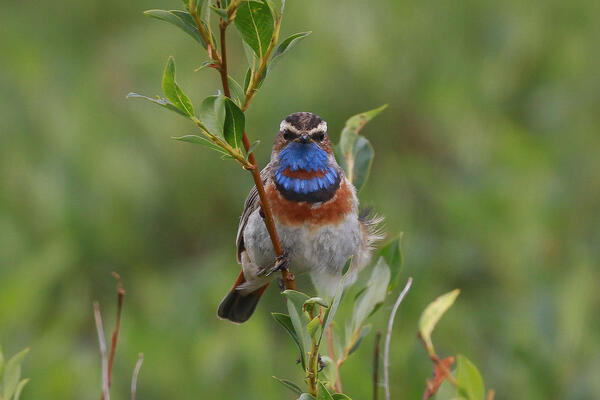
Male Arctic Warbler on the Seward Peninsula, Alaska
Male Arctic Warbler on the Seward Peninsula, AlaskaMale Arctic Warbler on the Seward Peninsula, Alaska. This photo was taken on the Seward Peninsula as part of the Changing Arctic Ecosystem Boreal-Arctic Transition Zone program.
Male Arctic Warbler on the Seward Peninsula, Alaska
Male Arctic Warbler on the Seward Peninsula, AlaskaMale Arctic Warbler on the Seward Peninsula, Alaska. This photo was taken on the Seward Peninsula as part of the Changing Arctic Ecosystem Boreal-Arctic Transition Zone program.
Setting a trap for gulls at the Soldotna landfill in June 2016
Setting a trap for gulls at the Soldotna landfill in June 2016Scientists Andrew Ramey, Bjorn Olsen, and Jonas Bonnedahl (L to R) setting a trap for gulls at the Soldotna landfill in June 2016.
Setting a trap for gulls at the Soldotna landfill in June 2016
Setting a trap for gulls at the Soldotna landfill in June 2016Scientists Andrew Ramey, Bjorn Olsen, and Jonas Bonnedahl (L to R) setting a trap for gulls at the Soldotna landfill in June 2016.
The field team included USGS geologists Rob Witter, Adrian Bender, Chris DuRoss, Peter Haeussler, Richard Lease and Kate Scharer
USGS research geologist Kate Scharer with her finger on the Fairweather Fault in southeast Alaska. The magnitude 7.8 Lituya Bay earthquake caused shaking that toppled trees along the fault, which left a break in the forest shown here.
Periodic calving of ice from the snout of South Crillon Glacier.
Fairweather fault lidar
View of Glacier Bay National Park from the air.
Nearly 60 years after a magnitude 7.7 earthquake struck Lituya Bay, Alaska — leading to a tsunami that devastated the area — six U.S. Geological Survey geologists revisited the isolated region of Alaska, to pick up where their scientific predecessors left off.
Trench site along the southern Fairweather Fault, in Glacier Bay National Park, Alaska. The alluvial fan at left consists of lake, stream channel and debris flow deposits impounded by the Fairweather Fault scarp, at right.
The field team revisited many of the same locations geologists Don Tocher and Don Miller studied in 1958.
The field crew studies various areas thoughout the fault.
The field crew walked miles daily to research the Fairweather fault and surrounding areas.
USGS scientist Burke Minsley and project partners from the U. Alaska Fairbanks lay ground cable to measure permafrost depth at Nome Creek site north of Fairbanks, Alaska.
Kenai River during the personal use dipnet fishery for sockeye salmon.
Kenai River during the personal use dipnet fishery for sockeye salmon.Gulls using beach at the mouth of Kenai River during the personal use dipnet fishery for sockeye salmon; photo taken during sampling trip in July 2016.
Kenai River during the personal use dipnet fishery for sockeye salmon.
Kenai River during the personal use dipnet fishery for sockeye salmon.Gulls using beach at the mouth of Kenai River during the personal use dipnet fishery for sockeye salmon; photo taken during sampling trip in July 2016.
A gull marked with a satellite transmitter at the Soldotna landfill
A gull marked with a satellite transmitter at the Soldotna landfillJohn Reed (USGS scientist) holding a gull marked with a satellite transmitter at the Soldotna landfill in June 2016.
A gull marked with a satellite transmitter at the Soldotna landfill
A gull marked with a satellite transmitter at the Soldotna landfillJohn Reed (USGS scientist) holding a gull marked with a satellite transmitter at the Soldotna landfill in June 2016.
USGS scientist Neal Pastick inspects a permafrost plot in North Slope of Alaska near Galbraith Lake.
American Golden-Plover nest in dwarf shrub mat habitat
American Golden-Plover nest in dwarf shrub mat habitatAmerican Golden-Plover nest in dwarf shrub mat habitat. This photo was taken on the Seward Peninsula as part of the Changing Arctic Ecosystem Boreal-Arctic Transition Zone program.
American Golden-Plover nest in dwarf shrub mat habitat
American Golden-Plover nest in dwarf shrub mat habitatAmerican Golden-Plover nest in dwarf shrub mat habitat. This photo was taken on the Seward Peninsula as part of the Changing Arctic Ecosystem Boreal-Arctic Transition Zone program.
Scientist conducting marine bird and mammal survey
Scientist conducting marine bird and mammal surveyScientists on the bow of the R/V Alaskan Gyre looking through binoculars
Scientist conducting marine bird and mammal survey
Scientist conducting marine bird and mammal surveyScientists on the bow of the R/V Alaskan Gyre looking through binoculars
Salcha River debris near Salchaket