Hook Pond Dreen at Davids Lane, East Hampton, New York
Hook Pond Dreen at Davids Lane, East Hampton, New YorkDucks in Hook Pond Dreen at Davids Lane, East Hampton, New York


Official websites use .gov
A .gov website belongs to an official government organization in the United States.

Secure .gov websites use HTTPS
A lock () or https:// means you’ve safely connected to the .gov website. Share sensitive information only on official, secure websites.

Images below come from a wide variety of USGS science activities in the Northeast Region. Science Center staff showcase what we do, who we are, and where we work conducting science that inform decision makers and addresses societal needs.
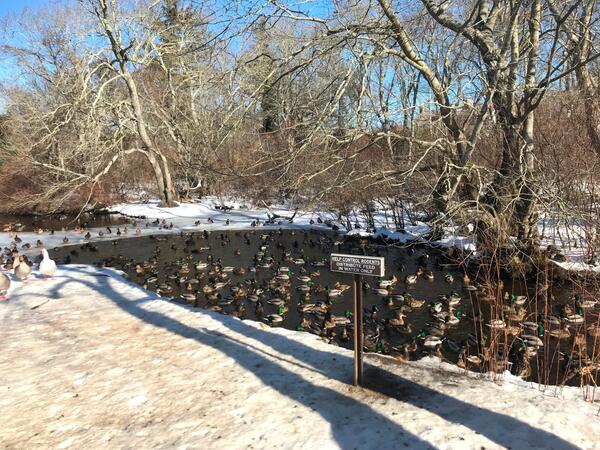
Ducks in Hook Pond Dreen at Davids Lane, East Hampton, New York
Ducks in Hook Pond Dreen at Davids Lane, East Hampton, New York

New England WSC Physical Scientist Andy Massey scouting out high water marks associated with the blizzard of January 2018. Houghs Neck Maritime Center, Quincy, MA.
New England WSC Physical Scientist Andy Massey scouting out high water marks associated with the blizzard of January 2018. Houghs Neck Maritime Center, Quincy, MA.

Northeast Region Photo Contest Winner | March 2019 | People
Jonathan Cohl holding a piece of ice from Delaware River at Frenchtown, NJ
Northeast Region Photo Contest Winner | March 2019 | People
Jonathan Cohl holding a piece of ice from Delaware River at Frenchtown, NJ

Transporting equipment used for maintenance of groundwater well CT2498 in Perrysburg, New York
Transporting equipment used for maintenance of groundwater well CT2498 in Perrysburg, New York

In Photo: The red circle indicates the same position as shown in the April 2014 photo. The mangroves have lost all their leaves and the berm is significantly thinner following the storm.
In Photo: The red circle indicates the same position as shown in the April 2014 photo. The mangroves have lost all their leaves and the berm is significantly thinner following the storm.

Dawn breaks behind one of the bottom landers on deployment day.
Dawn breaks behind one of the bottom landers on deployment day.

Sediment transport team members attach a quick-release to the top of a bottom lander prior to deployment
Sediment transport team members attach a quick-release to the top of a bottom lander prior to deployment

Sediment transport team members manage tag lines to control the motion of the bottom lander as it is deployed.
Sediment transport team members manage tag lines to control the motion of the bottom lander as it is deployed.

Sediment transport team members prepare to deploy a buoy instrumented with Meteorological sensors
Sediment transport team members prepare to deploy a buoy instrumented with Meteorological sensors

An instrumented bottom lander platform is lowered off the stern of the R/V Savannah during deploment
An instrumented bottom lander platform is lowered off the stern of the R/V Savannah during deploment

Sediment transport team members assemble chain, shackles and pear links that are are attached to the anchor and floats as part of deploying a mooring.
Sediment transport team members assemble chain, shackles and pear links that are are attached to the anchor and floats as part of deploying a mooring.

The buoy that measures meteorological conditions at the site after deployment.
The buoy that measures meteorological conditions at the site after deployment.

Yellow River at Knox, IN

USGS pilot Sandy Brosnahan and Senate Pro Tempore Marc Pacheco discuss the use of Umanned Aerial Systems (UASs, also known as drones) to collect data in coastal environments.
USGS pilot Sandy Brosnahan and Senate Pro Tempore Marc Pacheco discuss the use of Umanned Aerial Systems (UASs, also known as drones) to collect data in coastal environments.

Hill-shaded bathymetric, backscatter, and photographic data collected by NOAA and the USGS. Backscatter data give indications of seafloor character. In general, low-backscatter intensity (blue) corresponds to finer-grained material, whereas high-backscatter intensity (orange) corresponds to coarser substrate.
Hill-shaded bathymetric, backscatter, and photographic data collected by NOAA and the USGS. Backscatter data give indications of seafloor character. In general, low-backscatter intensity (blue) corresponds to finer-grained material, whereas high-backscatter intensity (orange) corresponds to coarser substrate.

The USGS conducted surveys on the inner continental shelf of the Delmarva Peninsula (shown in green) to complement related datasets previously collected in the area by partners NOAA and BOEM. The inset map shows location of the study area.
The USGS conducted surveys on the inner continental shelf of the Delmarva Peninsula (shown in green) to complement related datasets previously collected in the area by partners NOAA and BOEM. The inset map shows location of the study area.

Orthomosaic images of Matanzas, Florida, from (a) before and (b) after Hurricane Matthew, and (c) a digital elevation model (DEM) showing the associated topographic change. Note, these results were produced by applying Structure-from-Motion (SfM) to NOAA oblique photographs, but similar results can be obtained using UAS aerial imagery.
Orthomosaic images of Matanzas, Florida, from (a) before and (b) after Hurricane Matthew, and (c) a digital elevation model (DEM) showing the associated topographic change. Note, these results were produced by applying Structure-from-Motion (SfM) to NOAA oblique photographs, but similar results can be obtained using UAS aerial imagery.

The 3DR Solo with GoPro Hero4 camera and gimbal. Coming to a beach near you soon.
The 3DR Solo with GoPro Hero4 camera and gimbal. Coming to a beach near you soon.

Eroding permafrost on Alaska’s Arctic Coast. Inundation of permafrost like this produced subsea permafrost
Eroding permafrost on Alaska’s Arctic Coast. Inundation of permafrost like this produced subsea permafrost

Sandy Brosnahan (left) and Jon Borden at Unmanned Aerial Systems (UAS) training in Santa Cruz, California.
Sandy Brosnahan (left) and Jon Borden at Unmanned Aerial Systems (UAS) training in Santa Cruz, California.

Left: Key features in and around the Gulf of Alaska. A black rectangle outlines our 2016 study area along the Queen Charlotte-Fairweather fault. Red arrows indicate relative tectonic plate motions. Right: A shaded relief map of the 2016 study area. Rainbow colors show seafloor depths acquired by the USGS in 2015 and 2016. Red indicates shallower depths.
Left: Key features in and around the Gulf of Alaska. A black rectangle outlines our 2016 study area along the Queen Charlotte-Fairweather fault. Red arrows indicate relative tectonic plate motions. Right: A shaded relief map of the 2016 study area. Rainbow colors show seafloor depths acquired by the USGS in 2015 and 2016. Red indicates shallower depths.