



Invasive Species
Invasive Species
Filter Total Items: 22

USGS Sagebrush Science: Supporting Public Safety and Economic Decision Making Across the West
The sagebrush biome is one of the largest ecosystems in North America. Encompassing nearly one-third of the continental U.S., it provides critical resources for millions of Americans and a home for hundreds of plants and animal species in the West. Natural resource management in sagebrush ecosystems can be complex, and science can support management decisions by providing knowledge and tools to...
By
Core Science Systems Mission Area, Ecosystems Mission Area, Land Management Research Program, Earth Resources Observation and Science (EROS) Center, Forest and Rangeland Ecosystem Science Center, Fort Collins Science Center, Northern Rocky Mountain Science Center, Southwest Biological Science Center, Western Ecological Research Center (WERC), Wildland Fire Science
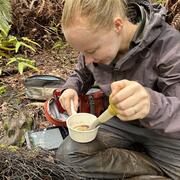
How to catch a vector: Mosquito monitoring for avian malaria control
USGS researchers are combatting avian malaria by improving the trapping and tracking of mosquitoes in endangered Hawaiian bird habitats.

eDNA to Inform Invasive Mosquito Distribution
We are using environmental DNA samples to assess habitat occupancy of the invasive southern house mosquito in Kīpahulu Valley, Maui. An understanding of mosquito distribution is critical to developing and implementing tools to prevent the transmission of avian malaria, a primary threat to Hawaiian forest birds.

Brown Treesnake Rapid Response Team
The Brown Treesnake Rapid Response Team (RRT) evaluates snake sightings and quickly deploys when sightings are credible and match a brown treesnake. The RRT is an interagency partnership that cooperatively prevents the spread of brown treesnakes in the United States and territories.

Guam power lines and brown treesnakes are an electric mix
Of all the economic impacts to Guam due to the introduction of the brown treesnake ( Boiga irregularis), the effects on the power infrastructure are the easiest to understand.

Chemical Ecology of Rapid ʽŌhiʽa Death
We are working on understanding the chemical ecology of Rapid ʽŌhiʽa Death (ROD), which is critical for protecting both healthy and ROD-infected ʽōhiʽa. A better understanding could lead to early ROD detection tools and the development of attractants and repellents to manipulate ambrosia beetle populations.

Impacts of Exotic Annual Grass Invasion, Wildfire, and Restoration on Carbon Storage in the Sagebrush Steppe
USGS is investigating the impact of the annual grass-fire cycle-- and restoration land treatments aimed at slowing that cycle-- on carbon storage in dryland soils.

Climatic and Ecological Scenarios to Guide Development of a Spatial Resist-Accept-Direct Portfolio at Nāpuʻu, Hawaiʻi
Climate change and invasive species are transforming ecosystems. The Resist-Accept-Direct (RAD) framework organizes management objectives into those that seek to Resist change and maintain historical ecological communities, those that Accept some or all aspects of ecological transformation, and those that Direct an ecological community to a preferred state. We are evaluating risks posed by climate...

Using Vegetation Trends and Fire Risk Simulations to Prioritize Management Interventions on National Park Service Lands in Sagebrush Steppe
City of Rocks National Reserve and Craters of the Moon National Monument and Preserve are lands managed by the National Park Service that contain ecologically valuable stands of sagebrush and unique forest communities that are at risk due to wildfire and invasion by exotic annual grasses. We are working to determine the extent of invasion and to provide park managers with wildfire risk assessments...

Climate-Smart Vegetation Treatments - Using 15 Years of SageSTEP Data to Inform Management of Resilient Ecosystems
Land managers require clear, forward-looking information about where and how vegetation treatments may make the greatest difference for drought resilience in sagebrush and woodland ecosystems. We are using soil moisture and vegetation data from SageSTEP-- a long-term ecological study on fuel treatments in the Great Basin-- to analyze soil moisture dynamics and vegetation responses after common...

SageSTEP – Sagebrush Steppe Treatment Evaluation Project
The Sagebrush Steppe Treatment Evaluation Project--or SageSTEP-- is a regional experiment taking place across six states in the Great Basin. A multidisciplinary team of scientists are evaluating methods of sagebrush steppe restoration to inform land managers working to protect one of the most threatened land types in North America. SageSTEP is the longest running and largest replicated ecological...

The Effect of Pre-Emergent Herbicides on Soil in The Sagebrush Steppe
We are studying how herbicides sprayed onto soil to prevent the establishment of exotic annual grasses such as cheatgrass may impact the health, growth resources and microbiota of soils in sagebrush-steppe, where herbicide use is an important and common tool. Our findings will help make herbicide applications more successful.