U.S. flag

An official website of the United States government

Natural Hazards Mission Area

Every year in the United States, natural hazards threaten lives and livelihoods and result in billions of dollars in damage. We work with many partners to monitor, assess, and conduct targeted research on a wide range of natural hazards so that policymakers and the public have the understanding they need to enhance preparedness, response, and resilience.

News

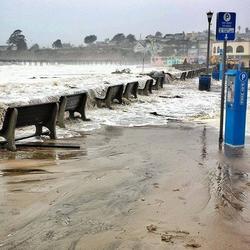
USGS monitors California's coastal hazards during the 2026-2027 El Niño event

USGS monitors California's coastal hazards during the 2026-2027 El Niño event

SPCMSC Repairs Madeira Beach, FL Coastal Camera

SPCMSC Repairs Madeira Beach, FL Coastal Camera

SPCMSC Scientists Perform Fieldwork on the Coral-Rubble Keys Protecting Dry Tortugas National Park

SPCMSC Scientists Perform Fieldwork on the Coral-Rubble Keys Protecting Dry Tortugas National Park

Publications

3D broadband ground motion simulations of Cascadia megathrust earthquakes: Full-margin scenarios incorporating variable magnitudes and frontal thrust splay faulting 3D broadband ground motion simulations of Cascadia megathrust earthquakes: Full-margin scenarios incorporating variable magnitudes and frontal thrust splay faulting

Great megathrust earthquakes (∼Mw 8–9) that rupture along the Cascadia Subduction Zone pose significant shaking and tsunami hazards to the U.S. Pacific Northwest. Although these large earthquakes are documented in the geologic record, none have been recorded with modern instrumentation, complicating regional seismic hazard assessments. To improve constraints on seismic hazard estimates...
Authors
Audrey M. Dunham, Erin A. Wirth, Alex R. Grant, Arthur D. Frankel, Madeleine C. Lucas, Anna Ledeczi, Harold Tobin, Janet Watt, David A. Schmidt, Jeonghyeop Kim, James Biemiller

ETAS-positive: Extracting unbiased epidemic-type aftershock models from incomplete earthquake catalogs ETAS-positive: Extracting unbiased epidemic-type aftershock models from incomplete earthquake catalogs

Earthquake catalogs are inherently incomplete, and short-term fluctuations in catalog completeness can strongly bias estimates of seismicity parameters. Here, we extend the positive statistics framework recently introduced for estimating Gutenberg–Richter a and b values to the Epidemic-Type Aftershock Sequence (ETAS) model. The approach focuses on complete magnitude–time intervals...
Authors
Nicholas J. van der Elst, Sebastian Hainzl

Estimating aftershock risk for entry into earthquake-damaged buildings Estimating aftershock risk for entry into earthquake-damaged buildings

We present a simple method to estimate the risk of experiencing strong shaking from aftershocks during entry into earthquake-damaged buildings. We compute wait times until the probability of strong ground shaking from aftershocks reaches a predefined risk threshold; for example, a 0.4 percent probability of experiencing Modified Mercalli Intensity 7 or greater shaking during the planned...
Authors
Jeanne L. Hardebeck, Alan J. Poulos

Science

El Niño Coastal Hazards (2026-2027)
The 2026-2027 El Niño is projected to be the largest and most intense on record. Pacific storms during previous El Niño events have caused widespread coastal hazards along the California coast from flooding and erosion. The USGS is uniquely positioned to assist with coastal monitoring, data collection, science and communications with partners about these pending hazards.
El Niño Coastal Hazards (2026-2027)

El Niño Coastal Hazards (2026-2027)

The 2026-2027 El Niño is projected to be the largest and most intense on record. Pacific storms during previous El Niño events have caused widespread coastal hazards along the California coast from flooding and erosion. The USGS is uniquely positioned to assist with coastal monitoring, data collection, science and communications with partners about these pending hazards.
Learn More

2026 Nepal Debris Avalanche and Flash Flood

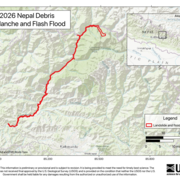
On Wednesday morning (local time), 26 August 2026, a catastrophic debris flow and flood was likely triggered by rapid slope failure involving a glacier in Lāṅṭāṇ National Park, Nepal, near the border with China. This debris flow and flooding travelled nearly 100 km and impacted populated areas downstream along the Lende Kholā and Trishuli̇̄ Kholā rivers, including the Rasuwāgaḍhi̇̄ border post...
2026 Nepal Debris Avalanche and Flash Flood

2026 Nepal Debris Avalanche and Flash Flood

On Wednesday morning (local time), 26 August 2026, a catastrophic debris flow and flood was likely triggered by rapid slope failure involving a glacier in Lāṅṭāṇ National Park, Nepal, near the border with China. This debris flow and flooding travelled nearly 100 km and impacted populated areas downstream along the Lende Kholā and Trishuli̇̄ Kholā rivers, including the Rasuwāgaḍhi̇̄ border post...
Learn More

Digital Shoreline Analysis System (DSAS)

Software for calculating positional boundary change over time The Digital Shoreline Analysis System (DSAS) version 6 is a standalone application that calculates shoreline or boundary change over time. The GIS of a user’s choice is used to prepare the data for DSAS. Like previous versions, DSAS v.6 enables a user to calculate rate-of-change statistics from multiple historical shoreline positions...
Digital Shoreline Analysis System (DSAS)

Digital Shoreline Analysis System (DSAS)

Software for calculating positional boundary change over time The Digital Shoreline Analysis System (DSAS) version 6 is a standalone application that calculates shoreline or boundary change over time. The GIS of a user’s choice is used to prepare the data for DSAS. Like previous versions, DSAS v.6 enables a user to calculate rate-of-change statistics from multiple historical shoreline positions...
Learn More
Was this page helpful?