An official website of the United States government
Here's how you know
Official websites use .gov
A .gov website belongs to an official government organization in the United States.
Secure .gov websites use HTTPS
A lock () or https:// means you’ve safely connected to the .gov website. Share sensitive information only on official, secure websites.
The Florence Bascom Geoscience Center researches five broad science themes: Paleoclimate & Paleoecology, Landscape Science, Geologic Mapping, Hazards, and Special Geologic Studies.
Life on Earth has existed for over 3 billion years. By studying ancient climate, called paleoclimate, researchers can learn about how the Earth changes over time and how life is impacted. The USGS uses rock and fossil records to understand ancient climate, giving us insights into how modern climate change may alter our world.
What is paleoclimate research?
The Earth has been around for a long time – 4.6 billion years! In that time, there have been warm periods, where inland seas covered much of what is now North America. And there have been cold ice ages, where glaciers stretched across whole continents. Whether it is thousands or millions of years ago, scientists can study ancient climate conditions, or paleoclimates, to learn about how the Earth changes and how ancient life dealt with it.
Today, we study climate by using instruments to measure temperature, humidity, and rainfall. Since we can’t travel back in time, scientists use paleoclimate archives, geologic and biologic materials (like rocks and tree rings) that preserve evidence of past changes in climate, to reconstruct what the Earth was like a long time ago.
Rocks are ancient time capsules. Geologists can look at the texture, layers, grains, and minerals in a rock and find out what the past environment was like. Rocks from millions of years ago still hold the stories of past oceans, rivers, lakes, floods, dunes, and deserts.
Paleoclimate scientists also look for clues in the remains of ancient life. Fossilized animals, plants, and their traces (tracks, burrows, scat) reveal what was alive during different time periods. Fossils of cold-loving species, like wooly mammoths, tell scientists that those areas probably had cooler climates. Whale fossils found high in coastal cliffs indicate a past elevated sea level.
Long-lived organisms, like corals and trees, change how they grow during cooler or warmer years. Analyzing ancient growth patterns, for example by measuring tree rings, can reveal shifts in climate over their lifespan. Some ancient species even collected records for us! Ten-thousand-year-old packrat dens contain the remains of plants, bones, and dung hoarded long-ago and preserved by packrat pee. These are a treasure trove to paleoclimate scientists!
How does ancient climate change compare to today?
Our planet has experienced both colder and hotter periods than the climate we live in today. So, why would anyone be concerned about the rapid warming trend today? Changes that occurred over millions of years in the past are happening within a human lifespan.
Paleoclimate studies indicate that most ancient changes in climate happened over very long periods of time. The scale was on the order of tens of thousands to millions of years, not 100 or 200 years. Plants and animals had countless generations to adapt or migrate to the slow change of conditions.
Rapid climate change in the past was usually associated with a major disruptive event, like a meteor impact or massive volcanic eruption, which caused abrupt, long-lasting changes in climate. A good example is an asteroid that struck the Earth around 65 million years ago. The impact, and rapid climate change that resulted, contributed to the extinction of around 75 percent of all species alive at the time, including the dinosaurs.
USGS Uses Paleoclimatology to Shed Light on Modern Climate Change
By collecting data on past climates and their impacts on ecosystems, USGS scientists can better predict what the future could look like. This provides valuable insights to help resource managers better respond to present and future ecosystem changes.
Within the last 65 million years, there have been a few intervals of warmer climates that particularly interest USGS researchers. None of them are exactly like our modern climate, but we can learn useful information by comparing them to each other and to today’s conditions. One USGS research effort is exploring sudden and extreme global warming events that occurred during the Paleocene-Eocene eras about 56 million years ago. These researchers are learning that some global warming events had smaller effects and then stabilized, while others took tens of thousands of years to stabilize. Another USGS effort is exploring the climate about 3 million years ago during the Pliocene Epoch, when continents, ocean currents, and plant and animal life were similar to today’s. The global temperature during this period was around 5°F warmer than today, where many climate models predict it will be by the end of this century.
Researchers are applying paleoclimate insights to modern-day problems, including understanding how sea level rise might affect coastal fishing industries, assessing future vegetation patterns to inform agricultural practices, and predicting future El Niño events.
USGS paleoclimate efforts are aimed at:
Improving climate models for more accurate forecasts
Predicting how the water cycle may change around the world
Characterizing ancient climate conditions using data sources such as marine microfossils, soil cores, ice cores, tree rings, and packrat middens.
Understanding ancient ocean and marine conditions using data sources such as corals, microfossils in sediment cores, and geochemical techniques.
Understanding ancient human distribution and migration
Understanding drivers and consequences of ancient climate change
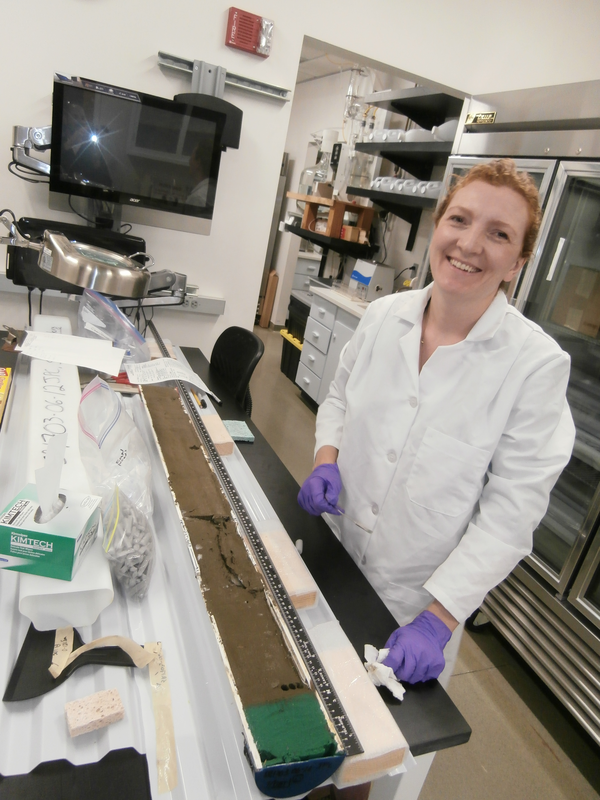
Summer Praetorius from the Geology, Minerals, Energy, & Geophysics (GMEG) Science Center collects samples from an ocean sediment core in the Pacific Ocean Paleoclimatology Lab at Menlo Park, CA.
Identifying how past environmental conditions shaped the evolution of corals and their skeletal traits provides a framework for predicting their persistence and that of their non-calcifying relatives under impending global warming and ocean acidification. Here we show that ocean geochemistry, particularly aragonite–calcite seas, drives patterns of morphological evolution in anthozoans...
Authors
Andrea M. Quattrini, Eliana Rodriguez-Burgueno, B. C. Faircloth, P. Cowman, M. R. Brugler, G. Farfan, M. E. Hellberg, M. V. Kitahara, Cheryl L. Morrison, D. A. Paz-Garcia, J. D. Reimer, C. S. McFadden
Strategies for 21st-century environmental management and conservation under global change require a strong understanding of the biological mechanisms that mediate responses to climate- and human-driven change to successfully mitigate range contractions, extinctions, and the degradation of ecosystem services. Biodiversity responses to past rapid warming events can be followed in situ and...
Authors
Damien A. Fordham, Stephen Jackson, Stuart C. Brown, Brian Huntley, Barry W. Brook, Dorthe Dahl-Jensen, M. Thomas P. Gilbert, Bette L. Otto-Bliesner, Anders Svensson, Spyros Theodoridis, Janet M. Wilmshurst, Jessie C. Buettel, Elisabetta Canteri, Matthew McDowell, Ludovic Orlando, Julia Pilowsky, Carsten Rahbek, David Nogues-Bravo
The progress of science is tied to the standardization of measurements, instruments, and data. This is especially true in the Big Data age, where analyzing large data volumes critically hinges on that data being standardized. Accordingly, the lack of community-sanctioned data standards in paleoclimatology has largely precluded the benefits of Big Data advances in the field. Building upon...
Authors
Natalie M. Kehrwald, Deborah Khider, Julien Emile-Geay, Nicholas P. McKay, Yolanda Gili, Daniel Garijo, Varun Ratnakar, Peter Brewer, Adam Csank, Emilie Dassie, Kristine Delong, Thomas Felix, William Gray, Lucas Jonkers, Michael Kahle, Darrell S. Kaufman, Julie N. Richey, Andreas Schmittner, Elaine Kennedy Sutherland, Montserrat Alonso-Garcia, Bertrand Sebastian, Oliver Bothe, Andrew Bunn, Manuel Chevalier, Pierre Francus, Amy Frappier, Simon Goring, Belen Martrat, Helen V. McGregor, Kathryn J. Allen, Fabien Arnaud, Yarrow L. Axford, Timothy T. Barrows, Lucie Bazin, Pilaar Birch, Elizabeth Bradley, Joshua Bregy, Emilie Capron, Olivier Cartapanis, Hong-Wei Chiang, Kim Cobb, Maxime Debret, Rene Dommain, Jianghui Du, Kelsey Dyez, Suellyn Emerick, Michael Erb, Georgina Falster, Walter Finsinger, Daniel Fortier, Nicolas Gauthier, Steven George, Eric Grimm, Jennifer Hertzberg, Fiona Hibbert, Aubrey Hillman, William Hobbs, Matthew Huber, Anna L. C. Hughes, Samuel Jaccard, Ruan Jiaoyang, Markus Kienast, Bronwen Konecky, Gael Le Roux, Vyacheslav Lyubchich, Valdir Novello, Lydia Olaka, Judson W. Partin, Christof Pearce, Steven J. Phipps, Cecile Pignol, Natalia Pietrowska, Maria-Serena Poli, Alexander Prokopenko, Franciele Schwanck, Christian Stepanek, George E. A. Swann, Richard Telford, Elizabeth R. Thomas, Zoe Thomas, Sarah Truebe, Lucien von Gunten, Amanda Waite, Nils Weitzel, Bruno Wilhelm, John B. Williams, Mai Winstrup, Ning Zhao, Yuxin Zhou
The field of paleoclimatology relies on physical, chemical, and biological proxies of past climate changes that have been preserved in natural archives such as glacial ice, tree rings, sediments, corals, and speleothems. Paleoclimate archives obtained through field investigations, ocean sediment coring expeditions, ice sheet coring programs, and other projects allow scientists to...
U.S. Geological Survey (USGS) researchers are at the forefront of paleoclimate research, the study of past climates. With their unique skills and perspective, only geologists have the tools necessary to delve into the distant past (long before instrumental records were collected) in order to better understand global environmental conditions that were very different from today's...
Paleoclimate proxies are physical, chemical and biological materials preserved within the geologic record (in paleoclimate archives) that can be analyzed and correlated with climate or environmental parameters in the modern world. Scientists combine proxy-based paleoclimate reconstructions with instrumental records (such as thermometer and rain gauge readings) to expand our understanding of...
Paleoclimate proxies are physical, chemical and biological materials preserved within the geologic record (in paleoclimate archives) that can be analyzed and correlated with climate or environmental parameters in the modern world. Scientists combine proxy-based paleoclimate reconstructions with instrumental records (such as thermometer and rain gauge readings) to expand our understanding of...
Paleoclimate archives consist of geologic (e.g., sediment cores) and biologic (e.g., tree rings) materials that preserve evidence of past changes in climate. They contain substances or features (climate proxies) that can be sampled and analyzed using a variety of physical and chemical methods. Using results from the analyses of proxies in archives, scientists reconstruct changes through time and...
Paleoclimate archives consist of geologic (e.g., sediment cores) and biologic (e.g., tree rings) materials that preserve evidence of past changes in climate. They contain substances or features (climate proxies) that can be sampled and analyzed using a variety of physical and chemical methods. Using results from the analyses of proxies in archives, scientists reconstruct changes through time and...
Lessons from the Past, Roadmap for the Future The present-day climate of the Earth is influenced by a combination of natural climate variability, increased concentrations of greenhouse gases in the atmosphere since the Industrial Revolution, and changes in land cover (such as conversion from forest to agriculture and back again).
Lessons from the Past, Roadmap for the Future The present-day climate of the Earth is influenced by a combination of natural climate variability, increased concentrations of greenhouse gases in the atmosphere since the Industrial Revolution, and changes in land cover (such as conversion from forest to agriculture and back again).
Climate model forecasts indicate an increase in extreme hydrologic events, including floods and droughts, for California and the western U.S. in the future. To better understand what the consequences of this future change in climate may be, USGS scientists are studying the frequency, magnitude, and impacts of past hydroclimate variability and extremes in the region. This project produces well...
Drivers and Impacts of North Pacific Climate Variability
Climate model forecasts indicate an increase in extreme hydrologic events, including floods and droughts, for California and the western U.S. in the future. To better understand what the consequences of this future change in climate may be, USGS scientists are studying the frequency, magnitude, and impacts of past hydroclimate variability and extremes in the region. This project produces well...
Projections for AD 2100 suggest warming of +1-4°C in the North Pacific Ocean, which will result in widespread transformations throughout the marine environment and western North America. Many of these changes are beyond the predictive capabilities of current climate models. To better address this future uncertainty, our team is developing a geological framework using past warm intervals as...
Pacific Ocean Patterns, Processes, and Productivity (POP3): Impacts of ancient warming on marine ecosystems and western North America
Projections for AD 2100 suggest warming of +1-4°C in the North Pacific Ocean, which will result in widespread transformations throughout the marine environment and western North America. Many of these changes are beyond the predictive capabilities of current climate models. To better address this future uncertainty, our team is developing a geological framework using past warm intervals as...
Climate Science Champions, Season 2: Ferdinand Oberle, Research Geologist
Along reef-lined shores of the Pacific Islands, USGS Research Geologist and Oceanographer Ferdinand Oberle studies how warming surface waters, nutrient runoff, and increasingly powerful storms impact coral reefs.
Along reef-lined shores of the Pacific Islands, USGS Research Geologist and Oceanographer Ferdinand Oberle studies how warming surface waters, nutrient runoff, and increasingly powerful storms impact coral reefs.
Climate Science Champions, Season 2: Kira Mizell, Research Oceanographer
Research Oceanographer Kira Mizell studies change in ocean chemistry by collecting marine minerals, looking for insights into past climate conditions and geologic history.
Research Oceanographer Kira Mizell studies change in ocean chemistry by collecting marine minerals, looking for insights into past climate conditions and geologic history.
USGS Florence Bascom Geoscience Center - Who we are
The USGS Florence Bascom Geoscience Center (FBGC) is at the leading edge of scientific research addressing critical societal issues and providing unbiased data and information to decision makers and the public.
The USGS Florence Bascom Geoscience Center (FBGC) is at the leading edge of scientific research addressing critical societal issues and providing unbiased data and information to decision makers and the public.
The USGS Florence Bascom Geoscience Center (FBGC) is at the leading edge of scientific research addressing critical societal issues and providing unbiased data and information to decision makers and the public.
The USGS Florence Bascom Geoscience Center (FBGC) is at the leading edge of scientific research addressing critical societal issues and providing unbiased data and information to decision makers and the public.
Cores were collected from various areas of thawing permafrost-peatlands in Alaska. Permafrost thaw results in ground subsidence and inundation that kills black spruce and other understory plants living on the permafrost plateau.
Cores were collected from various areas of thawing permafrost-peatlands in Alaska. Permafrost thaw results in ground subsidence and inundation that kills black spruce and other understory plants living on the permafrost plateau.
Flyover of the southeast Ceti Mensa map. Distinct groups of rock layers, called geologic units, are shaded in different colors, with dark browns representing the oldest rocks and green representing the youngest rocks. All of these rocks formed as wind-blown sand that became trapped in shallow, ephemeral lakes, similar to the wet playas of the desert southwest US.
Flyover of the southeast Ceti Mensa map. Distinct groups of rock layers, called geologic units, are shaded in different colors, with dark browns representing the oldest rocks and green representing the youngest rocks. All of these rocks formed as wind-blown sand that became trapped in shallow, ephemeral lakes, similar to the wet playas of the desert southwest US.
Regional- to continental-scale paleoclimate syntheses of temperature and hydroclimate in North America are essential for understanding long-term spatiotemporal variability in climate, and for properly assessing risk on decadal and longer timescales. However, existing syntheses rely almost exclusively on tree-ring records, which are known to underestimate low-frequency variability and...
Broader view of North American climate over the past two millennia: Synthesizing paleoclimate records from diverse archives
Regional- to continental-scale paleoclimate syntheses of temperature and hydroclimate in North America are essential for understanding long-term spatiotemporal variability in climate, and for properly assessing risk on decadal and longer timescales. However, existing syntheses rely almost exclusively on tree-ring records, which are known to underestimate low-frequency variability and rarely extend
Life on Earth has existed for over 3 billion years. By studying ancient climate, called paleoclimate, researchers can learn about how the Earth changes over time and how life is impacted. The USGS uses rock and fossil records to understand ancient climate, giving us insights into how modern climate change may alter our world.
What is paleoclimate research?
The Earth has been around for a long time – 4.6 billion years! In that time, there have been warm periods, where inland seas covered much of what is now North America. And there have been cold ice ages, where glaciers stretched across whole continents. Whether it is thousands or millions of years ago, scientists can study ancient climate conditions, or paleoclimates, to learn about how the Earth changes and how ancient life dealt with it.
Today, we study climate by using instruments to measure temperature, humidity, and rainfall. Since we can’t travel back in time, scientists use paleoclimate archives, geologic and biologic materials (like rocks and tree rings) that preserve evidence of past changes in climate, to reconstruct what the Earth was like a long time ago.
Rocks are ancient time capsules. Geologists can look at the texture, layers, grains, and minerals in a rock and find out what the past environment was like. Rocks from millions of years ago still hold the stories of past oceans, rivers, lakes, floods, dunes, and deserts.
Paleoclimate scientists also look for clues in the remains of ancient life. Fossilized animals, plants, and their traces (tracks, burrows, scat) reveal what was alive during different time periods. Fossils of cold-loving species, like wooly mammoths, tell scientists that those areas probably had cooler climates. Whale fossils found high in coastal cliffs indicate a past elevated sea level.
Long-lived organisms, like corals and trees, change how they grow during cooler or warmer years. Analyzing ancient growth patterns, for example by measuring tree rings, can reveal shifts in climate over their lifespan. Some ancient species even collected records for us! Ten-thousand-year-old packrat dens contain the remains of plants, bones, and dung hoarded long-ago and preserved by packrat pee. These are a treasure trove to paleoclimate scientists!
How does ancient climate change compare to today?
Our planet has experienced both colder and hotter periods than the climate we live in today. So, why would anyone be concerned about the rapid warming trend today? Changes that occurred over millions of years in the past are happening within a human lifespan.
Paleoclimate studies indicate that most ancient changes in climate happened over very long periods of time. The scale was on the order of tens of thousands to millions of years, not 100 or 200 years. Plants and animals had countless generations to adapt or migrate to the slow change of conditions.
Rapid climate change in the past was usually associated with a major disruptive event, like a meteor impact or massive volcanic eruption, which caused abrupt, long-lasting changes in climate. A good example is an asteroid that struck the Earth around 65 million years ago. The impact, and rapid climate change that resulted, contributed to the extinction of around 75 percent of all species alive at the time, including the dinosaurs.
USGS Uses Paleoclimatology to Shed Light on Modern Climate Change
By collecting data on past climates and their impacts on ecosystems, USGS scientists can better predict what the future could look like. This provides valuable insights to help resource managers better respond to present and future ecosystem changes.
Within the last 65 million years, there have been a few intervals of warmer climates that particularly interest USGS researchers. None of them are exactly like our modern climate, but we can learn useful information by comparing them to each other and to today’s conditions. One USGS research effort is exploring sudden and extreme global warming events that occurred during the Paleocene-Eocene eras about 56 million years ago. These researchers are learning that some global warming events had smaller effects and then stabilized, while others took tens of thousands of years to stabilize. Another USGS effort is exploring the climate about 3 million years ago during the Pliocene Epoch, when continents, ocean currents, and plant and animal life were similar to today’s. The global temperature during this period was around 5°F warmer than today, where many climate models predict it will be by the end of this century.
Researchers are applying paleoclimate insights to modern-day problems, including understanding how sea level rise might affect coastal fishing industries, assessing future vegetation patterns to inform agricultural practices, and predicting future El Niño events.
USGS paleoclimate efforts are aimed at:
Improving climate models for more accurate forecasts
Predicting how the water cycle may change around the world
Characterizing ancient climate conditions using data sources such as marine microfossils, soil cores, ice cores, tree rings, and packrat middens.
Understanding ancient ocean and marine conditions using data sources such as corals, microfossils in sediment cores, and geochemical techniques.
Understanding ancient human distribution and migration
Understanding drivers and consequences of ancient climate change
Summer Praetorius from the Geology, Minerals, Energy, & Geophysics (GMEG) Science Center collects samples from an ocean sediment core in the Pacific Ocean Paleoclimatology Lab at Menlo Park, CA.
Identifying how past environmental conditions shaped the evolution of corals and their skeletal traits provides a framework for predicting their persistence and that of their non-calcifying relatives under impending global warming and ocean acidification. Here we show that ocean geochemistry, particularly aragonite–calcite seas, drives patterns of morphological evolution in anthozoans...
Authors
Andrea M. Quattrini, Eliana Rodriguez-Burgueno, B. C. Faircloth, P. Cowman, M. R. Brugler, G. Farfan, M. E. Hellberg, M. V. Kitahara, Cheryl L. Morrison, D. A. Paz-Garcia, J. D. Reimer, C. S. McFadden
Strategies for 21st-century environmental management and conservation under global change require a strong understanding of the biological mechanisms that mediate responses to climate- and human-driven change to successfully mitigate range contractions, extinctions, and the degradation of ecosystem services. Biodiversity responses to past rapid warming events can be followed in situ and...
Authors
Damien A. Fordham, Stephen Jackson, Stuart C. Brown, Brian Huntley, Barry W. Brook, Dorthe Dahl-Jensen, M. Thomas P. Gilbert, Bette L. Otto-Bliesner, Anders Svensson, Spyros Theodoridis, Janet M. Wilmshurst, Jessie C. Buettel, Elisabetta Canteri, Matthew McDowell, Ludovic Orlando, Julia Pilowsky, Carsten Rahbek, David Nogues-Bravo
The progress of science is tied to the standardization of measurements, instruments, and data. This is especially true in the Big Data age, where analyzing large data volumes critically hinges on that data being standardized. Accordingly, the lack of community-sanctioned data standards in paleoclimatology has largely precluded the benefits of Big Data advances in the field. Building upon...
Authors
Natalie M. Kehrwald, Deborah Khider, Julien Emile-Geay, Nicholas P. McKay, Yolanda Gili, Daniel Garijo, Varun Ratnakar, Peter Brewer, Adam Csank, Emilie Dassie, Kristine Delong, Thomas Felix, William Gray, Lucas Jonkers, Michael Kahle, Darrell S. Kaufman, Julie N. Richey, Andreas Schmittner, Elaine Kennedy Sutherland, Montserrat Alonso-Garcia, Bertrand Sebastian, Oliver Bothe, Andrew Bunn, Manuel Chevalier, Pierre Francus, Amy Frappier, Simon Goring, Belen Martrat, Helen V. McGregor, Kathryn J. Allen, Fabien Arnaud, Yarrow L. Axford, Timothy T. Barrows, Lucie Bazin, Pilaar Birch, Elizabeth Bradley, Joshua Bregy, Emilie Capron, Olivier Cartapanis, Hong-Wei Chiang, Kim Cobb, Maxime Debret, Rene Dommain, Jianghui Du, Kelsey Dyez, Suellyn Emerick, Michael Erb, Georgina Falster, Walter Finsinger, Daniel Fortier, Nicolas Gauthier, Steven George, Eric Grimm, Jennifer Hertzberg, Fiona Hibbert, Aubrey Hillman, William Hobbs, Matthew Huber, Anna L. C. Hughes, Samuel Jaccard, Ruan Jiaoyang, Markus Kienast, Bronwen Konecky, Gael Le Roux, Vyacheslav Lyubchich, Valdir Novello, Lydia Olaka, Judson W. Partin, Christof Pearce, Steven J. Phipps, Cecile Pignol, Natalia Pietrowska, Maria-Serena Poli, Alexander Prokopenko, Franciele Schwanck, Christian Stepanek, George E. A. Swann, Richard Telford, Elizabeth R. Thomas, Zoe Thomas, Sarah Truebe, Lucien von Gunten, Amanda Waite, Nils Weitzel, Bruno Wilhelm, John B. Williams, Mai Winstrup, Ning Zhao, Yuxin Zhou
The field of paleoclimatology relies on physical, chemical, and biological proxies of past climate changes that have been preserved in natural archives such as glacial ice, tree rings, sediments, corals, and speleothems. Paleoclimate archives obtained through field investigations, ocean sediment coring expeditions, ice sheet coring programs, and other projects allow scientists to...
U.S. Geological Survey (USGS) researchers are at the forefront of paleoclimate research, the study of past climates. With their unique skills and perspective, only geologists have the tools necessary to delve into the distant past (long before instrumental records were collected) in order to better understand global environmental conditions that were very different from today's...
Paleoclimate proxies are physical, chemical and biological materials preserved within the geologic record (in paleoclimate archives) that can be analyzed and correlated with climate or environmental parameters in the modern world. Scientists combine proxy-based paleoclimate reconstructions with instrumental records (such as thermometer and rain gauge readings) to expand our understanding of...
Paleoclimate proxies are physical, chemical and biological materials preserved within the geologic record (in paleoclimate archives) that can be analyzed and correlated with climate or environmental parameters in the modern world. Scientists combine proxy-based paleoclimate reconstructions with instrumental records (such as thermometer and rain gauge readings) to expand our understanding of...
Paleoclimate archives consist of geologic (e.g., sediment cores) and biologic (e.g., tree rings) materials that preserve evidence of past changes in climate. They contain substances or features (climate proxies) that can be sampled and analyzed using a variety of physical and chemical methods. Using results from the analyses of proxies in archives, scientists reconstruct changes through time and...
Paleoclimate archives consist of geologic (e.g., sediment cores) and biologic (e.g., tree rings) materials that preserve evidence of past changes in climate. They contain substances or features (climate proxies) that can be sampled and analyzed using a variety of physical and chemical methods. Using results from the analyses of proxies in archives, scientists reconstruct changes through time and...
Lessons from the Past, Roadmap for the Future The present-day climate of the Earth is influenced by a combination of natural climate variability, increased concentrations of greenhouse gases in the atmosphere since the Industrial Revolution, and changes in land cover (such as conversion from forest to agriculture and back again).
Lessons from the Past, Roadmap for the Future The present-day climate of the Earth is influenced by a combination of natural climate variability, increased concentrations of greenhouse gases in the atmosphere since the Industrial Revolution, and changes in land cover (such as conversion from forest to agriculture and back again).
Climate model forecasts indicate an increase in extreme hydrologic events, including floods and droughts, for California and the western U.S. in the future. To better understand what the consequences of this future change in climate may be, USGS scientists are studying the frequency, magnitude, and impacts of past hydroclimate variability and extremes in the region. This project produces well...
Drivers and Impacts of North Pacific Climate Variability
Climate model forecasts indicate an increase in extreme hydrologic events, including floods and droughts, for California and the western U.S. in the future. To better understand what the consequences of this future change in climate may be, USGS scientists are studying the frequency, magnitude, and impacts of past hydroclimate variability and extremes in the region. This project produces well...
Projections for AD 2100 suggest warming of +1-4°C in the North Pacific Ocean, which will result in widespread transformations throughout the marine environment and western North America. Many of these changes are beyond the predictive capabilities of current climate models. To better address this future uncertainty, our team is developing a geological framework using past warm intervals as...
Pacific Ocean Patterns, Processes, and Productivity (POP3): Impacts of ancient warming on marine ecosystems and western North America
Projections for AD 2100 suggest warming of +1-4°C in the North Pacific Ocean, which will result in widespread transformations throughout the marine environment and western North America. Many of these changes are beyond the predictive capabilities of current climate models. To better address this future uncertainty, our team is developing a geological framework using past warm intervals as...
Climate Science Champions, Season 2: Ferdinand Oberle, Research Geologist
Along reef-lined shores of the Pacific Islands, USGS Research Geologist and Oceanographer Ferdinand Oberle studies how warming surface waters, nutrient runoff, and increasingly powerful storms impact coral reefs.
Along reef-lined shores of the Pacific Islands, USGS Research Geologist and Oceanographer Ferdinand Oberle studies how warming surface waters, nutrient runoff, and increasingly powerful storms impact coral reefs.
Climate Science Champions, Season 2: Kira Mizell, Research Oceanographer
Research Oceanographer Kira Mizell studies change in ocean chemistry by collecting marine minerals, looking for insights into past climate conditions and geologic history.
Research Oceanographer Kira Mizell studies change in ocean chemistry by collecting marine minerals, looking for insights into past climate conditions and geologic history.
USGS Florence Bascom Geoscience Center - Who we are
The USGS Florence Bascom Geoscience Center (FBGC) is at the leading edge of scientific research addressing critical societal issues and providing unbiased data and information to decision makers and the public.
The USGS Florence Bascom Geoscience Center (FBGC) is at the leading edge of scientific research addressing critical societal issues and providing unbiased data and information to decision makers and the public.
The USGS Florence Bascom Geoscience Center (FBGC) is at the leading edge of scientific research addressing critical societal issues and providing unbiased data and information to decision makers and the public.
The USGS Florence Bascom Geoscience Center (FBGC) is at the leading edge of scientific research addressing critical societal issues and providing unbiased data and information to decision makers and the public.
Cores were collected from various areas of thawing permafrost-peatlands in Alaska. Permafrost thaw results in ground subsidence and inundation that kills black spruce and other understory plants living on the permafrost plateau.
Cores were collected from various areas of thawing permafrost-peatlands in Alaska. Permafrost thaw results in ground subsidence and inundation that kills black spruce and other understory plants living on the permafrost plateau.
Flyover of the southeast Ceti Mensa map. Distinct groups of rock layers, called geologic units, are shaded in different colors, with dark browns representing the oldest rocks and green representing the youngest rocks. All of these rocks formed as wind-blown sand that became trapped in shallow, ephemeral lakes, similar to the wet playas of the desert southwest US.
Flyover of the southeast Ceti Mensa map. Distinct groups of rock layers, called geologic units, are shaded in different colors, with dark browns representing the oldest rocks and green representing the youngest rocks. All of these rocks formed as wind-blown sand that became trapped in shallow, ephemeral lakes, similar to the wet playas of the desert southwest US.
Regional- to continental-scale paleoclimate syntheses of temperature and hydroclimate in North America are essential for understanding long-term spatiotemporal variability in climate, and for properly assessing risk on decadal and longer timescales. However, existing syntheses rely almost exclusively on tree-ring records, which are known to underestimate low-frequency variability and...
Broader view of North American climate over the past two millennia: Synthesizing paleoclimate records from diverse archives
Regional- to continental-scale paleoclimate syntheses of temperature and hydroclimate in North America are essential for understanding long-term spatiotemporal variability in climate, and for properly assessing risk on decadal and longer timescales. However, existing syntheses rely almost exclusively on tree-ring records, which are known to underestimate low-frequency variability and rarely extend