



USGS scientists collecting lake-bottom sediments from Ashumet Pond on Cape Cod, Massachusetts for use in laboratory experiments on the fate of PFAS at groundwater/surface-water boundaries. The sediments are collected by pushing a tube into the lake bottom and transferring the sediment and pore water into glass jars.
Denis R LeBlanc
Denis LeBlanc is a Scientist Emeritus with the New England Water Science Center.
Denis conducts research on the hydrology of shallow, unconfined groundwater/surface-water systems and the fate and transport of contaminants.
He joined the USGS in 1975 and, until 1983, participated in and led investigations of Cape Cod's hydrologic system.
From 1983 until his retirement in 2023, he conducted and coordinated multidisciplinary research at the USGS Cape Cod Toxic Substances Hydrology Research site at the Joint Base Cape Cod (JBCC) near Falmouth, Mass. He also led the team that provided technical support to Air Force and Army National Guard environmental restoration programs at JBCC and participated in several projects with the U.S Environmental Protection Agency on nitrogen and other wastewater contaminants in Cape Cod's groundwater.
Denis received his B.S. in Hydrology from the University of New Hampshire and his M.S. in Civil and Environmental Engineering from the Massachusetts Institute of Technology.
He is a member of the National Ground Water Association and the Geological Society of America.
Science and Products

Unique Approach to Measure Per- and Polyfluoroalkyl Substances Uptake in Fish, Mussels, and Passive Samplers
Per- and polyfluoroalkyl substances (PFAS) uptake and bioconcentration by fish and mussels ─ housed in mobile laboratories at a legacy fire-training area contaminated by aqueous film-forming foams ─ varied by species, sex, and compound. PFAS in passive samplers deployed at the same time mimicked uptake by fish but not mussels indicating that passive samplers might prove useful as screening tools...

PFAS Transport, Exposure, and Effects
The team is determining the movement and behavior of per- and poly-fluoroalkyl substances (PFAS) from their sources in the environment, as they move through exposure pathways in ecosystems including watersheds and aquifers, their incorporation into food webs, and molecular to population scale effects on fish and wildlife. These studies are accomplished at a variety of spatial scales from regional...

Research on Per- and Polyfluoroalkyl Substances (PFAS) in the New England Water Science Center
Per- and polyfluoroalkyl substances (PFAS) are a diverse group of over 4,000 different compounds. Since the 1940s, PFAS have been manufactured and used around the globe, including in the United States. PFAS are resistant to chemical and thermal breakdown and impart stain and water-resistance properties, making them useful for a variety of commercial applications, but also persistent in the...

Large Fraction of Unidentified Organofluorine in a Coastal Watershed has Implications for River to Marine Ecosystems
A group of scientists investigated per- and polyfluoroalkyl substances (PFAS) in watersheds on Cape Cod and identified a unique signature for aqueous film forming foams (AFFF) from legacy firefighting and fire training. A combination of statistical modeling and laboratory measurements indicates that unidentified organofluorine constitutes a large fraction of PFAS in the river systems that...
Measurement and Modeling of Nitrogen Discharge to Cape Cod Rivers to Identify High-Priority Nitrogen Reduction Areas
In 2019 USGS and the U.S. Environmental Protection Agency (EPA) Region 1 initiated a study to measure spatial and temporal patterns of nitrogen loading in selected rivers on Cape Cod and then determine whether the measured patterns can be related to nitrogen source areas in the surrounding watersheds to prioritize nitrogen reduction efforts. Study results will improve understanding of nitrogen...

Hydrologic Monitoring in the Three Bays Watershed in Support of Nutrient Management Activities, Cape Cod, Massachusetts
In 2019 the USGS began a partnership with the U.S. Environmental Protection Agency (EPA) Office of Research and Development (ORD), EPA Region 1 Southeast New England Program for Coastal Watershed Restoration (SNEP), Barnstable Clean Water Coalition (BCWC), and other stakeholders to conduct hydrologic monitoring and assessment in support of multifaceted nutrient-management activities in the Three...

Assessment of Potential Effects of Water-Supply Withdrawals on Groundwater Levels near the Hyannis Ponds Complex, Barnstable, Massachusetts
The USGS, in cooperation with the Town of Barnstable and MassWildlife, is assessing the potential effects of new water-supply withdrawals on groundwater levels in the Hyannis Ponds Wildlife Management Area on Cape Cod. A groundwater-flow model is being used to simulate the effects of several possible withdrawal and wastewater-return flow scenarios developed by the Town of Barnstable and...

Hydrologic Site Assessment for Passive Treatment of Groundwater Nitrogen with Permeable Reactive Barriers, Cape Cod, Massachusetts
In 2019 USGS completed a study designed to develop and evaluate a phased site-assessment approach for determining the hydrologic suitability of sites being considered for permeable reactive barrier installation on Cape Cod. The approach provides a template for town officials and other stakeholders to follow when considering PRBs for passive treatment of nitrogen in groundwater on Cape Cod and...

USGS Publications on the Water Resources of Cape Cod and Southeastern Massachusetts
The U.S. Geological Survey (USGS) has been investigating groundwater and surface-water resources on Cape Cod for more than 50 years. Recent studies have focused on the sources of water to public-supply wells, ponds, streams, and coastal areas; transport and discharge of nitrogen and contaminants of emerging concern derived from domestic and municipal wastewater disposal; fate and transport of...

Per- and Polyfluoroalkyl Substances From Firefighting and Domestic Wastewater Remain in Groundwater for Decades
New study explores the persistence and transport of poly- and perfluoroalkyl substances (PFASs) that originated from both firefighting and domestic wastewater sources. Although the fire training area and wastewater facility were decommissioned over 20 years ago, both sites continue to be sources of PFASs to groundwater.
40 Years Presenting Cape Cod Hydrology
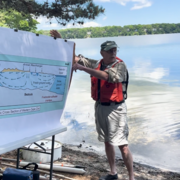
USGS has studied the hydrology of Cape Cod and the Islands and demonstrated our science to the public for more than four decades. Many visitor groups from government agencies, universities, nonprofit organizations, and local communities have learned about our groundwater and surface water research in southeastern Massachusetts. USGS Research Hydrologist Emeritus Denis Leblanc has been a pillar in...

USGS scientists collecting lake-bottom sediments
USGS scientists collecting lake-bottom sediments from Ashumet Pond on Cape Cod, Massachusetts for use in laboratory experiments on the fate of PFAS at groundwater/surface-water boundaries. The sediments are collected by pushing a tube into the lake bottom and transferring the sediment and pore water into glass jars.

Measuring Streamflow in the Santuit River on Cape Cod
Measuring Streamflow in the Santuit River on Cape CodHydrologic technician Kal Csigi takes a streamflow measurement in the Santuit River for a project that sought to identify areas of high nitrogen loading to selected rivers on Cape Cod through stream data, observations, and groundwater modeling.
Measuring Streamflow in the Santuit River on Cape Cod
Measuring Streamflow in the Santuit River on Cape CodHydrologic technician Kal Csigi takes a streamflow measurement in the Santuit River for a project that sought to identify areas of high nitrogen loading to selected rivers on Cape Cod through stream data, observations, and groundwater modeling.

Measuring Streamflow in the Quashnet River on Cape Cod
Measuring Streamflow in the Quashnet River on Cape CodHydrologic technician Kal Csigi takes a streamflow measurement of the Quashnet River on Cape Cod for a project that sought to identify areas of high nitrogen loading to selected rivers on Cape Cod through stream data, observations, and groundwater modeling.
Measuring Streamflow in the Quashnet River on Cape Cod
Measuring Streamflow in the Quashnet River on Cape CodHydrologic technician Kal Csigi takes a streamflow measurement of the Quashnet River on Cape Cod for a project that sought to identify areas of high nitrogen loading to selected rivers on Cape Cod through stream data, observations, and groundwater modeling.

Measuring Streamflow in the Santuit River on Cape Cod
Measuring Streamflow in the Santuit River on Cape CodHydrologic technician Kal Csigi takes a streamflow measurement in the Santuit River on Cape Cod for a project that sought to identify areas of high nitrogen loading to selected rivers on Cape Cod through stream data, observations, and groundwater modeling.
Measuring Streamflow in the Santuit River on Cape Cod
Measuring Streamflow in the Santuit River on Cape CodHydrologic technician Kal Csigi takes a streamflow measurement in the Santuit River on Cape Cod for a project that sought to identify areas of high nitrogen loading to selected rivers on Cape Cod through stream data, observations, and groundwater modeling.

Sampling Groundwater for poly- and Perfluoroalkyl Substances
Sampling Groundwater for poly- and Perfluoroalkyl SubstancesU.S. Geological Survey (USGS) scientist collecting groundwater samples for analysis of poly- and perfluoroalkyl substances (PFASs) from a multiport monitoring well downgradient from a former fire-training area on western Cape Cod, Massachusetts.
Sampling Groundwater for poly- and Perfluoroalkyl Substances
Sampling Groundwater for poly- and Perfluoroalkyl SubstancesU.S. Geological Survey (USGS) scientist collecting groundwater samples for analysis of poly- and perfluoroalkyl substances (PFASs) from a multiport monitoring well downgradient from a former fire-training area on western Cape Cod, Massachusetts.

Treated Wastewater from Joint Base Cape Cod was Discharged
Treated Wastewater from Joint Base Cape Cod was DischargedTreated wastewater from Joint Base Cape Cod was discharged to rapid-infiltration disposal beds from 1936 to 1995. The disposal formed a groundwater contamination plume that extends more than 10 kilometers in the Cape Cod sand and gravel glacial outwash aquifer.
Treated Wastewater from Joint Base Cape Cod was Discharged
Treated Wastewater from Joint Base Cape Cod was DischargedTreated wastewater from Joint Base Cape Cod was discharged to rapid-infiltration disposal beds from 1936 to 1995. The disposal formed a groundwater contamination plume that extends more than 10 kilometers in the Cape Cod sand and gravel glacial outwash aquifer.

Drilling on Maravista peninsula in Falmouth MA
Drilling on Maravista peninsula in Falmouth, Massachusetts
Drilling on Maravista peninsula in Falmouth, Massachusetts

Experimental setup for small-scale transport test
Experimental setup for small-scale transport test designed to assess the effectiveness of the "colmation layer" at the bottom sediments of Ashumet Pond (Cape Cod, Massachusetts) for filtering out cyanobacteria and viruses.
Experimental setup for small-scale transport test designed to assess the effectiveness of the "colmation layer" at the bottom sediments of Ashumet Pond (Cape Cod, Massachusetts) for filtering out cyanobacteria and viruses.

USGS Scientists Collecting Water-Quality Samples from Shallow Groundwater under Ashumet Pond
USGS Scientists Collecting Water-Quality Samples from Shallow Groundwater under Ashumet PondU.S. Geological Survey (USGS) scientists collecting water-quality samples from shallow groundwater under Ashumet Pond, Cape Cod, Massachusetts.
USGS Scientists Collecting Water-Quality Samples from Shallow Groundwater under Ashumet Pond
USGS Scientists Collecting Water-Quality Samples from Shallow Groundwater under Ashumet PondU.S. Geological Survey (USGS) scientists collecting water-quality samples from shallow groundwater under Ashumet Pond, Cape Cod, Massachusetts.

Ashumet Pond, Cape Cod with sample grid markers
Sunset view looking northwest from Fishermans Cove, across Ashumet Pond, Cape Cod, Massachusetts. The small sticks and flags in the lake are a sampling grid.
Sunset view looking northwest from Fishermans Cove, across Ashumet Pond, Cape Cod, Massachusetts. The small sticks and flags in the lake are a sampling grid.

Ashumet Pond, Cape Cod
View looking west from Fishermans Cove, across Ashumet Pond, Cape Cod, Massachusetts. The small sticks in the lake are a small-scale sampling grid.
View looking west from Fishermans Cove, across Ashumet Pond, Cape Cod, Massachusetts. The small sticks in the lake are a small-scale sampling grid.

Groundwater sampling array
Groundwater sampling array at the Toxics Substances research site, Cape Cod, Massachusetts
Groundwater sampling array at the Toxics Substances research site, Cape Cod, Massachusetts

Antibiotics in Groundwater Tracer Injection
U.S. Geological Survey (USGS) scientists conducted a unique study, which demonstrated that the ecology of natural groundwater bacteria changed after exposure of the bacteria to the antibiotic sulfamethoxazole (SMX).
U.S. Geological Survey (USGS) scientists conducted a unique study, which demonstrated that the ecology of natural groundwater bacteria changed after exposure of the bacteria to the antibiotic sulfamethoxazole (SMX).

Anammox Research Site on Cape Cod
An aerial view looking southeast of the treated-wastewater infiltration beds at Joint Base Cape Cod. The wastewater disposal beds (source of the nitrogen contamination) appear in the foreground. In the background is a freshwater pond that is receiving discharge of some of the groundwater contaminants. Toxic waste disposal at the site ended in 1995.
An aerial view looking southeast of the treated-wastewater infiltration beds at Joint Base Cape Cod. The wastewater disposal beds (source of the nitrogen contamination) appear in the foreground. In the background is a freshwater pond that is receiving discharge of some of the groundwater contaminants. Toxic waste disposal at the site ended in 1995.
Science and Products
Unique Approach to Measure Per- and Polyfluoroalkyl Substances Uptake in Fish, Mussels, and Passive Samplers
Per- and polyfluoroalkyl substances (PFAS) uptake and bioconcentration by fish and mussels ─ housed in mobile laboratories at a legacy fire-training area contaminated by aqueous film-forming foams ─ varied by species, sex, and compound. PFAS in passive samplers deployed at the same time mimicked uptake by fish but not mussels indicating that passive samplers might prove useful as screening tools...
PFAS Transport, Exposure, and Effects
The team is determining the movement and behavior of per- and poly-fluoroalkyl substances (PFAS) from their sources in the environment, as they move through exposure pathways in ecosystems including watersheds and aquifers, their incorporation into food webs, and molecular to population scale effects on fish and wildlife. These studies are accomplished at a variety of spatial scales from regional...
Research on Per- and Polyfluoroalkyl Substances (PFAS) in the New England Water Science Center
Per- and polyfluoroalkyl substances (PFAS) are a diverse group of over 4,000 different compounds. Since the 1940s, PFAS have been manufactured and used around the globe, including in the United States. PFAS are resistant to chemical and thermal breakdown and impart stain and water-resistance properties, making them useful for a variety of commercial applications, but also persistent in the...
Large Fraction of Unidentified Organofluorine in a Coastal Watershed has Implications for River to Marine Ecosystems
A group of scientists investigated per- and polyfluoroalkyl substances (PFAS) in watersheds on Cape Cod and identified a unique signature for aqueous film forming foams (AFFF) from legacy firefighting and fire training. A combination of statistical modeling and laboratory measurements indicates that unidentified organofluorine constitutes a large fraction of PFAS in the river systems that...
Measurement and Modeling of Nitrogen Discharge to Cape Cod Rivers to Identify High-Priority Nitrogen Reduction Areas
In 2019 USGS and the U.S. Environmental Protection Agency (EPA) Region 1 initiated a study to measure spatial and temporal patterns of nitrogen loading in selected rivers on Cape Cod and then determine whether the measured patterns can be related to nitrogen source areas in the surrounding watersheds to prioritize nitrogen reduction efforts. Study results will improve understanding of nitrogen...
Hydrologic Monitoring in the Three Bays Watershed in Support of Nutrient Management Activities, Cape Cod, Massachusetts
In 2019 the USGS began a partnership with the U.S. Environmental Protection Agency (EPA) Office of Research and Development (ORD), EPA Region 1 Southeast New England Program for Coastal Watershed Restoration (SNEP), Barnstable Clean Water Coalition (BCWC), and other stakeholders to conduct hydrologic monitoring and assessment in support of multifaceted nutrient-management activities in the Three...
Assessment of Potential Effects of Water-Supply Withdrawals on Groundwater Levels near the Hyannis Ponds Complex, Barnstable, Massachusetts
The USGS, in cooperation with the Town of Barnstable and MassWildlife, is assessing the potential effects of new water-supply withdrawals on groundwater levels in the Hyannis Ponds Wildlife Management Area on Cape Cod. A groundwater-flow model is being used to simulate the effects of several possible withdrawal and wastewater-return flow scenarios developed by the Town of Barnstable and...
Hydrologic Site Assessment for Passive Treatment of Groundwater Nitrogen with Permeable Reactive Barriers, Cape Cod, Massachusetts
In 2019 USGS completed a study designed to develop and evaluate a phased site-assessment approach for determining the hydrologic suitability of sites being considered for permeable reactive barrier installation on Cape Cod. The approach provides a template for town officials and other stakeholders to follow when considering PRBs for passive treatment of nitrogen in groundwater on Cape Cod and...
USGS Publications on the Water Resources of Cape Cod and Southeastern Massachusetts
The U.S. Geological Survey (USGS) has been investigating groundwater and surface-water resources on Cape Cod for more than 50 years. Recent studies have focused on the sources of water to public-supply wells, ponds, streams, and coastal areas; transport and discharge of nitrogen and contaminants of emerging concern derived from domestic and municipal wastewater disposal; fate and transport of...
Per- and Polyfluoroalkyl Substances From Firefighting and Domestic Wastewater Remain in Groundwater for Decades
New study explores the persistence and transport of poly- and perfluoroalkyl substances (PFASs) that originated from both firefighting and domestic wastewater sources. Although the fire training area and wastewater facility were decommissioned over 20 years ago, both sites continue to be sources of PFASs to groundwater.
40 Years Presenting Cape Cod Hydrology
USGS has studied the hydrology of Cape Cod and the Islands and demonstrated our science to the public for more than four decades. Many visitor groups from government agencies, universities, nonprofit organizations, and local communities have learned about our groundwater and surface water research in southeastern Massachusetts. USGS Research Hydrologist Emeritus Denis Leblanc has been a pillar in...
USGS scientists collecting lake-bottom sediments
USGS scientists collecting lake-bottom sediments from Ashumet Pond on Cape Cod, Massachusetts for use in laboratory experiments on the fate of PFAS at groundwater/surface-water boundaries. The sediments are collected by pushing a tube into the lake bottom and transferring the sediment and pore water into glass jars.
USGS scientists collecting lake-bottom sediments from Ashumet Pond on Cape Cod, Massachusetts for use in laboratory experiments on the fate of PFAS at groundwater/surface-water boundaries. The sediments are collected by pushing a tube into the lake bottom and transferring the sediment and pore water into glass jars.
Measuring Streamflow in the Santuit River on Cape Cod
Measuring Streamflow in the Santuit River on Cape CodHydrologic technician Kal Csigi takes a streamflow measurement in the Santuit River for a project that sought to identify areas of high nitrogen loading to selected rivers on Cape Cod through stream data, observations, and groundwater modeling.
Measuring Streamflow in the Santuit River on Cape Cod
Measuring Streamflow in the Santuit River on Cape CodHydrologic technician Kal Csigi takes a streamflow measurement in the Santuit River for a project that sought to identify areas of high nitrogen loading to selected rivers on Cape Cod through stream data, observations, and groundwater modeling.
Measuring Streamflow in the Quashnet River on Cape Cod
Measuring Streamflow in the Quashnet River on Cape CodHydrologic technician Kal Csigi takes a streamflow measurement of the Quashnet River on Cape Cod for a project that sought to identify areas of high nitrogen loading to selected rivers on Cape Cod through stream data, observations, and groundwater modeling.
Measuring Streamflow in the Quashnet River on Cape Cod
Measuring Streamflow in the Quashnet River on Cape CodHydrologic technician Kal Csigi takes a streamflow measurement of the Quashnet River on Cape Cod for a project that sought to identify areas of high nitrogen loading to selected rivers on Cape Cod through stream data, observations, and groundwater modeling.
Measuring Streamflow in the Santuit River on Cape Cod
Measuring Streamflow in the Santuit River on Cape CodHydrologic technician Kal Csigi takes a streamflow measurement in the Santuit River on Cape Cod for a project that sought to identify areas of high nitrogen loading to selected rivers on Cape Cod through stream data, observations, and groundwater modeling.
Measuring Streamflow in the Santuit River on Cape Cod
Measuring Streamflow in the Santuit River on Cape CodHydrologic technician Kal Csigi takes a streamflow measurement in the Santuit River on Cape Cod for a project that sought to identify areas of high nitrogen loading to selected rivers on Cape Cod through stream data, observations, and groundwater modeling.
Sampling Groundwater for poly- and Perfluoroalkyl Substances
Sampling Groundwater for poly- and Perfluoroalkyl SubstancesU.S. Geological Survey (USGS) scientist collecting groundwater samples for analysis of poly- and perfluoroalkyl substances (PFASs) from a multiport monitoring well downgradient from a former fire-training area on western Cape Cod, Massachusetts.
Sampling Groundwater for poly- and Perfluoroalkyl Substances
Sampling Groundwater for poly- and Perfluoroalkyl SubstancesU.S. Geological Survey (USGS) scientist collecting groundwater samples for analysis of poly- and perfluoroalkyl substances (PFASs) from a multiport monitoring well downgradient from a former fire-training area on western Cape Cod, Massachusetts.
Treated Wastewater from Joint Base Cape Cod was Discharged
Treated Wastewater from Joint Base Cape Cod was DischargedTreated wastewater from Joint Base Cape Cod was discharged to rapid-infiltration disposal beds from 1936 to 1995. The disposal formed a groundwater contamination plume that extends more than 10 kilometers in the Cape Cod sand and gravel glacial outwash aquifer.
Treated Wastewater from Joint Base Cape Cod was Discharged
Treated Wastewater from Joint Base Cape Cod was DischargedTreated wastewater from Joint Base Cape Cod was discharged to rapid-infiltration disposal beds from 1936 to 1995. The disposal formed a groundwater contamination plume that extends more than 10 kilometers in the Cape Cod sand and gravel glacial outwash aquifer.
Drilling on Maravista peninsula in Falmouth MA
Drilling on Maravista peninsula in Falmouth, Massachusetts
Drilling on Maravista peninsula in Falmouth, Massachusetts
Experimental setup for small-scale transport test
Experimental setup for small-scale transport test designed to assess the effectiveness of the "colmation layer" at the bottom sediments of Ashumet Pond (Cape Cod, Massachusetts) for filtering out cyanobacteria and viruses.
Experimental setup for small-scale transport test designed to assess the effectiveness of the "colmation layer" at the bottom sediments of Ashumet Pond (Cape Cod, Massachusetts) for filtering out cyanobacteria and viruses.
USGS Scientists Collecting Water-Quality Samples from Shallow Groundwater under Ashumet Pond
USGS Scientists Collecting Water-Quality Samples from Shallow Groundwater under Ashumet PondU.S. Geological Survey (USGS) scientists collecting water-quality samples from shallow groundwater under Ashumet Pond, Cape Cod, Massachusetts.
USGS Scientists Collecting Water-Quality Samples from Shallow Groundwater under Ashumet Pond
USGS Scientists Collecting Water-Quality Samples from Shallow Groundwater under Ashumet PondU.S. Geological Survey (USGS) scientists collecting water-quality samples from shallow groundwater under Ashumet Pond, Cape Cod, Massachusetts.
Ashumet Pond, Cape Cod with sample grid markers
Sunset view looking northwest from Fishermans Cove, across Ashumet Pond, Cape Cod, Massachusetts. The small sticks and flags in the lake are a sampling grid.
Sunset view looking northwest from Fishermans Cove, across Ashumet Pond, Cape Cod, Massachusetts. The small sticks and flags in the lake are a sampling grid.
Ashumet Pond, Cape Cod
View looking west from Fishermans Cove, across Ashumet Pond, Cape Cod, Massachusetts. The small sticks in the lake are a small-scale sampling grid.
View looking west from Fishermans Cove, across Ashumet Pond, Cape Cod, Massachusetts. The small sticks in the lake are a small-scale sampling grid.
Groundwater sampling array
Groundwater sampling array at the Toxics Substances research site, Cape Cod, Massachusetts
Groundwater sampling array at the Toxics Substances research site, Cape Cod, Massachusetts
Antibiotics in Groundwater Tracer Injection
U.S. Geological Survey (USGS) scientists conducted a unique study, which demonstrated that the ecology of natural groundwater bacteria changed after exposure of the bacteria to the antibiotic sulfamethoxazole (SMX).
U.S. Geological Survey (USGS) scientists conducted a unique study, which demonstrated that the ecology of natural groundwater bacteria changed after exposure of the bacteria to the antibiotic sulfamethoxazole (SMX).
Anammox Research Site on Cape Cod
An aerial view looking southeast of the treated-wastewater infiltration beds at Joint Base Cape Cod. The wastewater disposal beds (source of the nitrogen contamination) appear in the foreground. In the background is a freshwater pond that is receiving discharge of some of the groundwater contaminants. Toxic waste disposal at the site ended in 1995.
An aerial view looking southeast of the treated-wastewater infiltration beds at Joint Base Cape Cod. The wastewater disposal beds (source of the nitrogen contamination) appear in the foreground. In the background is a freshwater pond that is receiving discharge of some of the groundwater contaminants. Toxic waste disposal at the site ended in 1995.
*Disclaimer: Listing outside positions with professional scientific organizations on this Staff Profile are for informational purposes only and do not constitute an endorsement of those professional scientific organizations or their activities by the USGS, Department of the Interior, or U.S. Government