This dragonfly is called a Cardinal Meadowhawk.
Images
Check out photos of some of the awesome work USGS scientists and field technicians have done over the years.
This dragonfly is called a Cardinal Meadowhawk.
Algal bloom in WIllow Creek Reservoir, Oregon, taken during a photointerpretive study of the lake.
View of the Willow Creek Reservoir near Heppner, OR
Beaver swimming in Summer Lake, Oregon.
Beaver eating at Summer Lake, OR
Beaver swimming in Summer Lake, OR
Rough skin newt just below the surface of a wetland pond
Rough skin newt just below the surface of a wetland pondRough skin newt just below the surface of a wetland pond in the Tualatin River Basin, Oregon.
Rough skin newt just below the surface of a wetland pond
Rough skin newt just below the surface of a wetland pondRough skin newt just below the surface of a wetland pond in the Tualatin River Basin, Oregon.
Hydrologic technician Sylas Daughtrey works at a gagehouse on Columbia River at Stevenson, Washington
Trask River stage, discharge, and water-quality data are collected and used together to help monitor the current health of the river. Instream equipment is stored in protective housing to protect it from the elements. Data from the river are sent to equipment in the gage house, where it is stored then transmitted to USGS servers.
A U.S. Geological Survey hydrologist collects a water sample from the Williamson River below Chiloquin, Oregon. The sample was analyzed as part of a water-quality study the USGS conducted in cooperation with the U.S. Bureau of Reclamation and the Klamath Tribes.
Scenic view from Siuslaw National Forest, OR.
USGS scientist completing a stream assessement of West Fork Palmer Creek, Oregon.
Photograph of field gear and equipment used in water quality monitoring.
USGS hydrologist working in the field.
An agriculture field in the upper floodplain of the Willamette Valley near Junction City, Oregon.
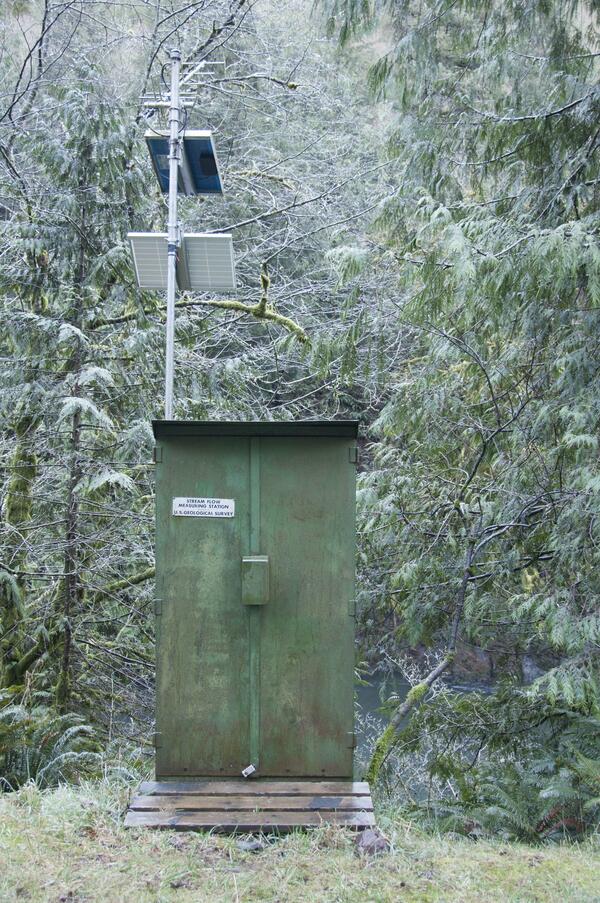
A USGS streamflow gaging station is used to collect water data
A USGS streamflow gaging station is used to collect water dataA U.S. Geological Survey streamflow gaging station collects water data on the Trask River. The Trask River gage is located near Tillamook, Ore. and has been in operation for 17 years.
A USGS streamflow gaging station is used to collect water data
A USGS streamflow gaging station is used to collect water dataA U.S. Geological Survey streamflow gaging station collects water data on the Trask River. The Trask River gage is located near Tillamook, Ore. and has been in operation for 17 years.
Trask River stage, discharge, and water-quality data are collected and used together to help monitor the current health of the river. Data from the river are sent to equipment in the gage house, where it is stored then transmitted to USGS servers.
Glyphosate is frequently applied to corn and soybeans
Glyphosate is frequently applied to corn and soybeansGlyphosate is frequently applied to corn and soybeans growing areas like these in Iowa.
Glyphosate is frequently applied to corn and soybeans
Glyphosate is frequently applied to corn and soybeansGlyphosate is frequently applied to corn and soybeans growing areas like these in Iowa.
Plankton response to low dissolved oxygen in the Tualatin River
Plankton response to low dissolved oxygen in the Tualatin RiverPoster for Tualatin plankton study.
Carpenter, K.D. and Rounds, S.A., 2014, Plankton communities and summertime declines in algal abundance associated with low dissolved oxygen in the Tualatin River, Oregon.
Plankton response to low dissolved oxygen in the Tualatin River
Plankton response to low dissolved oxygen in the Tualatin RiverPoster for Tualatin plankton study.
Carpenter, K.D. and Rounds, S.A., 2014, Plankton communities and summertime declines in algal abundance associated with low dissolved oxygen in the Tualatin River, Oregon.
Monitoring water in Wapato Lake WIldlife Refuge, Oregon
Monitoring water in Wapato Lake WIldlife Refuge, OregonPoster for Wapato Lake Monitoring Project.
Rounds, S.A., 2014, Monitoring streamflow, water levels, and water quality in the Wapato Lake National Wildlife Refuge, Oregon.
Monitoring water in Wapato Lake WIldlife Refuge, Oregon
Monitoring water in Wapato Lake WIldlife Refuge, OregonPoster for Wapato Lake Monitoring Project.
Rounds, S.A., 2014, Monitoring streamflow, water levels, and water quality in the Wapato Lake National Wildlife Refuge, Oregon.
Over 1 million acres of the Willamette Basin is dedicated to agriculture. This farm rests in the floodplain of the Middle Willamette River near Albany, Oregon.