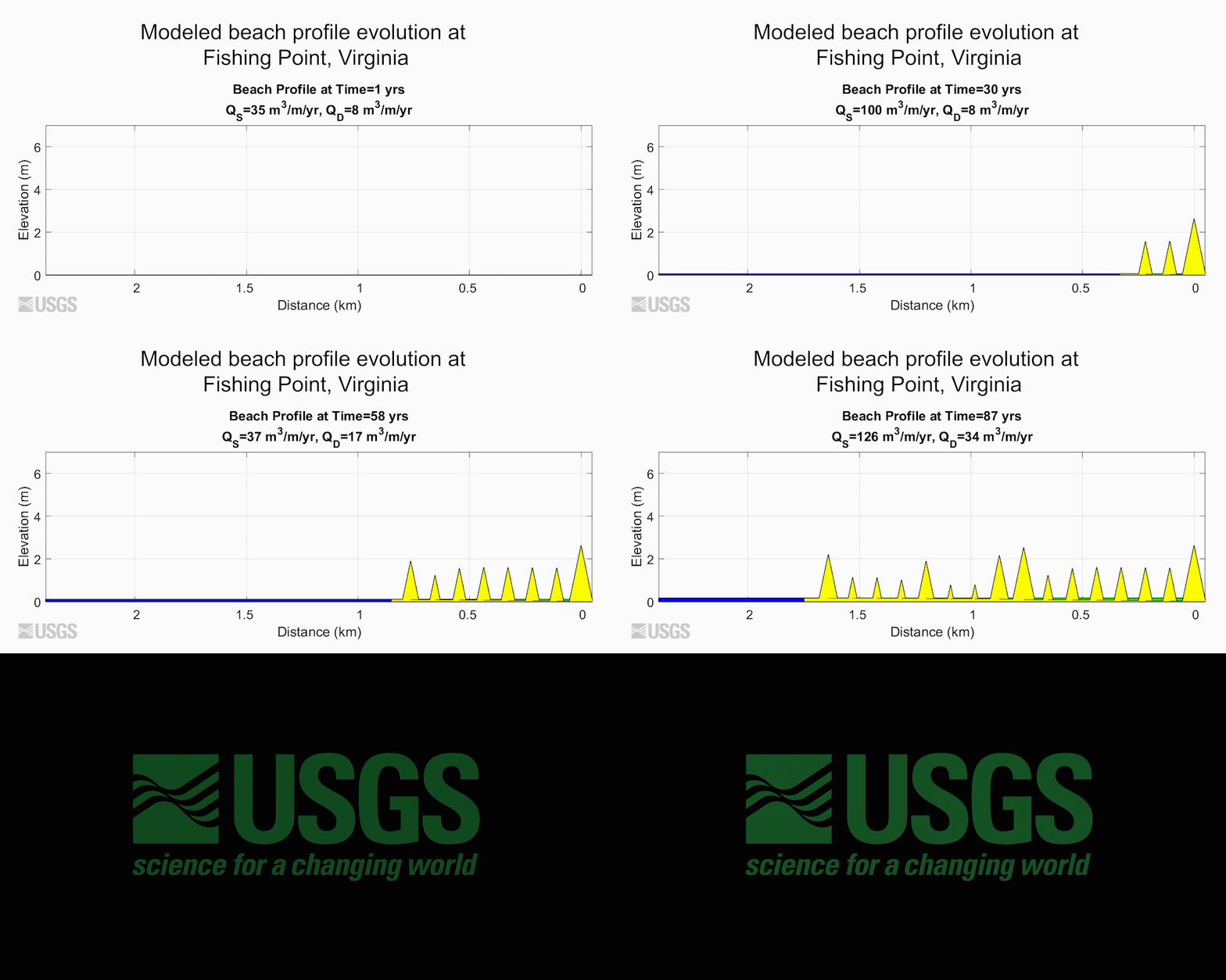
The USGS St. Petersburg Coastal and Marine Science Center conducted outreach at the Localtopia Event held in February 2020. Staff demonstrated a simulation of how storms can impact sandy coastlines through processes such as erosion.
Images
St. Petersburg Coastal and Marine Science Center images.
The USGS St. Petersburg Coastal and Marine Science Center conducted outreach at the Localtopia Event held in February 2020. Staff demonstrated a simulation of how storms can impact sandy coastlines through processes such as erosion.
Map and graphs illustrating (A) the extent of the shoreline and dune-base forecast locations (red). The year of (B) the first available and (C) most recent shoreline (red) and dune-base (blue) positions are provided for each transect. (D) Total number of shoreline and dune-base positions used in the analysis are also shown. #, number.
Lauren Toth and Julie Richey speak to students about climate change
Lauren Toth and Julie Richey speak to students about climate changeThe St. Petersburg Coastal and Marine Science Center hosted a mini panel discussion of scientists for local children to learn about USGS research, capabilities, and techniques for studying changes in climate across Earth’s history.
Lauren Toth and Julie Richey speak to students about climate change
Lauren Toth and Julie Richey speak to students about climate changeThe St. Petersburg Coastal and Marine Science Center hosted a mini panel discussion of scientists for local children to learn about USGS research, capabilities, and techniques for studying changes in climate across Earth’s history.
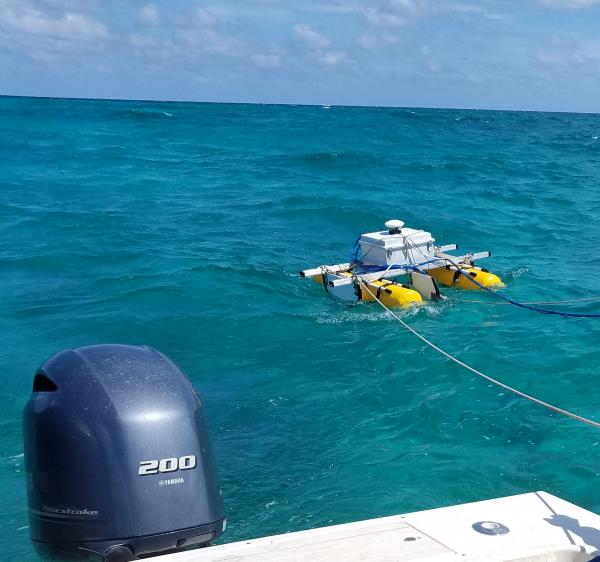
SQUID-5 - Structure-from-Motion Quantitative Underwater Imaging Device
SQUID-5 - Structure-from-Motion Quantitative Underwater Imaging DeviceThe SQUID-5, or a Structure-from-Motion (SfM) Quantitative Underwater Imaging Device with 5 cameras is a towed surface vehicle with an onboard Global Navigation Satellite System (GNSS) and 5 downward-looking cameras with overlapping views of the seafloor.
SQUID-5 - Structure-from-Motion Quantitative Underwater Imaging Device
SQUID-5 - Structure-from-Motion Quantitative Underwater Imaging DeviceThe SQUID-5, or a Structure-from-Motion (SfM) Quantitative Underwater Imaging Device with 5 cameras is a towed surface vehicle with an onboard Global Navigation Satellite System (GNSS) and 5 downward-looking cameras with overlapping views of the seafloor.
State of Our Nation’s Coast Stakeholder Engagement Workshop
State of Our Nation’s Coast Stakeholder Engagement WorkshopA group of participants at the Coastal Change Hazards State of Our Nation’s Coast stakeholder engagement workshop at the Waquoit Bay National Estuarine Reserve in Falmouth, MA. Here participants are pictured writing the names of tools they use on sticky notes.
State of Our Nation’s Coast Stakeholder Engagement Workshop
State of Our Nation’s Coast Stakeholder Engagement WorkshopA group of participants at the Coastal Change Hazards State of Our Nation’s Coast stakeholder engagement workshop at the Waquoit Bay National Estuarine Reserve in Falmouth, MA. Here participants are pictured writing the names of tools they use on sticky notes.
State of Our Nation’s Coast Stakeholder Engagement Workshop
State of Our Nation’s Coast Stakeholder Engagement WorkshopParticipants of the Coastal Change Hazards State of Our Nation’s Coast stakeholder engagement workshop at the Waquoit Bay National Estuarine Reserve in Falmouth, MA. Participants are pictured here talking in small groups.
State of Our Nation’s Coast Stakeholder Engagement Workshop
State of Our Nation’s Coast Stakeholder Engagement WorkshopParticipants of the Coastal Change Hazards State of Our Nation’s Coast stakeholder engagement workshop at the Waquoit Bay National Estuarine Reserve in Falmouth, MA. Participants are pictured here talking in small groups.
A large winch on the stern of R/V Pelican is used to retrieve two sediment traps from the bottom of the Gulf of Mexico.
A CTD-rosette is a commonly used instrument that measures conductivity (that can inform scientists about salinity), temperature, and depth (CTD). As the instrument is lowered into the water--sometimes down to great depths--the cylinders around will open at various depths to collect water samples at discrete locations throughout the water column.
Caitlin Reynolds with a sediment trap in the Gulf of Mexico
Caitlin Reynolds with a sediment trap in the Gulf of MexicoCaitlin Reynolds of the USGS St. Petersburg Coastal and Marine Science Center secures a sediment trap, retrieved from the bottom of the Gulf of Mexico on board the R/V Pelican.
Caitlin Reynolds with a sediment trap in the Gulf of Mexico
Caitlin Reynolds with a sediment trap in the Gulf of MexicoCaitlin Reynolds of the USGS St. Petersburg Coastal and Marine Science Center secures a sediment trap, retrieved from the bottom of the Gulf of Mexico on board the R/V Pelican.
A beautiful sun set over the Gulf of Mexico from the stern of the R/V Pelican.
Caitlin Reynolds collects samples from sediment trap
Caitlin Reynolds collects samples from sediment trapHere, Caitlin Reynolds sits on the R/V Pelican next to a sediment trap that collects samples in the Gulf of America.
Caitlin Reynolds collects samples from sediment trap
Caitlin Reynolds collects samples from sediment trapHere, Caitlin Reynolds sits on the R/V Pelican next to a sediment trap that collects samples in the Gulf of America.
The USGS St. Petersburg Coastal and Marine Science Center has grown from a core group of geologists and oceanographers to over 100 staff members including biologists, oceanographers, modelers, remote sensing specialists, biogeochemists, microbiologists, coral reef experts, support staff, marine operations crew, data management specialists, and more.
USGS researchers Chris Moore and Mitchell Lemon took a trip on the R/V Weatherbird in January of 2020 with the University of South Florida College of Marine Science as part of a study on carbon dioxide in the Gulf of Mexico. Carbon Dioxide, or CO2, is a greenhouse gas that can be absorbed by the ocean.
This core sample was taken from an elkhorn coral reef offshore of the Fort Lauderdale region of Florida. Samples from coral skeletons are taken from numerous locations in the core for radiocarbon dating, which tells scientists the age of each coral and of sections within the reef. The corals in this core lived from 7,100 to 6,200 years ago.
This piece of a core sample taken from offshore of the Fort Lauderdale region of Florida is from an elkhorn coral that lived 6,200 years ago. Coral type, orientation of corallites, and evidence of other fauna and characteristics within the core sample are used to determine how reliable the coral sample is to use for past sea-level reconstruction.
SQUID-5 - Structure-from-Motion Quantitative Underwater Imaging Device
SQUID-5 - Structure-from-Motion Quantitative Underwater Imaging DeviceThe SQUID-5, or a Structure-from-Motion (SfM) Quantitative Underwater Imaging Device with 5 cameras is a towed surface vehicle with an onboard Global Navigation Satellite System (GNSS) and 5 downward-looking cameras with overlapping views of the seafloor.
SQUID-5 - Structure-from-Motion Quantitative Underwater Imaging Device
SQUID-5 - Structure-from-Motion Quantitative Underwater Imaging DeviceThe SQUID-5, or a Structure-from-Motion (SfM) Quantitative Underwater Imaging Device with 5 cameras is a towed surface vehicle with an onboard Global Navigation Satellite System (GNSS) and 5 downward-looking cameras with overlapping views of the seafloor.
A wave breaks over a degraded reef crest at Buck Island in St. Croix
A wave breaks over a degraded reef crest at Buck Island in St. CroixA wave breaking over a degraded reef crest at Buck Island National Monument in St. Croix. Wave-breaking in these habitats relies on reef framework built by the elkhorn coral, Acropora palmata, which is now a threatened species throughout the western Atlantic.
A wave breaks over a degraded reef crest at Buck Island in St. Croix
A wave breaks over a degraded reef crest at Buck Island in St. CroixA wave breaking over a degraded reef crest at Buck Island National Monument in St. Croix. Wave-breaking in these habitats relies on reef framework built by the elkhorn coral, Acropora palmata, which is now a threatened species throughout the western Atlantic.
In 2015, artist Lenn Neff dedicated this stained-glass artwork commemorating Dr. Abby Sallenger, former Center Director of SPCMSC. The glass now resides in the main hall of the Getting building, facing the courtyard.
This historic Studebaker building is the home of the St. Petersburg Coastal and Marine Science Center.
Learn more about the history of the St. Petersburg Coastal and Marine Science Center.
This historic Studebaker building is the home of the St. Petersburg Coastal and Marine Science Center.
Learn more about the history of the St. Petersburg Coastal and Marine Science Center.
This historic brick Studebaker Building, originally built in 1925, was chosen as the location for the USGS St. Petersburg Coastal and Marine Science Center in the late 1980s.
Construction of the Young building at the St. Petersburg Coastal and Marine Science Center began in 2002. The newest building of SPCMSC encompasses an area of 11,400 ft2 and features six state-of-the-art laboratories, a dive locker, and 12 additional offices. Dedicated in March 2008, the third building is the latest addition to the C.W.