
U.S. flag

An official website of the United States government

Videos

Videos

Filter Total Items: 1158
USGS Public Lecture: Warm Ice—Dynamics of Rapidly Changing Glaciers
  • Glacier Numerology – The how big, how long, how thick, how much, how often, of glacier science.
  • Glacier Photography – While a picture may be worth a thousand words, a collection of images may tell a complete forensic story.
  • Glacier Numerology – The how big, how long, how thick, how much, how often, of glacier science.
  • Glacier Photography – While a picture may be worth a thousand words, a collection of images may tell a complete forensic story.
Image of the Week: Batagaika Crater and the Megaslump

Warm summers and short winters are thawing permafrost in the Siberian tundra, causing soil erosion. As a result, the 800 meter wide Batagaika crater continues to expand.


At the USGS EROS Center, we study land change, operate the Landsat satellites, and maintain the longest, continuously acquired collection of images of the Earth's land surface.

Warm summers and short winters are thawing permafrost in the Siberian tundra, causing soil erosion. As a result, the 800 meter wide Batagaika crater continues to expand.


At the USGS EROS Center, we study land change, operate the Landsat satellites, and maintain the longest, continuously acquired collection of images of the Earth's land surface.

Instagram Story: Matt Patrick, Research Geologist

An Instagram Story posted to the @USGS Instagram account about Matt Patrick, Research Geologist at the Hawaiian Volcano Observatory (HVO).

Image of the Week: Iceberg Separates from Larsen C Ice Shelf

Thermal satellite images are tracking A-68, a newly calved iceberg off the Larsen C Ice Shelf in Antartica.


At the USGS EROS Center, we study land change, operate the Landsat satellites, and maintain the longest, continuously acquired collection of images of the Earth's land surface.
Thermal satellite images are tracking A-68, a newly calved iceberg off the Larsen C Ice Shelf in Antartica.


At the USGS EROS Center, we study land change, operate the Landsat satellites, and maintain the longest, continuously acquired collection of images of the Earth's land surface.

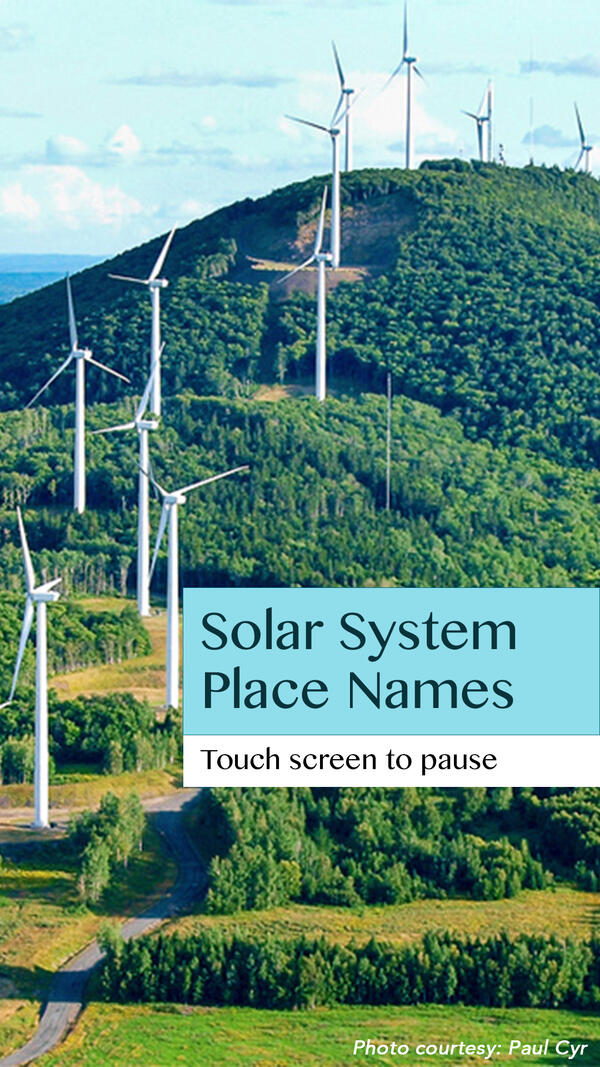
Instagram Story: Solar System Place Names

Instagram Story from the @USGS Instagram account on solar system related place names derived from GNIS mapping data (http://geonames.usgs.gov).

Photography of Mars Hill, ME (copyrighted) used courtesy of Paul Cyr Photography

Instagram Story from the @USGS Instagram account on solar system related place names derived from GNIS mapping data (http://geonames.usgs.gov).

Photography of Mars Hill, ME (copyrighted) used courtesy of Paul Cyr Photography

Sagebrush Ecosystems in a Changing Climate and Adaptive Management

This webinar was conducted on July 17, 2017 as part of the USGS National Climate Change and Wildlife Science Center Climate Change Science and Management Webinar Series, held in partnership with FWS National Conservation Training Center. 

This webinar was conducted on July 17, 2017 as part of the USGS National Climate Change and Wildlife Science Center Climate Change Science and Management Webinar Series, held in partnership with FWS National Conservation Training Center. 

Debris flow monitoring at Chalk Cliffs, CO (2017)

The USGS and its cooperators have installed debris-flow monitoring equipment in the largest drainage basin at Chalk Cliffs, CO. Data collection at this site supports research on the hydrologic factors that control debris-flow initiation, entrainment, and flow dynamics.

The USGS and its cooperators have installed debris-flow monitoring equipment in the largest drainage basin at Chalk Cliffs, CO. Data collection at this site supports research on the hydrologic factors that control debris-flow initiation, entrainment, and flow dynamics.

20th Anniversary - EROS Center Hailstorm

Softball-sized hail caused millions of dollars of damage to the USGS EROS Center 20 years ago this week. July 13, 1997, marks the date of the massive hailstorm in southeastern South Dakota. 

Softball-sized hail caused millions of dollars of damage to the USGS EROS Center 20 years ago this week. July 13, 1997, marks the date of the massive hailstorm in southeastern South Dakota. 

Wildlife on the Nevada National Security Site

Mountain lions, desert bighorn sheep, mule deer, and a variety of other wildlife live on and pass through the Nevada National Security Site each day. It’s a highly restricted area that is free of hunting and has surprisingly pristine areas.This 22-minute program highlights an extraordinary study on how mountain lions interact with their prey.

Mountain lions, desert bighorn sheep, mule deer, and a variety of other wildlife live on and pass through the Nevada National Security Site each day. It’s a highly restricted area that is free of hunting and has surprisingly pristine areas.This 22-minute program highlights an extraordinary study on how mountain lions interact with their prey.

Return of the Yellowstone Grizzly Bear

Yellowstone grizzly bears inhabit federal, state, tribal, and private lands, and long-term research requires careful coordination across governmental levels.

Yellowstone grizzly bears inhabit federal, state, tribal, and private lands, and long-term research requires careful coordination across governmental levels.

USGS Instagram Story: Science Camp

A USGS Instagram Story (@USGS on Instagram) about kids at Science Camp 2017 learning about topographic maps and why they're important. 

A USGS Instagram Story (@USGS on Instagram) about kids at Science Camp 2017 learning about topographic maps and why they're important. 

PubTalk 6/2017 — Effects of Climate Change: A Scientific Path Forward

Title: The Effects of Climate Change: A Scientific Pathway Forward

  • The frequency of extreme and unpredictable weather events is increasing.
  • What are the effects of an increase or decrease in carbon emissions?
  • What is scientific research projecting for the future of climate change?

Title: The Effects of Climate Change: A Scientific Pathway Forward

  • The frequency of extreme and unpredictable weather events is increasing.
  • What are the effects of an increase or decrease in carbon emissions?
  • What is scientific research projecting for the future of climate change?
Drought Refugia: Remote Sensing Approaches and Management Applications

This webinar was recorded on June 12, 2017 as part of the Climate Change Science and Management Webinar Series, held in partnership by the USGS National Climate Change and Wildlife Science Center and the USFWS National Conservation Training Center.

This webinar was recorded on June 12, 2017 as part of the Climate Change Science and Management Webinar Series, held in partnership by the USGS National Climate Change and Wildlife Science Center and the USFWS National Conservation Training Center.

Image of the Week: Deforestation in Peru

Landsat helps document large-scale deforestation in Peru.

The widespread land change is captured over the past few decades.

TopoView - A look at version 2.1

A tutorial by USGS scientist and topoView developer Chris Garrity demonstrating how to use topoView version 2.1. TopoView let's you access and download maps free of charge from the USGS's Historical Topographic Map Collection, published between 1884 and 2006. 

Resources:
An Introduction to TopoView (version 1.0)

A tutorial by USGS scientist and topoView developer Chris Garrity demonstrating how to use topoView version 2.1. TopoView let's you access and download maps free of charge from the USGS's Historical Topographic Map Collection, published between 1884 and 2006. 

Resources:
An Introduction to TopoView (version 1.0)

New USGS Maps of Mars Reveal Ancient Oases

Flyover of the southeast Ceti Mensa map. Distinct groups of rock layers, called geologic units, are shaded in different colors, with dark browns representing the oldest rocks and green representing the youngest rocks. All of these rocks formed as wind-blown sand that became trapped in shallow, ephemeral lakes, similar to the wet playas of the desert southwest US.

Flyover of the southeast Ceti Mensa map. Distinct groups of rock layers, called geologic units, are shaded in different colors, with dark browns representing the oldest rocks and green representing the youngest rocks. All of these rocks formed as wind-blown sand that became trapped in shallow, ephemeral lakes, similar to the wet playas of the desert southwest US.

Reach-Scale Monitoring | Advances in Stream Gaging

The Arizona Water Science Center demonstrates new methods in Reach-Scale Monitoring to improve accuracy and measurability of high flow events. By installing pressure transducers and using LiDAR to measure topography data, hydrologists are able to simulate flows with two dimensional models which will help better calibrate stream gages.

The Arizona Water Science Center demonstrates new methods in Reach-Scale Monitoring to improve accuracy and measurability of high flow events. By installing pressure transducers and using LiDAR to measure topography data, hydrologists are able to simulate flows with two dimensional models which will help better calibrate stream gages.

Was this page helpful?