



Fish and Wildlife Disease
Fish and Wildlife Disease
White-Nose Syndrome and Bat Health: 2025 Year in Review
Batrachochytrium salamandrivorans (Bsal) Surveillance
Tackling avian influenza with automated detection for an early warning system
Distribution of CWD Expanding
Chronic Wasting Disease continues to spread across North America
Chronic Wasting Disease continues to spread across North America
What is Avian Influenza (AI)?
USGS is the lead Federal agency for free-ranging wildlife disease research and surveillance. Our capabilities enhance the understanding of wildlife disease ecology and epidemiology as well as inform the development of decision-support and control tools. USGS wildlife disease experts provide technical assistance as needed to manage wildlife disease and conduct cause-of-death investigations.

Filter Total Items: 165

USGS Chronic Wasting Disease Research at the National Elk Refuge
Over the past 20 years, chronic wasting disease (CWD) in Wyoming has been spreading slowly outward from the southeastern corner of the state into the Greater Yellowstone Area and Wyoming's elk feed grounds. CWD detections have been getting closer to the National Elk Refuge, which provides supplemental feeding to approximately 8,000 elk and 500 bison each winter. NOROCK scientists have been...
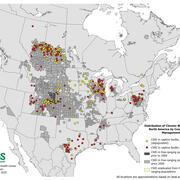
Expanding Distribution of Chronic Wasting Disease
Chronic wasting disease (CWD) has been detected in 36 US states and five Canadian provinces in free-ranging cervids and/or captive cervid facilities.

The influence of natural mineral licks on wildlife disease dynamics
Some locations on the landscape can aggregate animals of multiple species and could become hotspots of disease transmission. One example of this are areas of localized concentrations of minerals that animals like deer, elk, bighorn sheep, and mountain goats use and diseases like chronic wasting disease or respiratory diseases could spread among or within species who use natural mineral licks...

Understanding Avian Influenza Exposure and Antibodies in Understudied Species
Recent outbreaks of highly pathogenic avian influenza have impacted a dramatically wider range of bird hosts than ever before. USGS researchers are working to identify which bird species have been exposed, which have developed immune responses, and how these species may influence viral ecology to inform risk management activities.

Using Telemetry to Understand Overlap in Habitat Use Between Waterfowl and Agricultural Birds in North America
USGS researchers are using telemetry to improve our understanding of how wild birds move throughout their environments and the potential implications for disease transmission within and to domestic poultry.

Avian Influenza Dynamics in the Chesapeake Bay Region
This project focuses on understanding the forces driving the risk of avian influenza transmission from wild waterfowl to domestic poultry within the Chesapeake Bay region.

Understanding Avian Influenza Infection and Movement Behavior of Wild Birds
This project focuses on improving our understanding of how current and previous infection with avian influenza viruses impact the movement ecology of wild bird species.

Developing Tools to Evaluate Chronic Wasting Disease Transmission Risk
Chronic Wasting Disease (CWD) infects and kills ungulates (deer, elk, moose), and has been spreading across North America for the past 20 years. Some ungulate populations have declined because of CWD and there are no viable vaccines or treatments for this disease. Therefore, tools that assist wildlife managers in preventing and mitigating CWD can be powerful assets in protecting our nation’s big...

High Priority Species for Avian Influenza in Alaska
In early 2006, an Alaska Interagency Avian Influenza Working Group was formed to develop a ranking matrix for selecting priority species to be sampled within Alaska. Most wild bird species with populations that utilize areas of both Alaska and Asia were identified and considered in the ranking exercise. Based on scoring criteria, 28 target species were chosen for sampling. Alaska is a...

Bird Migration and Influenza
The movement and transmission of avian influenza viruses in wild birds may differ by the migratory nature of each host species.

Predicting the effects of supplemental feeding and chronic wasting disease in Greater Yellowstone Ecosystem elk
To support management decisions concerning 500 bison and 8,000 elk in Jackson, Wyoming, USGS scientists assessed how alternative U.S. Fish and Wildlife Service plans for providing supplemental food would influence: 1) chronic wasting disease prevalence, 2) elk and bison numbers, 3) wildlife movement and human-wildlife conflict 4) multiple use opportunities for the public, like hunting, and 5)...

Manatee Health Assessment and Biomedical Studies
A multi-agency effort assesses the health of manatees and provides baseline information on their health, reproductive status, and nutritional condition.