



Cyanotoxins and Harmful Algal blooms
Cyanotoxins and Harmful Algal blooms
Filter Total Items: 30

USGS Environmental Health Program: Integrating Science for Public Health and Resource Management
The USGS Environmental Health Program seeks to understand how environmental factors, especially contaminants and pathogens, influence human health and ecosystems. It focuses on studying the distribution and effects of toxic substances, environmental stressors, and their pathways. The program prioritizes collaboration with State, Federal and local governments; Tribes; non-government organizations...

Algal and Environmental Toxins Research Laboratory — Lawrence, Kansas
About the Laboratory The Environmental Health Program collaborates with scientists at the Organic Geochemistry Research Laboratory (OGRL) in Lawrence, Kansas, to develop and employ targeted and non-targeted analytical methods for identification and quantitation of known and understudied algal/cyanobacterial toxins. The laboratory contructed in 2019 is a 2,500 square foot modern laboratory facility...

Decoding Harmful Algal Blooms: Unraveling the Mystery
Harmful algal blooms (HABs) are a significant environmental concern due to their potential effects on health, ecosystems, and economies. Algal toxins, which are toxic compounds produced by certain species of cyanobacteria and algae, are commonly linked to these blooms. It's important to note that algal toxins can still be present even when a bloom is not visible, highlighting the need for ongoing...
By
Ecosystems Mission Area, Contaminant Biology, Environmental Health Program, Toxic Substances Hydrology, California Water Science Center, Caribbean-Florida Water Science Center (CFWSC), Maryland-Delaware-D.C. Water Science Center, National Wildlife Health Center, Nevada Water Science Center, New England Water Science Center, New Jersey Water Science Center, New Mexico Water Science Center, South Atlantic Water Science Center (SAWSC), St. Petersburg Coastal and Marine Science Center, Upper Midwest Environmental Sciences Center, Upper Midwest Water Science Center

Understanding Algal Bloom Dynamics in Lake Okeechobee
The U.S. Geological Survey (USGS) is conducting studies to better understand algal bloom dynamics to enhance lake management. Recent research, in Lake Okeechobee, Florida, focused on phytoplankton community and abundance. Phytoplankton can be a potential driver of harmful algal blooms (HABs).

Nutrient Management for Harmful Algal Blooms: The Importance of Nitrogen and Micronutrients in the Great Lakes
Managing harmful algal blooms in the Great Lakes requires understanding the roles of nitrogen, phosphorus, and micronutrients, emphasizing a comprehensive approach beyond just phosphorus reduction.

Behavioral Toxicology Core Technology Team
About the Research. The Environmental Health Program supports scientists in the Behavioral Toxicology Core Technology Team (CTT) at the Columbia Environmental Research Center. The scientists identify how contaminants alter the behavior of organisms and what implication those changes may have on individuals, populations, and communities.

Organic Geochemistry Research Core Technology Team
About the Research The Organic Geochemistry Research Laboratory Core Technology Team (CTT) as part of the Environmental Health Program works to develop targeted and non-targeted analytical methods for the identification and quantitation of chemicals that can impact the health of humans and other organisms, and uses bioassays to screen for receptor inhibition.

Photomicroscopy and Flow Cytometry Core Technology Team
About the Research The Photomicroscopy and Flow Cytometry Core Technology Team (CTT) as part of the Environmental Health Program works to develop and apply biomarkers to evaluate the potential impacts of environmental contaminants at cellular and molecular levels. Because molecular and biochemical responses of cells are preceded by chemical changes in nuclei, cytoplasm, membranes, and...

Geospatial Analyses and Applications Core Technology Team
About the Research The Geospatial Analyses and Applications Core Technology Team (CTT) as part of the Environmental Health Program collaborates with teams across USGS to develop and apply geospatial analytical methods to answer broad-scale questions about source-sink and cause-effect relationships between contaminants and vulnerable communities.

Toxin Producing Algae Across U.S. Landscapes—Are They Gaining a Foothold?
There are still many unknowns related to the occurrence and potential range of various types of algae in inland waters. To fill some of these gaps, scientists at the U.S. Geological Survey (USGS) recently published a review and synthesis of toxic algae in inland waters of the conterminous United States.

Web-Based Tool Developed through Multiagency Effort Allows Visualization of Cyanobacteria Blooms in Lakes and Reservoirs—Steps Toward Public Awareness and Exposure Prevention
A web-based application tool utilizing satellite data—CyANWeb—developed through collaborative interagency efforts was released as part of the Cyanobacteria Assessment Network (CyAN) to help Federal, State, Tribal, and local partners identify when cyanobacterial blooms may be forming. Available through a web browser or as an application, the tool can access, download, and provide data to notify...
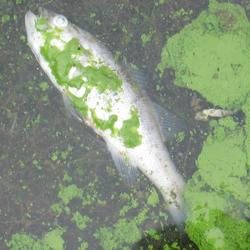
Toxins and Harmful Algal Blooms Science Team
The team develops advanced methods to study factors driving algal toxin production, how and where wildlife or humans are exposed to toxins, and ecotoxicology. That information is used to develop decision tools to understand if toxin exposure leads to adverse health effects in order to protect human and wildlife health.