



Hazard and Event Monitoring
Hazard and Event Monitoring
Filter Total Items: 37

Peak-Flow Frequency Analysis for Selected Montana Streamgages
Peak-flow frequency information is needed for flood-plain mapping, design of highway infrastructure, and many other purposes across Montana. The USGS Wyoming-Montana Water Science Center has an ongoing project working to update peak-flow frequency estimates at USGS streamgages across the state.

Rapid Deployment Gages (RDGs)
Rapid Deployment Gages (RDGs) are fully-functional streamgages designed to be deployed quickly and temporarily to measure and transmit stream stage data in emergency situations.

Hydroacoustics
Since the early 1980s the USGS has worked cooperatively with manufacturers to develop and enhance the use of acoustic Doppler instruments for streamflow and other hydraulic measurements. This site provides information on hydroacoustic technology, instruments, and their use.

Hydrologic and Erosion Responses of Burned Watersheds
The enhanced probability of catastrophic wildfires has increased our need to understand the risk of floods, erosion, and debris and contaminant transport in burned watersheds. This project investigates the relation between rainfall intensity and peak discharge; erosion and deposition processes; and water-quality impacts to minimize the loss of life and property resulting from post-wildfire floods.

Surge, Wave, and Tide Hydrodynamics (SWaTH) Network
During large coastal storms, the storm surge and waves are the main cause of destruction and landscape change, transporting saline water, sediment, and debris inland. The USGS, in collaboration with stakeholders, has constructed a national Surge, Wave, and Tide Hydrodynamics (SWaTH) Network for the Atlantic, Eastern Pacific, and Central Pacific. SWaTH monitors and documents the height, extent, and...
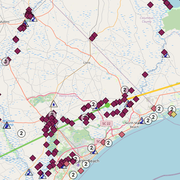
Providing Major Storm and Short-Term Flood Event Data
During major storms or other short-term events, the USGS collects streamflow and additional data to help document high-water events. This data is uploaded to the Short-Term Network (STN) for long-term archival and served out to the public through the Flood Event Viewer (FEV) which provides convenient, map-based access to downloadable event-based data.

Transportation-Related Water Projects
The USGS has a long history of cooperative investigations with the Federal Highway Administration (FHWA) and state highway agencies to provide data and information to address various issues related to water resources and the Nation’s transportation infrastructure. These issues cover a wide spectrum and include items such as regional flow statistics, flood documentation, regional stream...

USGS Cooperative Matching Funds
USGS Cooperative Matching Funds (CMF) support joint projects with our state, regional, tribal, and local partners to provide reliable, impartial, and timely information needed to understand and manage the Nation's water resources.

Historical Flooding
The USGS provides practical, unbiased information about the Nation's rivers and streams that is crucial in mitigating hazards associated with floods. This site provides information about the USGS activities, data, and services provided during regional high-flow events, such as hurricanes or multi-state flooding events. The USGS response to these events is typically managed by the National Flood...

2011 - The Year of the Flood
2011 proved to be another record-breaking flood year in the United States. USGS Water Science Center personnel from North Dakota to Louisiana measured springtime floods on the Red River of the North, the Ohio River, the Mississippi River, and many tributaries. The Missouri River and its tributaries saw record-breaking snow-melt runoff through the summer, followed closely by Hurricane Irene and...

Groundwater-Level Response to Virginia Earthquake, August 23, 2011
A magnitude 5.8 (Mw) earthquake occurred at 1:51 pm EDT (17:51 UTC) on August 23, 2011, at a depth of about 3.7 miles (6 kilometers) beneath the town of Mineral, Virginia, located approximately 27 miles (45 kilometers) east of Charlottesville. The event is among the largest earthquakes recorded in the eastern United States.

Sequential, Time-Integrated Collector of Precipitation, Ground Water, and Surface Water for Analysis of Isotopes; US Patent 7,687,028
Patent for a sequential, time-integrated collector having an electronic controller that actuates either of two electrically-actuated valves, each connected to a water reservoir. (Full details provided by the U.S. Patent and Trademark Office website.)