



This is our office.
These are our co-workers.
This is our rush hour.
Pacific Island Ecosystems Research Center
Research at the Pacific Island Ecosystems Research Center focuses on providing the scientific understanding and technologies needed to support and implement sound management and conservation of our Nation's biological resources occurring in Hawai'i and other Pacific island locations.
Featured Research
Featured Research

Learn about research to understand power outages caused by brown treensnakes and explore approaches to protect sensitive infrastructure.
News
WEBINAR: USGS Invasive Species Science - Innovation for a Healthy Nation
WEBINAR: USGS Invasive Species Science - Innovation for a Healthy Nation
USGS ecologists lead Powell Center working group investigating the broader impacts of invasive plants
USGS ecologists lead Powell Center working group investigating the broader impacts of invasive plants
Inaugural USGS Wildlife Health Awareness Day - April 25, 2025
Inaugural USGS Wildlife Health Awareness Day - April 25, 2025
Publications
Inventory of bat activity at Pearl Harbor National Memorial to inform historic preservation and compliance Inventory of bat activity at Pearl Harbor National Memorial to inform historic preservation and compliance
We examined ‘ōpe‘ape‘a, or Hawaiian hoary bat (Lasiurus semotus; Chiroptera: Vespertilionidae), acoustic activity and surveyed potential roost trees at the Ford Island Chief Petty Officer’s (CPO) Bungalows Neighborhood of Pearl Harbor National Memorial (PERL) on the island of O‘ahu. We established four acoustic monitoring stations (PERL1–PERL4) that operated nightly to survey for ‘ōpe...
The continued decline of the Palila (Loxioides bailleui) on Mauna Kea, Island of Hawaiʻi The continued decline of the Palila (Loxioides bailleui) on Mauna Kea, Island of Hawaiʻi
Palila (Loxioides bailleui) are critically endangered Hawaiian honeycreepers specializing on māmane (Sophora chrysophylla) seeds and restricted to Mauna Kea volcano on the Island of Hawaiʻi. Recently, the population was estimated to decline by 89% between 1998 and 2021, despite decades of ungulate removal, fence construction, māmane regeneration, fire suppression, and predator control...
A monitoring framework to assess forest bird population response to landscape scale mosquito suppression using the Incompatible Insect Technique A monitoring framework to assess forest bird population response to landscape scale mosquito suppression using the Incompatible Insect Technique
The Birds, Not Mosquitoes Monitoring and Support Science Working Group detailed methods for monitoring the population response of Hawaiian forest birds during implementation of the Incompatible Insect Technique (IIT) on the islands of Maui and Kauaʻi. The group prioritized methods for measuring the influence of mosquito suppression on populations within IIT treatment and control areas...
Science

How to catch a vector: Mosquito monitoring for avian malaria control
USGS researchers are combatting avian malaria by improving the trapping and tracking of mosquitoes in endangered Hawaiian bird habitats.
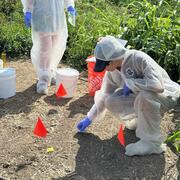
eDNA and the Efficacy of Management Actions
Environmental DNA (eDNA) is a powerful feedback tool, giving managers fast, clear, and cost-effective evidence to guide decisions and improve conservation outcomes.
By
Ecosystems Mission Area, Biological Threats and Invasive Species Research Program, Environmental Health Program, Species Management Research Program, Alaska Science Center, Columbia Environmental Research Center, Eastern Ecological Science Center, Forest and Rangeland Ecosystem Science Center, Fort Collins Science Center, Great Lakes Science Center, National Wildlife Health Center, Northern Prairie Wildlife Research Center, Northern Rocky Mountain Science Center, Pacific Island Ecosystems Research Center, Southwest Biological Science Center, Upper Midwest Environmental Sciences Center, Western Ecological Research Center (WERC), Western Fisheries Research Center, Wetland and Aquatic Research Center , Pacific Northwest Environmental DNA Laboratory
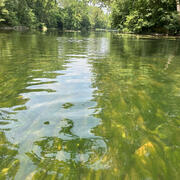
eDNA for Water-Quality Monitoring and Public Health Protection
By analyzing genetic traces left behind in water, eDNA provides early warning signs of problems—helping managers respond faster, protect public health, and keep freshwater ecosystems resilient.
By
Ecosystems Mission Area, Biological Threats and Invasive Species Research Program, Environmental Health Program, Alaska Science Center, Columbia Environmental Research Center, Eastern Ecological Science Center, Forest and Rangeland Ecosystem Science Center, Fort Collins Science Center, Great Lakes Science Center, National Wildlife Health Center, Northern Prairie Wildlife Research Center, Northern Rocky Mountain Science Center, Pacific Island Ecosystems Research Center, Upper Midwest Environmental Sciences Center, Western Ecological Research Center (WERC), Western Fisheries Research Center, Wetland and Aquatic Research Center , Pacific Northwest Environmental DNA Laboratory