Helicopter with forward facing stinger magnetometer
Helicopter with forward facing stinger magnetometerAn AS350 helicopter with forward facing stinger magnetometer. Credit: New-Sense Geophysics Limited
An official website of the United States government
Here's how you know
Official websites use .gov
A .gov website belongs to an official government organization in the United States.
Secure .gov websites use HTTPS
A lock () or https:// means you’ve safely connected to the .gov website. Share sensitive information only on official, secure websites.
Images described and linked on this webpage come from a wide variety of USGS science activities and presentations performed by USGS Science Center staff members in the Region 7: Upper Colorado Basin. A search tool is provided to narrow the number of image files shown.
An AS350 helicopter with forward facing stinger magnetometer. Credit: New-Sense Geophysics Limited
Bear Lake, Colorado is a high alpine lake near tree line that is affected by regional to local fires and vegetation changes.
Map showing helicopter survey area and near Granby, Colo. Surveys will not occur directly above populated areas. Black circle indicates study area.
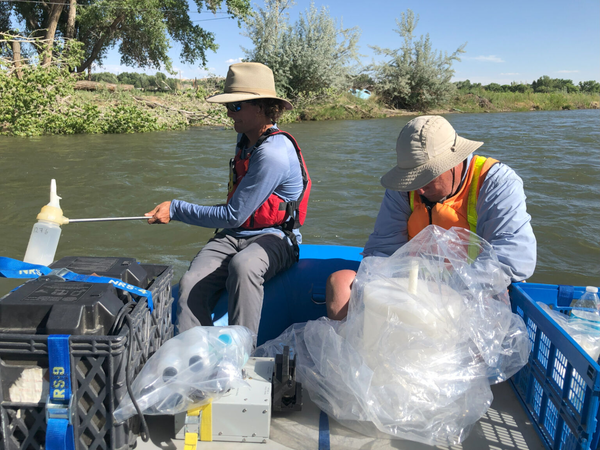
USGS researchers collect surface water samples on the Animas River, New Mexico, June 2022
Helicopter conducting low-level flights. Image courtesy Sander Geophysics Ltd.
Drought Intensity Map compiled by the U.S. Drought Monitor for the area of NOAA's Colorado River Basin River Forecast Center, which includes part of the Great Basin drainage area in western Utah, for April 19, 2024.
Loch Vale is one of 250 sites in the National Atmospheric Deposition Program/National Trends Network (NADP/NTN). Precipitation samples are collected weekly to present local and national data of pollutants and other chemicals in rain and snow since 1978.
Male (ram - left) and female (ewe) bighorn sheep outside of Yellowstone National Park.
The Grizzly Creek Fire initiated in August 2020, and widespread destructive debris flow activity followed the during the summer of 2021. This image shows damage from the summer 2021 debris flow in Glenwood Canyon, Colorado.
Argentine black and white tegus (Salvator merianae) can survive the winter under semi-natural conditions well beyond their current invasive range.
Debris flow in Glenwood Canyon during the summer of 2021. This event followed the 2020 Grizzly Creek Fire in Glenwood Canyon, Colorado.
Interstate 70 in Glenwood Canyon, Colorado. In the summer of 2021, travelers in Colorado's Glenwood Canyon were safely evacuated before massive debris flows buried highways and destroyed bridges, thanks to a debris flow warning system developed in part by the U.S. Geological Survey.
USGS scientist assesses debris flow in Glenwood Canyon, Colorado. This post-wildfire debris flow follows the 2020 Grizzly Creek Fire.
Scientists assess post wildfire debris flow following the 2020 Grizzly Creek fire.
This image shows a male bighorn sheep with large horns.
Vehicles drive on interstate I-70 in Glenwood Canyon, Colorado. In the summer of 2021, travelers in Colorado's Glenwood Canyon were safely evacuated before massive debris flows buried highways and destroyed bridges, thanks to a debris flow warning system developed in part by the U.S. Geological Survey.
USGS drilling and installing monitoring wells at trench infiltrations site in Monument Valley, Utah, Navajo Nation Reservation, to investigate the feasibility of recharging a groundwater aquifer.
Photo looking downstream from the Pack Creek Road Bridge shows the rain gage on top with a USGS sticker. Below is a solar panel for power. The other white round object contains the data logger and satellite antenna.
Rain gauge installed in Glenwood Canyon, Colorado. After the 2020 Grizzly Creek fire, scientists installed a network of rain gauges and soil moisture sensors throughout the rugged burn area. These instruments provide real-time data on rainfall intensity and duration, which are critical factors in determining the likelihood of a debris flow.
Rain gauge in Glenwood Canyon, Colorado. After the 2020 Grizzly Creek fire, scientists installed a network of rain gauges and soil moisture sensors throughout the rugged burn area. These instruments provide real-time data on rainfall intensity and duration, which are critical factors in determining the likelihood of a debris flow.
USGS scientist monitors the burn area following the Grizzly Creek fire of 2020 in Glenwood Canyon, Colorado.