



Landsat 7 underfly with Landsat 5 over the Niobrara River, Nebraska on June 2, 1999. The left image shows the Landsat 5 TM image and the right image is from Landsat 7 ETM+. Both images are shown as a false color image using the near infrared, red, and green bands (Bands 4|3|2).
Michelle Bouchard (Former Employee)
Science and Products
Filter Total Items: 66
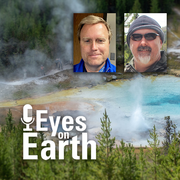
Eyes on Earth Episode 137 – Landsat Takes Yellowstone’s Temperature
How do you keep track of thousands of hot spots in an area the size of Yellowstone National Park? Check out thermal satellite data like Landsat’s!

Eyes on Earth Episode 136 – The EROS Test Site
The same as the Landsat satellite, only smaller—that’s a fair description of the field spectrometer used at the EROS test site for validating Landsat’s accuracy.

Eyes on Earth Episode 135 – Exotic Annual Grasses and Sheep Grazing
Invasive grasses are degrading sagebrush in western states. Can sheep help us restore these ecosystems?

Eyes on Earth Episode 134 – Data Accuracy: The Calibration and Validation of Landsat
Researchers and other satellite programs rely on the scientifically correct data from Landsat—every pixel and every spectral band that is measured.

Eyes on Earth Episode 133 – Vietnam War Bomb Craters
No longer used for spying, declassified spy satellite imagery is finding fascinating new uses.

Eyes on Earth Episode 132 – Moving Forward with AI at EROS
Artificial intelligence (AI) is helping to make the science work at EROS better and more efficient, as we continue to develop valuable data products.

Eyes on Earth Episode 131 – Using AI in Geospatial Work
Artificial intelligence (AI) is helping to make EROS data products better and more efficient.

Eyes on Earth Episode 130 – NLCD Accuracy
Providing accuracy metrics for a land cover map takes some work. But there’s poetry and story involved, too.

Eyes on Earth Episode 129 – What Happens During a Landsat Pass?
For this episode, we go inside the Landsat operations room at EROS to see what happens during a live Landsat pass.

Eyes on Earth Episode 128 – 2024 EROS Fall Poster Session
Posters covered a wide range of topics as local graduate students and EROS scientists shared their work in the EROS atrium.

Eyes on Earth Episode 127 – The Historic Landsat 7 Mission
Taking care of a satellite that’s 438 miles in space requires creative problem solving—we talk about those moments and memories of the nearly 25 years of land imaging from Landsat 7.

Eyes on Earth Episode 126 – Annual NLCD
The next generation of USGS land cover mapping is here. Annual NLCD provides land cover data of the U.S. every year back to 1985.

Landsat 8 Image of Lake St. Clair
Landsat captured the tug of war between winter and spring on the heart-shaped Lake St. Clair along the U.S./Canadian border near Detroit. This Landsat 8 image was acquired on March 6, 2021 and is shown as a natural color composite. Learn more about the Landsat program at www.usgs.gov/landsat
Filter Total Items: 29

Landsat 7 Underfly Image with Landsat 5
Landsat 7 underfly with Landsat 5 over the Niobrara River, Nebraska on June 2, 1999. The left image shows the Landsat 5 TM image and the right image is from Landsat 7 ETM+. Both images are shown as a false color image using the near infrared, red, and green bands (Bands 4|3|2).

First Landsat 7 image of Sioux Falls, South Dakota
First Landsat 7 image of Sioux Falls, South DakotaThis pan sharpened color infrared image of Sioux Falls, South Dakota is from the first scene acquired by Landsat 7's Enhanced Thematic Mapper Plus (ETM+) sensor on April 18, 1999. The image is shown using the near infrared, red, and green bands (Bands 4,3,2).
First Landsat 7 image of Sioux Falls, South Dakota
First Landsat 7 image of Sioux Falls, South DakotaThis pan sharpened color infrared image of Sioux Falls, South Dakota is from the first scene acquired by Landsat 7's Enhanced Thematic Mapper Plus (ETM+) sensor on April 18, 1999. The image is shown using the near infrared, red, and green bands (Bands 4,3,2).

Landsat 5 Underfly with Landsat 4 over Huntsville, Alabama
Landsat 5 Underfly with Landsat 4 over Huntsville, AlabamaShowing images acquired over Huntsville, Alabama during the Landsat 5 underfly with Landsat 4. On the top is the Landsat 4 TM image, and on the bottom is the Landsat 5 TM image. Both image composites are shown as a natural color composite using the red, green, and blue bands (Bands 3|2|1)
Landsat 5 Underfly with Landsat 4 over Huntsville, Alabama
Landsat 5 Underfly with Landsat 4 over Huntsville, AlabamaShowing images acquired over Huntsville, Alabama during the Landsat 5 underfly with Landsat 4. On the top is the Landsat 4 TM image, and on the bottom is the Landsat 5 TM image. Both image composites are shown as a natural color composite using the red, green, and blue bands (Bands 3|2|1)

Landsat 5 First Light Image of Lake Superior
One of the first clear Landsat 5 images shows an icy Lake Superior, northern Minnesota, and the Wisconsin's Apostle Islands. The Thematic Mapper (TM) image is shown as a false color composite using the near infrared, red and green bands (bands 4,3,2) and was acquired on March 6, 1984, just 5 days after the launch.
One of the first clear Landsat 5 images shows an icy Lake Superior, northern Minnesota, and the Wisconsin's Apostle Islands. The Thematic Mapper (TM) image is shown as a false color composite using the near infrared, red and green bands (bands 4,3,2) and was acquired on March 6, 1984, just 5 days after the launch.

Landsat 5 First Light Image over South Texas Gulf Coast
Landsat 5 First Light Image over South Texas Gulf CoastOne of the first Landsat 5 images in the archive shows Corpus Christi and Padre Island National Seashore. The image was acquired on March 6, 1984 and is shown as a false color composite using the near infrared, red, and green bands (bands 4,3,2).
Learn more about the mission on the Landsat 5 web page
Landsat 5 First Light Image over South Texas Gulf Coast
Landsat 5 First Light Image over South Texas Gulf CoastOne of the first Landsat 5 images in the archive shows Corpus Christi and Padre Island National Seashore. The image was acquired on March 6, 1984 and is shown as a false color composite using the near infrared, red, and green bands (bands 4,3,2).
Learn more about the mission on the Landsat 5 web page

Landsat 4 First Light Image of Detroit
The first Landsat 4 image was acquired over western Lake Erie on July 25, 1982, just 9 days after launch. This image shows the Detroit River dividing the metropolitan areas of Detroit, Michigan and Windsor, Ontario while acting as a strait between Lake Erie and Lake St. Clair.
The first Landsat 4 image was acquired over western Lake Erie on July 25, 1982, just 9 days after launch. This image shows the Detroit River dividing the metropolitan areas of Detroit, Michigan and Windsor, Ontario while acting as a strait between Lake Erie and Lake St. Clair.

Landsat 4 First Light Image over western Lake Erie
Landsat 4 First Light Image over western Lake ErieLandsat 4's first light image captured eastern Lake Erie, and the cities of Toledo, Detroit, and Windsor on July 25, 1982. Although the Landsat program had been collecting images of the Earth since 1972, this was the first time that the data could be depicted as a natural color image due to the new Thematic Mapper sensor onboard Landsat 4.
Landsat 4 First Light Image over western Lake Erie
Landsat 4 First Light Image over western Lake ErieLandsat 4's first light image captured eastern Lake Erie, and the cities of Toledo, Detroit, and Windsor on July 25, 1982. Although the Landsat program had been collecting images of the Earth since 1972, this was the first time that the data could be depicted as a natural color image due to the new Thematic Mapper sensor onboard Landsat 4.

Landsat 1 views Alaska Fire
Within days of the launch, Landsat 1 acquired an image of an astounding 81,000-acre (327.8 square kilometers) fire burning in isolated, central Alaska. For the first time ever, scientists and resource management officials were able to see the full extent of damage from a fire in a single image while it was still burning.
Within days of the launch, Landsat 1 acquired an image of an astounding 81,000-acre (327.8 square kilometers) fire burning in isolated, central Alaska. For the first time ever, scientists and resource management officials were able to see the full extent of damage from a fire in a single image while it was still burning.
Science and Products
Filter Total Items: 66
Eyes on Earth Episode 137 – Landsat Takes Yellowstone’s Temperature
How do you keep track of thousands of hot spots in an area the size of Yellowstone National Park? Check out thermal satellite data like Landsat’s!
Eyes on Earth Episode 136 – The EROS Test Site
The same as the Landsat satellite, only smaller—that’s a fair description of the field spectrometer used at the EROS test site for validating Landsat’s accuracy.
Eyes on Earth Episode 135 – Exotic Annual Grasses and Sheep Grazing
Invasive grasses are degrading sagebrush in western states. Can sheep help us restore these ecosystems?
Eyes on Earth Episode 134 – Data Accuracy: The Calibration and Validation of Landsat
Researchers and other satellite programs rely on the scientifically correct data from Landsat—every pixel and every spectral band that is measured.
Eyes on Earth Episode 133 – Vietnam War Bomb Craters
No longer used for spying, declassified spy satellite imagery is finding fascinating new uses.
Eyes on Earth Episode 132 – Moving Forward with AI at EROS
Artificial intelligence (AI) is helping to make the science work at EROS better and more efficient, as we continue to develop valuable data products.
Eyes on Earth Episode 131 – Using AI in Geospatial Work
Artificial intelligence (AI) is helping to make EROS data products better and more efficient.
Eyes on Earth Episode 130 – NLCD Accuracy
Providing accuracy metrics for a land cover map takes some work. But there’s poetry and story involved, too.
Eyes on Earth Episode 129 – What Happens During a Landsat Pass?
For this episode, we go inside the Landsat operations room at EROS to see what happens during a live Landsat pass.
Eyes on Earth Episode 128 – 2024 EROS Fall Poster Session
Posters covered a wide range of topics as local graduate students and EROS scientists shared their work in the EROS atrium.
Eyes on Earth Episode 127 – The Historic Landsat 7 Mission
Taking care of a satellite that’s 438 miles in space requires creative problem solving—we talk about those moments and memories of the nearly 25 years of land imaging from Landsat 7.
Eyes on Earth Episode 126 – Annual NLCD
The next generation of USGS land cover mapping is here. Annual NLCD provides land cover data of the U.S. every year back to 1985.
Landsat 8 Image of Lake St. Clair
Landsat captured the tug of war between winter and spring on the heart-shaped Lake St. Clair along the U.S./Canadian border near Detroit. This Landsat 8 image was acquired on March 6, 2021 and is shown as a natural color composite. Learn more about the Landsat program at www.usgs.gov/landsat
Filter Total Items: 29
Landsat 7 Underfly Image with Landsat 5
Landsat 7 underfly with Landsat 5 over the Niobrara River, Nebraska on June 2, 1999. The left image shows the Landsat 5 TM image and the right image is from Landsat 7 ETM+. Both images are shown as a false color image using the near infrared, red, and green bands (Bands 4|3|2).
Landsat 7 underfly with Landsat 5 over the Niobrara River, Nebraska on June 2, 1999. The left image shows the Landsat 5 TM image and the right image is from Landsat 7 ETM+. Both images are shown as a false color image using the near infrared, red, and green bands (Bands 4|3|2).
First Landsat 7 image of Sioux Falls, South Dakota
First Landsat 7 image of Sioux Falls, South DakotaThis pan sharpened color infrared image of Sioux Falls, South Dakota is from the first scene acquired by Landsat 7's Enhanced Thematic Mapper Plus (ETM+) sensor on April 18, 1999. The image is shown using the near infrared, red, and green bands (Bands 4,3,2).
First Landsat 7 image of Sioux Falls, South Dakota
First Landsat 7 image of Sioux Falls, South DakotaThis pan sharpened color infrared image of Sioux Falls, South Dakota is from the first scene acquired by Landsat 7's Enhanced Thematic Mapper Plus (ETM+) sensor on April 18, 1999. The image is shown using the near infrared, red, and green bands (Bands 4,3,2).
Landsat 5 Underfly with Landsat 4 over Huntsville, Alabama
Landsat 5 Underfly with Landsat 4 over Huntsville, AlabamaShowing images acquired over Huntsville, Alabama during the Landsat 5 underfly with Landsat 4. On the top is the Landsat 4 TM image, and on the bottom is the Landsat 5 TM image. Both image composites are shown as a natural color composite using the red, green, and blue bands (Bands 3|2|1)
Landsat 5 Underfly with Landsat 4 over Huntsville, Alabama
Landsat 5 Underfly with Landsat 4 over Huntsville, AlabamaShowing images acquired over Huntsville, Alabama during the Landsat 5 underfly with Landsat 4. On the top is the Landsat 4 TM image, and on the bottom is the Landsat 5 TM image. Both image composites are shown as a natural color composite using the red, green, and blue bands (Bands 3|2|1)
Landsat 5 First Light Image of Lake Superior
One of the first clear Landsat 5 images shows an icy Lake Superior, northern Minnesota, and the Wisconsin's Apostle Islands. The Thematic Mapper (TM) image is shown as a false color composite using the near infrared, red and green bands (bands 4,3,2) and was acquired on March 6, 1984, just 5 days after the launch.
One of the first clear Landsat 5 images shows an icy Lake Superior, northern Minnesota, and the Wisconsin's Apostle Islands. The Thematic Mapper (TM) image is shown as a false color composite using the near infrared, red and green bands (bands 4,3,2) and was acquired on March 6, 1984, just 5 days after the launch.
Landsat 5 First Light Image over South Texas Gulf Coast
Landsat 5 First Light Image over South Texas Gulf CoastOne of the first Landsat 5 images in the archive shows Corpus Christi and Padre Island National Seashore. The image was acquired on March 6, 1984 and is shown as a false color composite using the near infrared, red, and green bands (bands 4,3,2).
Learn more about the mission on the Landsat 5 web page
Landsat 5 First Light Image over South Texas Gulf Coast
Landsat 5 First Light Image over South Texas Gulf CoastOne of the first Landsat 5 images in the archive shows Corpus Christi and Padre Island National Seashore. The image was acquired on March 6, 1984 and is shown as a false color composite using the near infrared, red, and green bands (bands 4,3,2).
Learn more about the mission on the Landsat 5 web page
Landsat 4 First Light Image of Detroit
The first Landsat 4 image was acquired over western Lake Erie on July 25, 1982, just 9 days after launch. This image shows the Detroit River dividing the metropolitan areas of Detroit, Michigan and Windsor, Ontario while acting as a strait between Lake Erie and Lake St. Clair.
The first Landsat 4 image was acquired over western Lake Erie on July 25, 1982, just 9 days after launch. This image shows the Detroit River dividing the metropolitan areas of Detroit, Michigan and Windsor, Ontario while acting as a strait between Lake Erie and Lake St. Clair.
Landsat 4 First Light Image over western Lake Erie
Landsat 4 First Light Image over western Lake ErieLandsat 4's first light image captured eastern Lake Erie, and the cities of Toledo, Detroit, and Windsor on July 25, 1982. Although the Landsat program had been collecting images of the Earth since 1972, this was the first time that the data could be depicted as a natural color image due to the new Thematic Mapper sensor onboard Landsat 4.
Landsat 4 First Light Image over western Lake Erie
Landsat 4 First Light Image over western Lake ErieLandsat 4's first light image captured eastern Lake Erie, and the cities of Toledo, Detroit, and Windsor on July 25, 1982. Although the Landsat program had been collecting images of the Earth since 1972, this was the first time that the data could be depicted as a natural color image due to the new Thematic Mapper sensor onboard Landsat 4.
Landsat 1 views Alaska Fire
Within days of the launch, Landsat 1 acquired an image of an astounding 81,000-acre (327.8 square kilometers) fire burning in isolated, central Alaska. For the first time ever, scientists and resource management officials were able to see the full extent of damage from a fire in a single image while it was still burning.
Within days of the launch, Landsat 1 acquired an image of an astounding 81,000-acre (327.8 square kilometers) fire burning in isolated, central Alaska. For the first time ever, scientists and resource management officials were able to see the full extent of damage from a fire in a single image while it was still burning.