U.S. flag

An official website of the United States government

Sometimes it takes distance to really see something. Take the Earth observing Landsat satellites. They’re orbiting 438 miles above us, but they capture data about what’s on the ground surrounding us—and in remote places that very few have walked.

The Landsat satellite program, with its unparalleled 53-year historic record, can even reveal what has changed about the land since your parents or grandparents were your age. Maybe the forest in their favorite camping area was devastated by a wildfire or insect outbreak, or their childhood neighborhood on the edge of town now lies nearer to the middle. 

Landsat sees these changes, and so do scientists at the U.S. Geological Survey (USGS) Earth Resources Observation and Science (EROS) Center who detail different types of land cover across the United States for the Landsat-based resource Annual National Land Cover Database (NLCD). Annual NLCD data currently provides four decades of land cover and land change information across the lower 48 states from 1985 to 2024.

Annual NLCD and its predecessor, NLCD, which released data less frequently and for a shorter time series, support thousands of remotely sensed data uses in the private, public and academic sectors. The data are used to develop land management policies and assess ecosystem status. It also serves as a critical data layer in regional and national assessments of surface water and groundwater quality, wildfire monitoring and modeling, conservation efforts, disaster modeling and more. 

“The number of applications for NLCD are just staggering,” said Terry Sohl, who oversees the production of Annual NLCD as the Integrated Science and Applications Branch chief at USGS EROS.

Media
Two side-by-side animations of fire and recovery on the landscape in various greens and browns

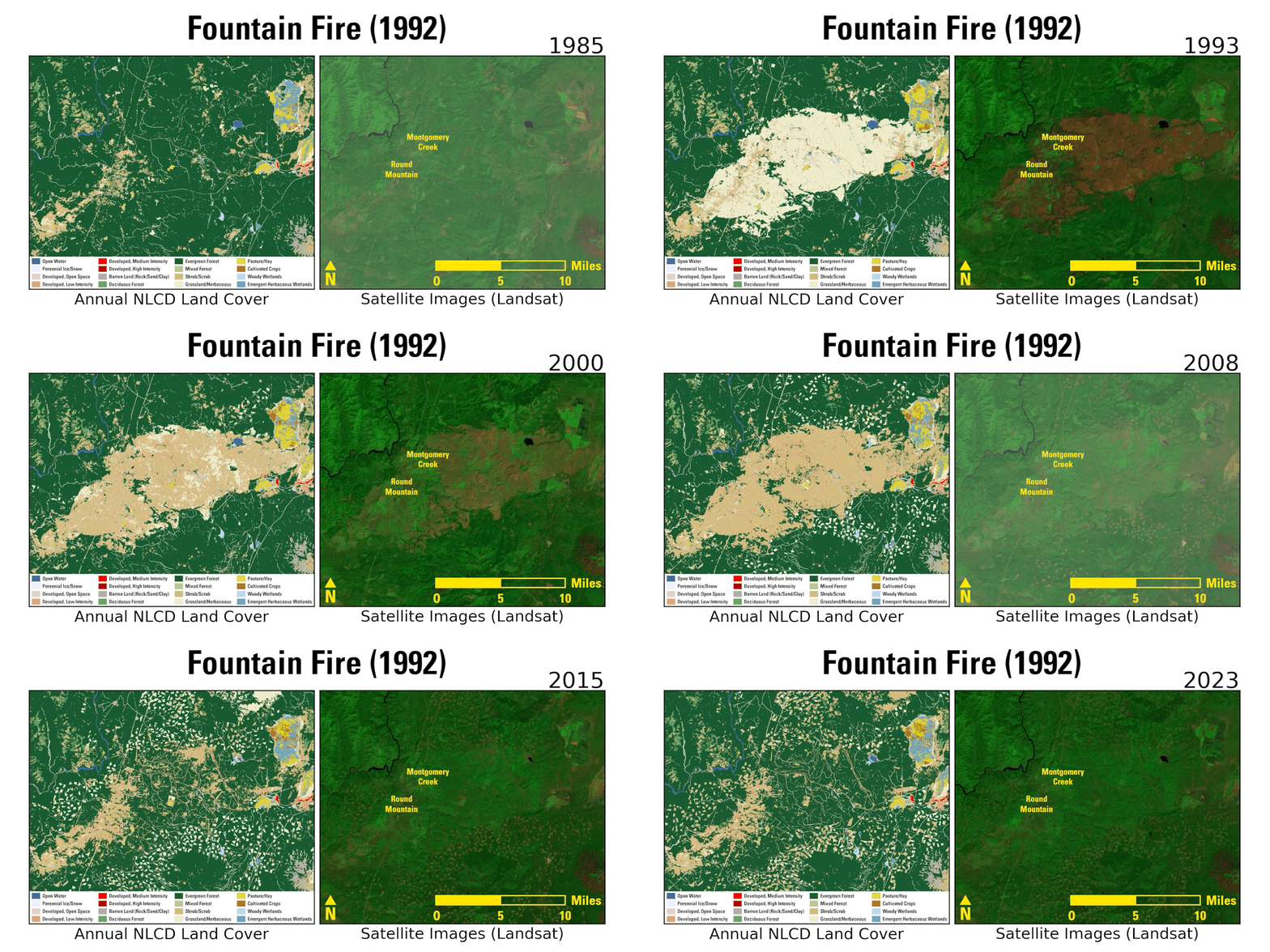
The animation above shows Annual NLCD land cover data on the left that was derived from Landsat imagery on the right. It illustrates the effects of the 1992 Fountain Fire in northern California and much of the forested area’s eventual recovery. The Fountain Fire burned about 64,000 acres, almost all of it privately owned. Nearly two-thirds of the land was owned by timber companies, which replanted trees after the fire. In the 2010s, the results of their reforestation efforts become clear as evergreen tree cover (dark green) reappears. To the upper right of the fire scar, note the area with fluctuating cropland, hay/pasture and wetlands. That’s a ranch with wild rice and hay where agricultural practices have evolved over time.

Always Evolving, Always in Use

Media
Graphic showing a mix of facts and figures
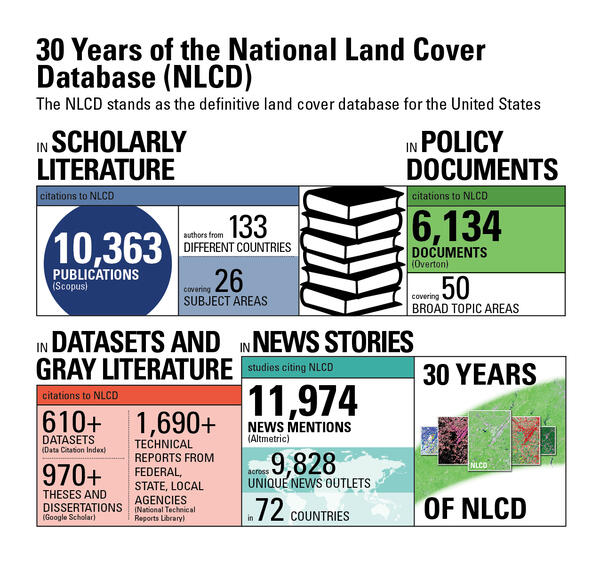
This graphic shows the prevalence of NLCD in a variety of publications.

Landsat, the pioneering civilian Earth observation satellite, remains relevant as technology within the satellites has evolved, and methods for processing and offering the data have become increasingly sophisticated. Convenient access to the public, at no cost since 2008, has also heightened Landsat’s usage. 

Landsat’s annual value was calculated to be \$25.6 billion in 2023, and NLCD’s share of that value is notable. 

“I can’t think of any Landsat-based product that has a higher impact than NLCD,” Sohl said.

The use of NLCD data has been widespread since its beginnings as the first national scale, Landsat-based land cover product in the 1990s. It has been cited in more than 10,000 scholarly publications and more than 6,000 policy documents. In addition, there have been about 12,000 news media mentions about studies citing NLCD data.

While NLCD has always been based on Landsat satellite data, its transformation into Annual NLCD in October 2024 yielded a much more robust use of the satellite program’s archive while maintaining the resource’s high-quality standards. Expanding the historical record of NLCD back to 1985 with yearly data required deep-learning processing of every single clear Landsat pixel over the United States, which each measure 30 meters by 30 meters on the ground. That’s 295 trillion pixels!

Media
Two animations, side by side, with different color schemes but showing the same landscape area

The animation above shows Treasure Valley, part of the Snake River Valley and home to the Boise, Idaho, metro area. The Boise Mountains lie to the east, and cropland and pasture/hay land lie to the west. The area’s population has seen significant growth in recent decades, far more than doubling between 1990 and now to above 800,000. The change is especially evident in the Annual NLCD land cover view of cropland (brown) changing to urban area (shades of red). Common crops in the area include hay/pasture, corn and wheat.

Sohl points to one factor that distinguishes both NLCD and the Landsat program from anything similar: their enduring, uninterrupted production of data.

“Landsat is the old man on the block. It’s the one that has been around forever,” Sohl said. “It’s easy to go and look at the bright, shiny new toy out there, but the thing that makes Landsat so important is the continuity. And I think that's the same with NLCD. The nice thing about what we've done at EROS with NLCD is we've continued that continuity—and not only continued it but improved the product.”

Yearly data additions to Annual NLCD alongside future Landsat satellite launches would maintain that continuity for land managers and ultimately all residents of the United States well into the future. 

And then when they are your age, your children and grandchildren will be able to spot the changes time has brought to your favorite places. 

Was this page helpful?