U.S. flag

An official website of the United States government

The southeastern United States is an important wood-producing region of the world, sometimes referred to as the wood basket. The state of Georgia is a global forestry leader, and according to the Georgia Forestry Commission, Georgia has more acres of plantations, timberland and privately owned timberland than any other state (GFC, 2025).

In the sparsely populated southeastern corner of Georgia, the Okefenokee Plains were originally covered in southern mixed forest of pines and hardwoods, such as oak, of varied ages and forested wetlands (Griffith et al., 2001). Since the 1970s, those forests have mostly been replaced by even-aged stands of loblolly, shortleaf, slash and longleaf pine that provide wood products for lumber, poles, posts and paper (Drummond et al., 2015; Sayler et al., 2016; Wear et al, 2007). 

Transitions over time

Media
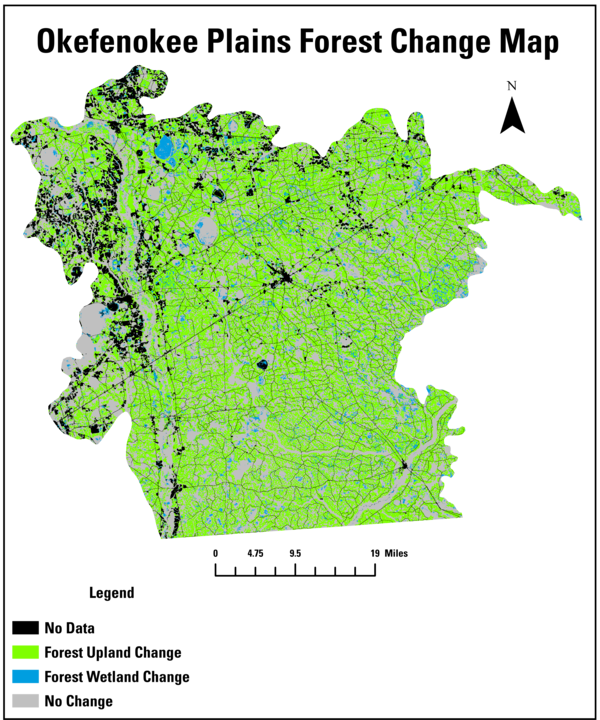
A map of an irregularly shaped area with mostly green background, black text labels and a legend

Changes to the forest across the Okefenokee Plains in Georgia can be assessed using four decades of Annual National Land Cover Database (NLCD) data. Annual NLCD, a land cover resource based on Landsat satellite data and produced by the U.S. Geological Survey (USGS) for the lower 48 states, reveals the types of land change, the rates at which change is happening and the locations of change.  

The map on the right shows changes to forests in the Okefenokee Plains using the most recent Annual NLCD Collection 1.1 data spanning 1985 to 2024. The green color represents areas where there has been forest disturbance during that time. The color gray represents undisturbed forest areas, much less common in this area. Shown in blue are areas of woody wetlands, with a different species composition than pine plantations, that have been disturbed. 

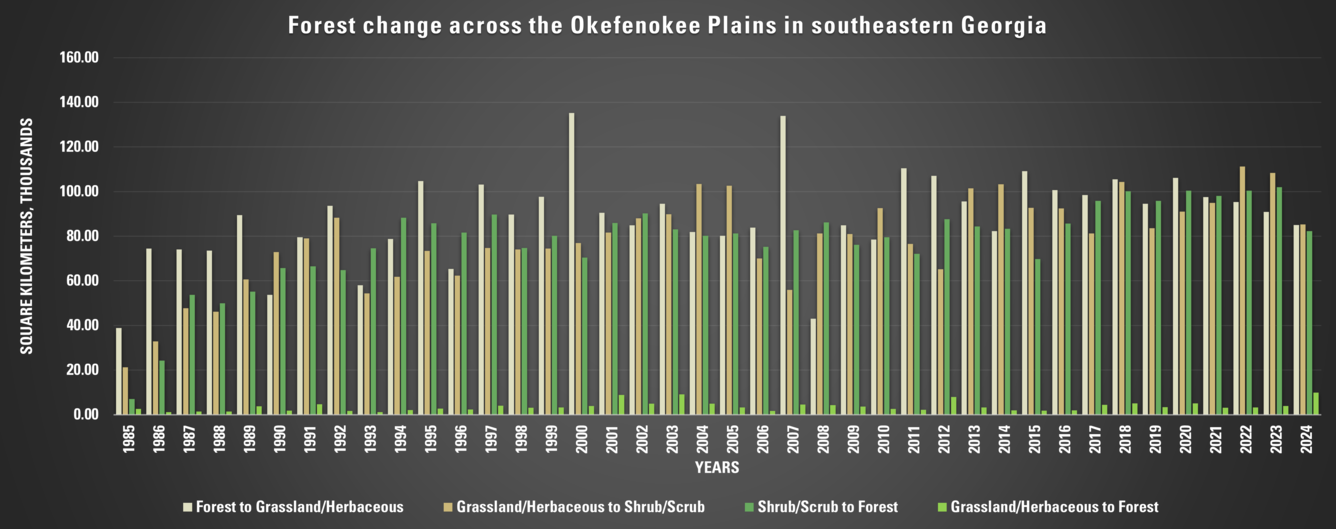
The chart below shows the amount of land across the Okefenokee Plains that transitioned from forest cover to herbaceous species like grasses, herbaceous to shrubland, and shrubland back to forest from 1985 to 2024, according to Annual NLCD Collection 1.1. These changes represent cycles of tree cutting and regrowth, common in pine plantations. 

Media
A long bar chart with a title and text

Management Cycle

Across the Okefenokee Plains, pine plantations are established mainly for industrial forestry purposes and are intensively managed. Management includes planting one or two species of trees and managing soils, ground vegetation and pests to increase the growth rate of the desired species (Wear et al, 2007; Fox et al., 2007). 

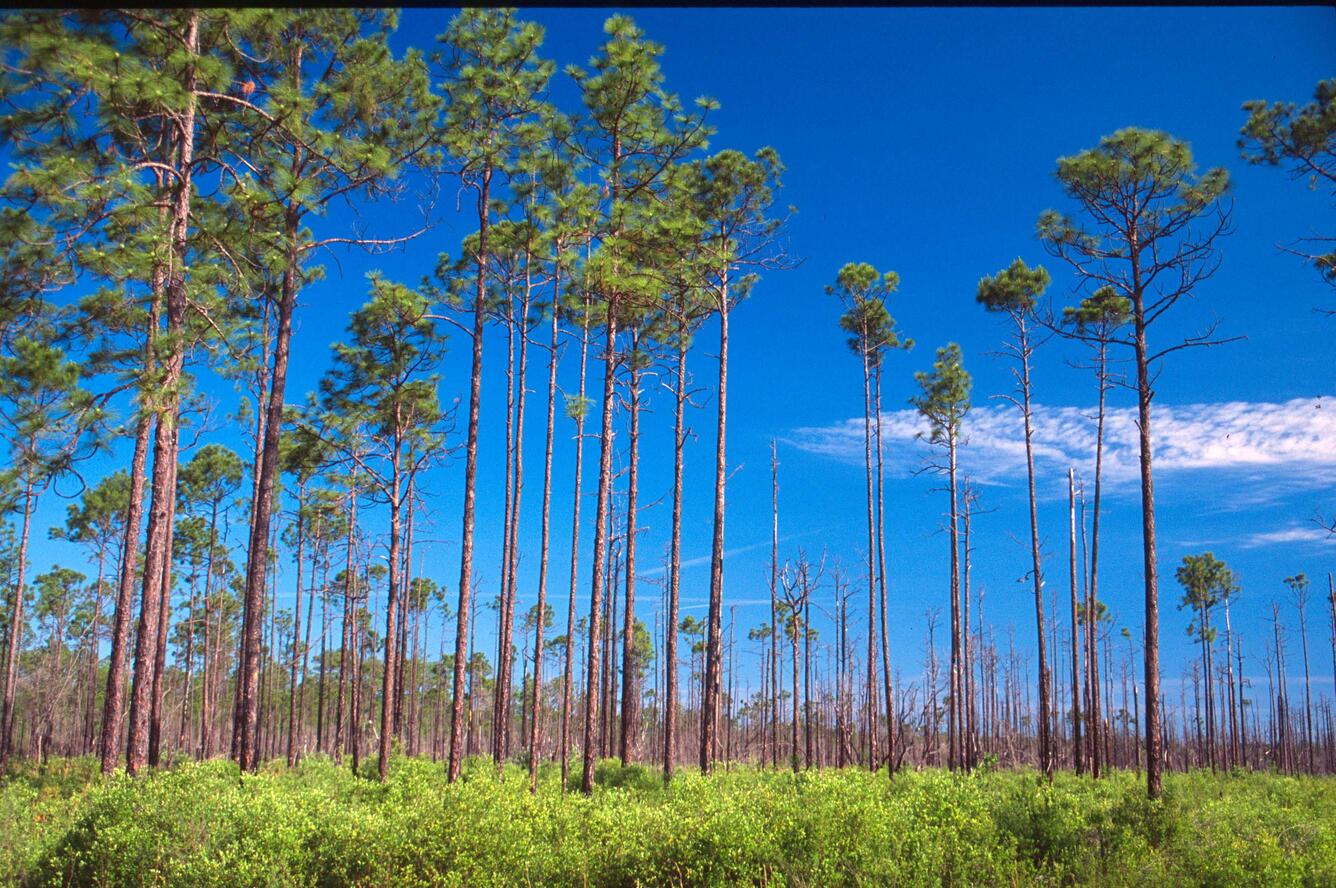
A harvest can be a clearcut where all trees are removed at one time, or a thinning (see background photo) where only some trees are removed. A clearcut is followed within a year by replanting or seeding new trees. The trees grow quickly from small plants to shrubs and then taller trees. 

This cyclical process of harvest and regrowth lasts 25 to 35 years for trees used for timber and 10 to 15 years for trees used for pulp. Genetic research has long been used to develop faster-growing and more productive trees (Fox et al., 2007), which contributes to a fast and generally increasing rate of landscape change.

Media
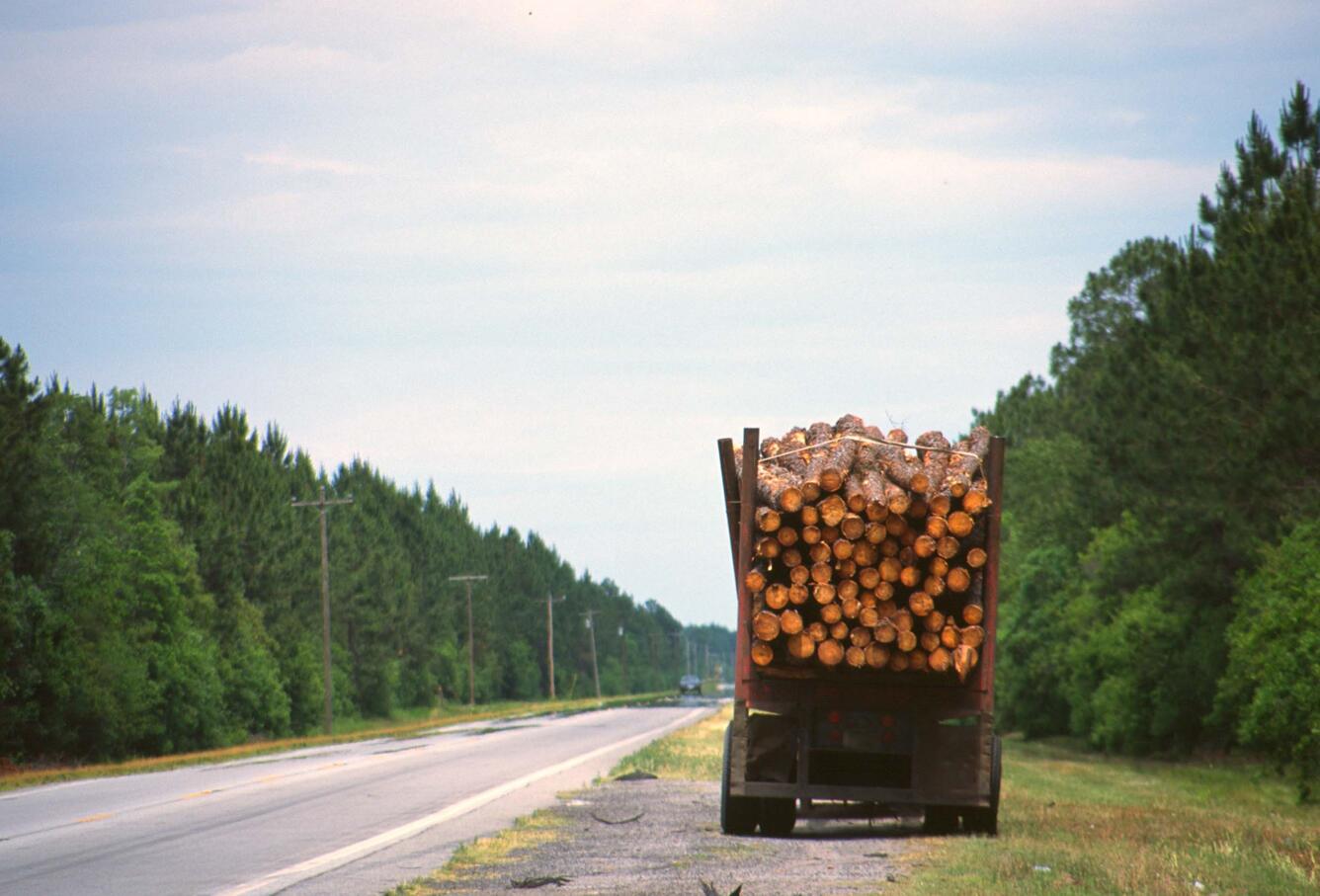
A truck with a load of logs is stopped on the side of a two-lane highway lined on both sides by a grass ditch and then trees
A logging truck stops by the side of the road in Georgia. USGS photo for the Land Cover Trends project
A thinned stand of slash pine forest in the Southern Coastal Plain

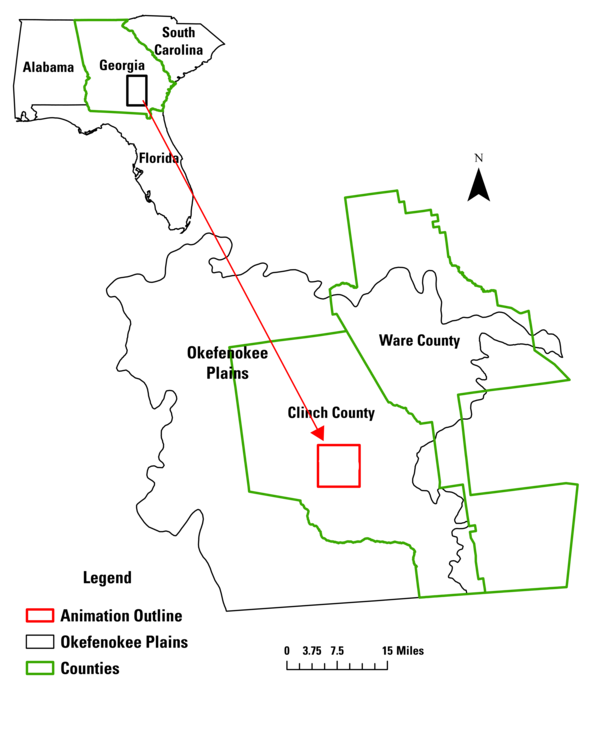
The map below shows the Okefenokee Plains, along with the area shown in the animations that follow.

Media
Map showing southeastern US in the upper left with an arrow from Georgia leading to a section of the state in the lower right

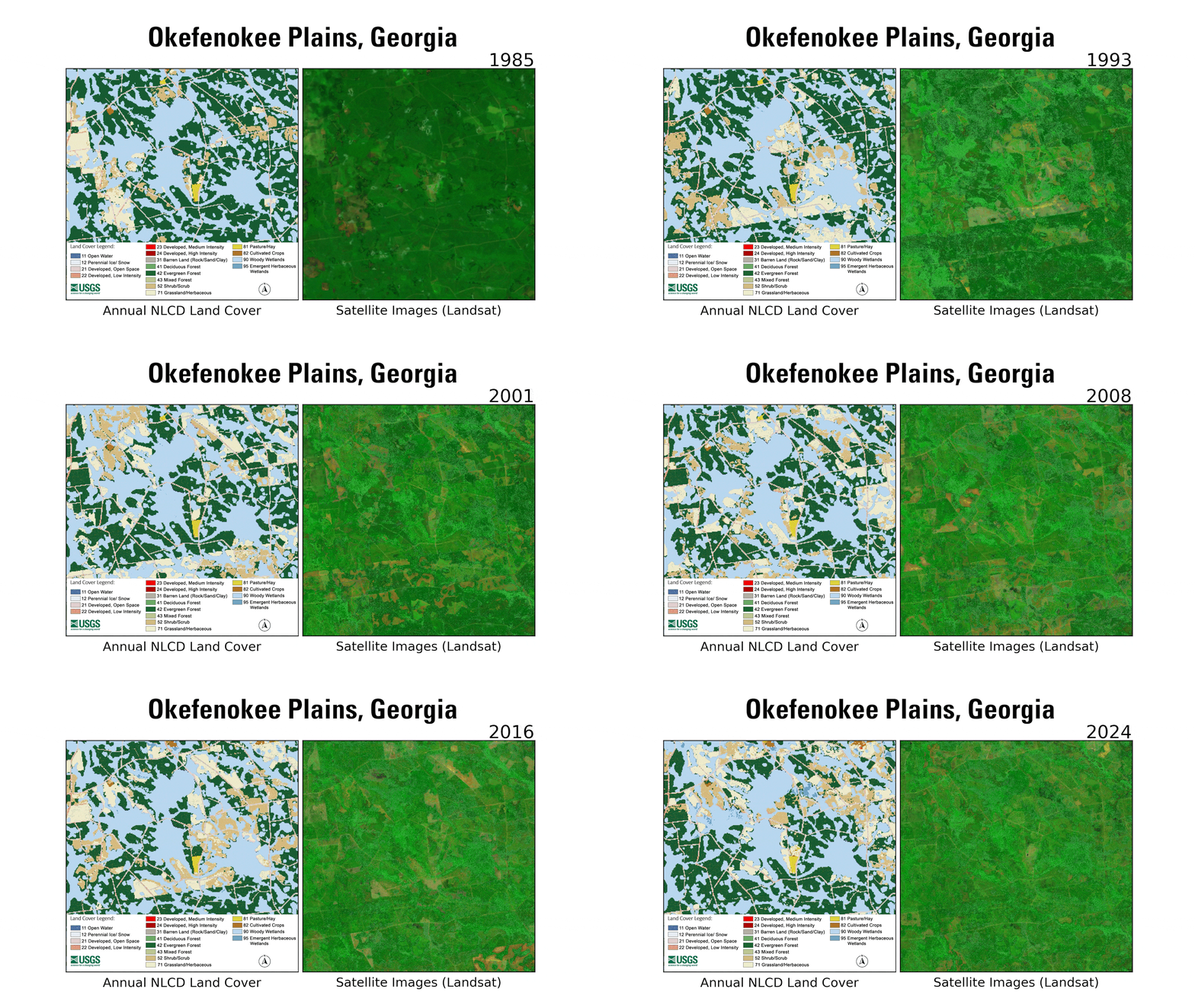
A cycle of forest change can be seen in the animations below. Across these animated scenes of Annual NLCD Collection 1.1 land cover and true-color Landsat, forest change affects a large total area within this plot between 1985 and 2024. These annual maps sequenced in the animation show harvests and regrowth tract by tract, creating an ever-changing landscape (Fagan et al., 2018). Change in woody wetlands is less frequent, at times due to difficult conditions for mechanical harvesting.

Media
2 animations side by side, one in green and tan colors with a legend, the other in mostly greens and browns

Growing Share of U.S. Harvest

The commercial timber industry in the Southeast expanded quickly in response to timber harvest declines in the northwestern United States, expanding from 46% of the U.S. harvest in 1986 to 59% in 1996 (Haynes et al., 2003). Today, the region is still a world leader in timber production (Johnston et al., 2023). The mild climate in the Southeast facilitates fast-growing species, and intensive management practices are driven by the economic demand for pulp and other wood products (Fox et al., 2007; Brandeis et al., 2021; Li and Campbell, 2024; Wear et al., 2007). 

Annual NLCD provides land cover and land change information that’s not just useful in resource management of forests, but also in a wide variety of other circumstances. 

References:

Brandeis, C., Taylor, M., Abt, K.L., Alderman, D., and Buehlmann, U., 2021. Status and trends for the U.S. forest products sector: a technical document supporting the Forest Service 2020 RPA Assessment. Gen. Tech. Rep. SRS–258. Asheville, NC: U.S. Department of Agriculture Forest Service, Southern Research Station. 55 p. https://doi.org/10.2737/SRS-GTR-25 

Drummond, M.A., Stier, M.P., Auch, R.F. et al., 2015, Assessing Landscape Change and Processes of Recurrence, Replacement, and Recovery in the Southeastern Coastal Plains, USA; Environmental Management 56, 1252–1271. https://doi.org/10.1007/s00267-015-0574-1

Fagan, M.E., Morton, D.C., Cook, B.D., Masek, J., Zhao, F., Nelson, R.F., and Huang, C., 2018, Mapping pine plantations in the southeastern U.S. using structural, spectral, and temporal remote sensing data; Remote Sensing of Environment, Volume 216, Pages 415-426, ISSN 0034-4257. https://doi.org/10.1016/j.rse.2018.07.007 

Fox, T.R. Jokela. E.J., and Allen, H.L., 2007, The Development of Pine Plantation Silviculture in the Southern United States; Journal of Forestry, 105, 7.

Georgia Forestry Commission (GFC), 2025, Georgia’s forest industry is a global leader: Georgia Forestry Commission webpage, accessed online 7/22/2025, at https://gatrees.org/forest-industry/ 

Griffith, G.E., Omernik, J.M., Comstock, J.A., Lawrence, S., Martin, G., Goddard, A., Hulcher, V.J., Foster, T., 2001, Ecoregions of Alabama and Georgia; United States Environmental Protection Agency, accessed on line 7/25/2025, https://www.epa.gov/eco-research/ecoregion-download-files-state-region-4 

Haynes, R.W, 2003, An analysis of the timber situation in the United States: 1952 to 2050; U.S. Department of Agriculture, Forest Service, Pacific Northwest Research Station, accessed online 7/22/2025, https://doi.org/10.2737/PNW-GTR-560 

Johnston, C.M.T., Guo, J., and Prestemon, J.P., 2023, Forest Products. In: U.S. Department of Agriculture, Forest Service. 2023. Future of America’s Forest and Rangelands: Forest Service 2020 Resources Planning Act Assessment. Gen. Tech. Rep. WO-102. Washington, DC: 7-1–7-26. Chapter 7. https://doi.org/10.2737/WO-GTR-102-Chap7 

Lambert, S.G., Gray, J., McCollum, J.M., Brandeis, T.J., and Brown, M., 2023, Georgia’s Forests, 2019; Resour. Bull. SRS-236. Asheville, NC: U.S. Department of Agriculture Forest Service, Southern Research Station. 109 p. https://doi.org/10.2737/SRS-RB-236 

Li, Y., and Campbell, B. 2024, Timber Situation and 2024 Outlook, University of Georgia Extension, Annual Publication 130-2-1, https://extension.uga.edu/publications/series/detail/90/2024-georgia-ag-forecast.html 

Sayler, K.L., Acevedo, W., and Taylor, J.L., eds., 2016, Status and trends of land change in the Eastern United States—1973 to 2000: U.S. Geological Survey Professional Paper 1794–D, 195 p., https://pubs.usgs.gov/publication/pp1794D

Wear, D.N., Carter, D.R., Prestemon, J., 2007, The U.S. South’s timber sector in 2005: a prospective analysis of recent change; Gen. Tech. Rep. SRS-99. U.S. Department of Agriculture, Forest Service, Southern Research Station, Asheville.

Was this page helpful?