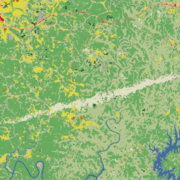
NLCD’s land cover information helps inform efforts to develop new and expanding sources of minerals, energy and utilities within the United States to meet the needs of a growing population and growing industries.
In one example, the natural gas 303-mile Mountain Valley Pipeline began flowing in 2024 to customers in West Virginia and Virginia. NLCD contributed to several aspects of the Environmental Impact Statement for the pipeline, including the classification of vegetation types along the pipeline routes, such as for habitat evaluation; land use types affected by construction; land use types to help define baseline sediment condition; and vegetation that could potentially screen the pipeline from historic resources. (The pipeline is shown under excavation in the background photo.)
SoftWright LLC provides radio frequency software, Terrain Analysis Package (TAP), to a variety of customers, including federal agencies, public safety departments, energy companies and utilities. TAP’s inclusion of NLCD land cover data that was released in 2023 helps indicate where buildings and vegetation may interfere with radio signals.
Lithium is a mineral valued for use in the consumer electronics, automotive and pharmaceutical industries, among others. Companies aim to increase lithium extraction in the United States, including Albemarle, which proposes to resume open pit mining at the legacy Kings Mountain Mine in North Carolina. Albemarle Corporation used NLCD to indicate the land cover types found in the area for a draft environmental assessment prepared in 2024.
Exelon, the largest utility company in the United States, transmits and distributes electricity and natural gas to markets in the eastern United States and northern Illinois. Exelon produced maps of its utility service areas in 2023 that relied heavily on NLCD for the resulting analysis of biodiversity sensitivity in those areas.